
Social Media API Guide for Builders in 2026
Learn what a social media API returns in 2026, how rate limits and sample bias work, and where Instagram data access fits.

Your marketing team can open a creator's public Instagram profile, see recent posts, and read the comments. Your developer sends a request for the same account and gets an empty list, missing fields, or a permission error. Everyone's looking at the same platform, so why doesn't the code see what the browser sees?
A social media API isn't a browser with an export button. It's a controlled interface, and building around it means understanding both what the platform lets you retrieve and what your team can reasonably conclude from the result.
Table of Contents
- What a Social Media API Actually Returns
- How Platform Access Closed After 2018
- Jobs Teams Automate With Platform Data
- Where Instagram Fits in the Landscape
- Rate Limits and Publishing Ceilings
- Why a JSON Response Is Not a Census
- Pick the Access Model That Fits the Job
What a Social Media API Actually Returns
Think of a public library. You can walk past the shelves, but borrowing still requires a card, some books stay inside, and the clerk limits what you can take home. A social platform works similarly: seeing content doesn't automatically give your application permission to retrieve it.
An API lets software request records or perform actions through a defined interface. A publishing application might submit a video, while an analytics application requests post metadata. If the request-response mechanics are unfamiliar, this explanation of what a REST API is provides the underlying model.
Records, context, and access rules
A useful integration contract has distinct layers:
- Structured records: Profiles, posts, comments, media, and other objects your application can process.
- Metadata: Identifiers, timestamps, counts, and pagination information that make those objects usable.
- Access rules: Authentication requirements, approved permissions, and rate windows governing requests.
That last layer usually lives in documentation, response headers, dashboards, and errors, not just the JSON body. Don't assume a missing field means the value is empty. Your application might lack permission to receive it.
Social media APIs compared in 2026
| Access path | Usual auth | Core data | First constraint |
|---|---|---|---|
| Meta Graph and Instagram official | OAuth plus app review | Owned media, insights, publishing, limited discovery | Reviewed scopes and Business Use Case limits |
| X | Paid access and OAuth | Posts, users, and search within purchased access | Paid-access allowances and plan caps |
| Member OAuth or partner approval | Profiles and organization posts | Narrow partner scopes | |
| YouTube Data API | API key or OAuth | Videos, channels, comments | Daily quota units |
| TikTok developer products | App review and account authorization where required | Video and account data for approved uses | Use-case approval |
| Third-party Instagram data API | API key without customer Instagram OAuth | Public profiles, posts, comments, hashtags, locations | Unofficial access, not Meta, and incomplete coverage |
Treat this comparison as an access-model map, not a permanent entitlement list. Before committing to a platform, test the exact endpoint, account type, and permission your product needs.
Match authorization to the action
OAuth lets an account holder authorize an application without handing over their password. A scope describes a permission within that authorization, such as an approved publishing action. An API key usually identifies the application or customer instead; it doesn't automatically authorize actions on someone's social account.
For an embedded publishing interface, PostNitro's documentation on how to connect social accounts via API is a useful account-connection reference. That connection problem is separate from collecting public creator, hashtag, or location records for analysis.
Choose the access path by the job, not by which service returns JSON fastest.
How Platform Access Closed After 2018
Say a developer inherits a script that once collected public posts successfully. The account names still resolve in a browser, but the script no longer works. Replacing an expired token might help, but the underlying access permission may have disappeared entirely.
The earlier environment was more open. A historical analysis of social-media API access describes Facebook Graph API 1.0's public search with a two-week rolling window until April 2015, retrospective public Page and Group collection from 2011 through April 2018, and severely limited academic-accessible options from April 2018 to July 2020.
The turning point was permission
Companies, developers, and academics could previously obtain substantial public platform records through official interfaces. That made it tempting to design applications around the assumption that public content would remain programmatically accessible.
The Cambridge Analytica scandal broke that assumption. The After the APIcalypse paper documents tighter approval requirements and removal of sensitive profile access, alongside Instagram's accelerated public API shutdown on April 4, 2018, and Facebook's reported suspension of approximately 200 third-party applications during its review.
The shift is easier to understand as a change in who controls the checkout desk.
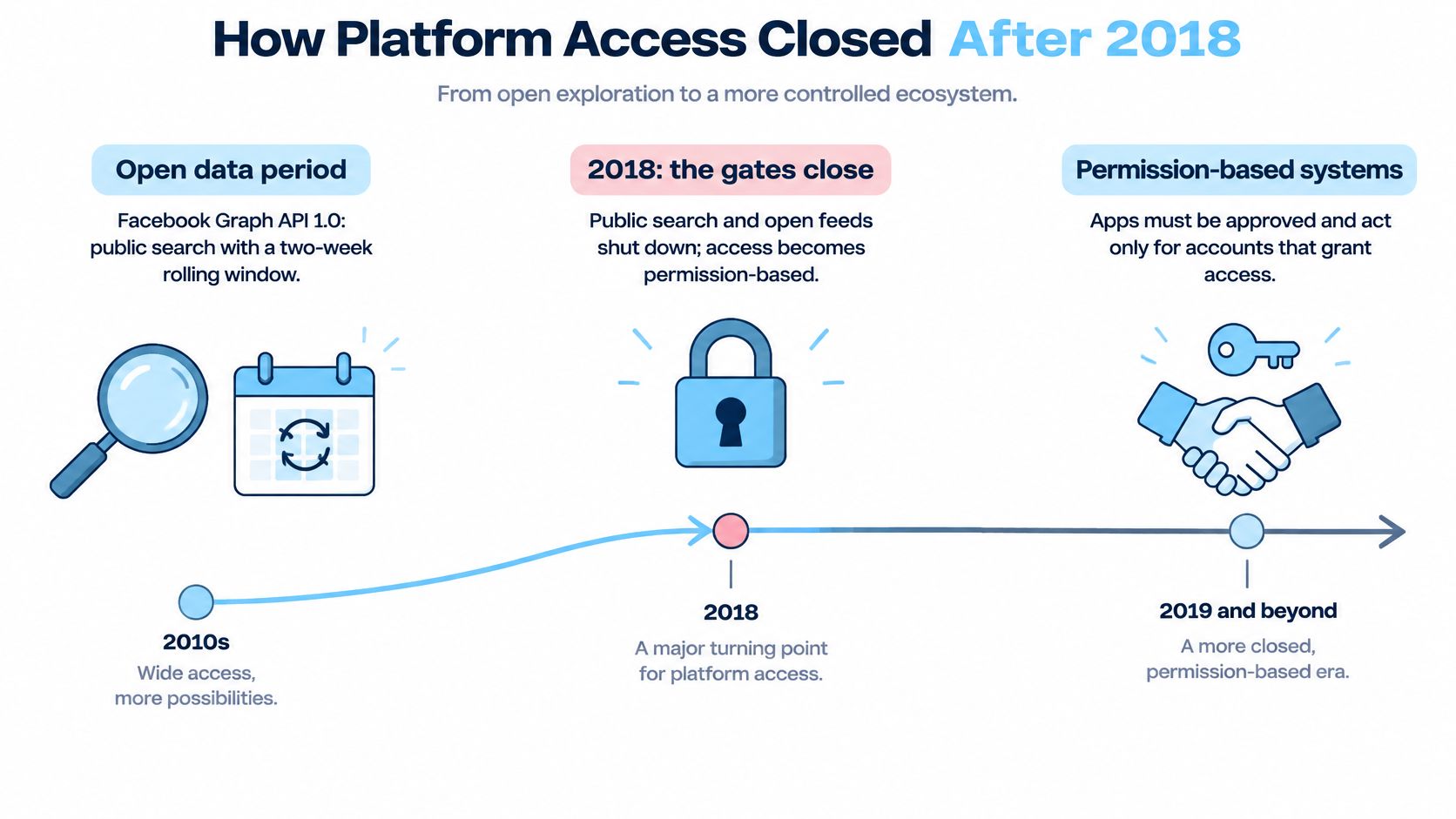
Architecture lesson: Build around an explicit access contract, not the assumption that a visible page will remain retrievable.
For a developer maintaining that inherited script, the right investigation starts with eligibility and approved scopes. Check whether the endpoint still exists, whether the application qualifies, and whether the proposed storage and use remain permitted.
A working request is only part of that review. Your product also needs a response when permissions change: disable affected jobs, explain unavailable results, and avoid replacing missing records with invented values.
Jobs Teams Automate With Platform Data
A useful API workflow starts with a decision someone needs to make. The endpoint is a means of supplying evidence, not the business outcome.
The broader relationship between retrieval and operations is explored in this guide to APIs in marketing. For implementation, it helps to follow the records from input to human decision.
A creator shortlist becomes a scorecard
A campaign manager supplies a creator's username. The application retrieves an available public profile, recent posts and reels, comment samples, and engagement information.
The manager compares those observations with a follower-quality assessment rather than relying only on screenshots supplied by the creator. The human decision is whether the creator fits the campaign, not whether a score has declared them trustworthy. Repetitive comments might justify a closer review, but they aren't proof of purchased engagement.
A campaign tag becomes a monitoring queue
A brand operator supplies a hashtag or location. The application stores returned captions, media URLs, engagement counts, and authors, then refreshes observations on a defined schedule.
For a store or venue, location-tagged posts can help surface customer experiences. For an event, they can help assemble candidate user-generated content. The operator still decides whether a post is relevant, whether it needs a response, and whether reuse permission has been obtained.
The same records can support several operational jobs.
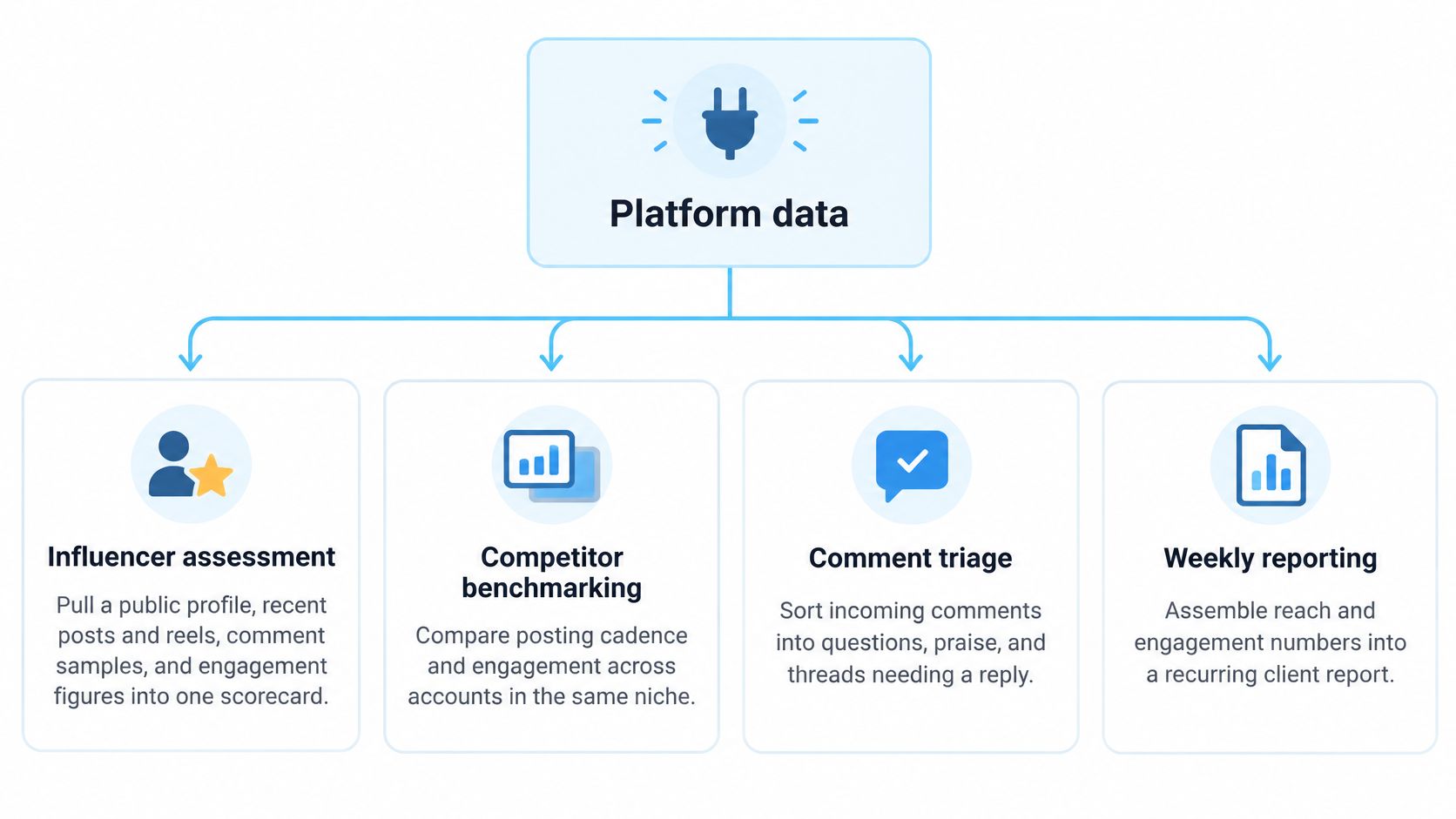
A username becomes a prospect record
For lead enrichment, the input might be an Instagram handle submitted through a form. The integration turns available profile fields into a CRM record and adds a clearly labeled lead-fit note.
Keep observed facts separate from interpretation. A bio mentioning wholesale orders can support a relevance note; it doesn't justify inventing an email address or claiming purchasing authority. A salesperson decides whether outreach is appropriate.
An agent gets a bounded tool result
An AI agent should receive a predictable tool response, not an unstructured page it must interpret as both content and instructions. Include a request identifier, retrieval status, and explicit empty or unavailable state.
- Successful retrieval: Return the requested records with provenance.
- No available records: Report an empty result without inventing activity.
- Retrieval failure: Return a typed failure so the agent can stop or request review.
The human still owns the consequential decision. Every workflow also needs an integration that can tolerate throttling, interrupted pagination, and changed platform behavior.
Where Instagram Fits in the Landscape
Instagram makes the distinction between acting for an account and reading public observations especially important. These are different product requirements, even when both involve the same profile.
The official path includes account-type and authorization gates.
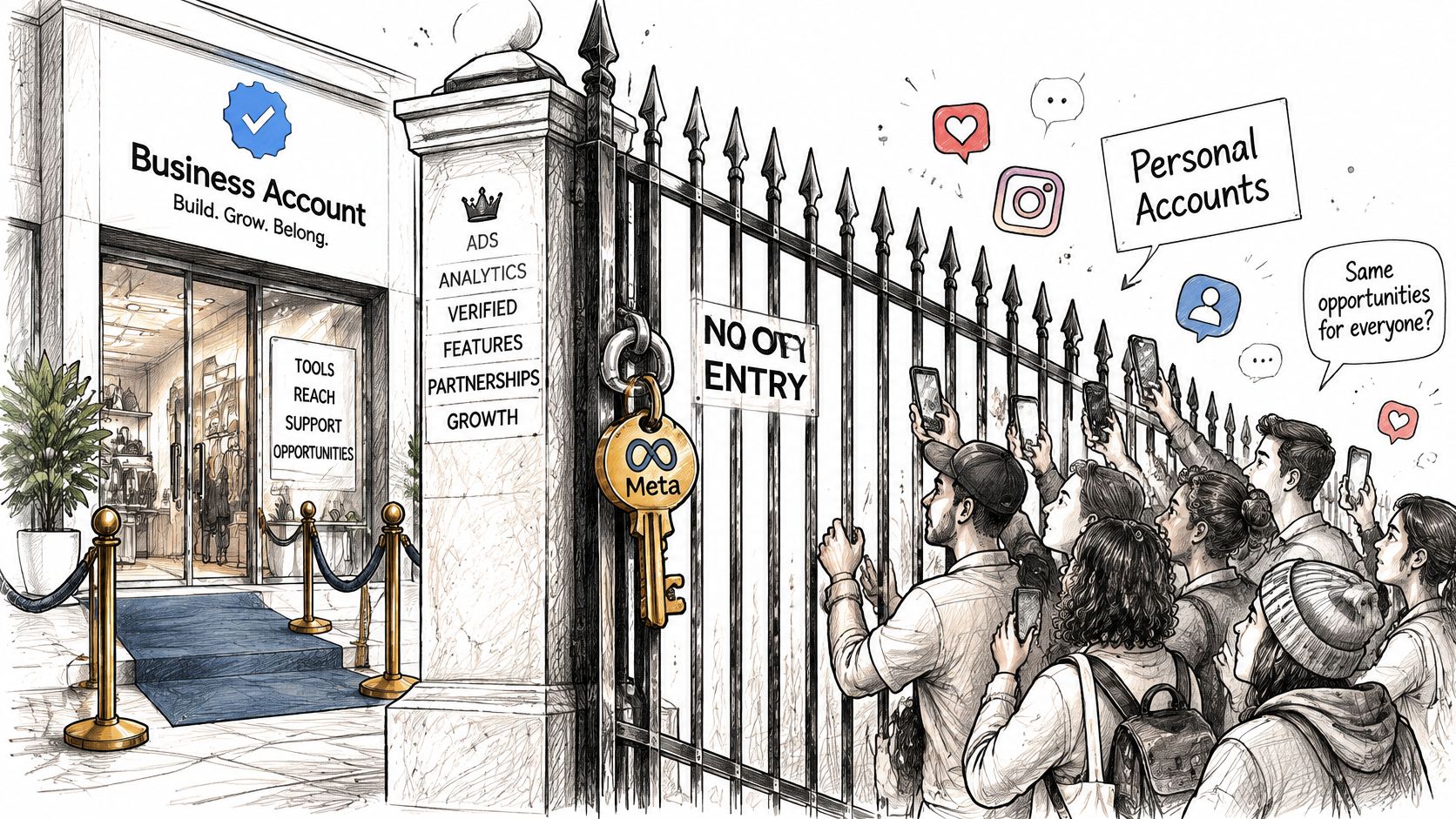
The official door supports authorized account operations
Meta's Instagram platform is the appropriate starting point for professional-account workflows such as publishing, permitted comment operations, and insights on owned media. Your application needs the relevant account authorization and approved permissions.
Build the account connection into the product experience. Store tokens securely, track authorization state, and give the account owner a clear way to reconnect when access expires or is revoked. Don't treat a successful development-account test as proof that unrelated customer accounts will work.
Discovery features are narrower than a platform-wide search engine. Business Discovery and hashtag access should be evaluated against the exact account eligibility and endpoint contract, rather than treated as general access to everything visible in Instagram.
The public-read door supports observation
A third-party data service can expose public records such as profiles, posts, reels, comments, hashtags, or locations through its own interface. Some services also offer stories, highlights, or follower-related endpoints, but endpoint availability must be checked individually.
This route doesn't replace an official publishing integration. A public-data key won't authorize posting, and a publishing permission won't turn your application into an unrestricted platform archive.
A useful distinction is what the user expects after pressing the button:
- Publish or reply: The application changes something on an authorized account.
- Inspect or monitor: The application retrieves available observations for analysis.
- Assess credibility: The application combines observations into a judgment that needs human review.
Account-history fields deserve particular care. Previous usernames or registration-country information can provide due-diligence context, but they don't establish identity, current residence, or malicious intent.
For a visual companion to Instagram integration concepts, use the video below.
Before choosing either route, write down the action your application must perform and the fields it needs. Reject an access path that can't demonstrate that specific operation, even if its endpoint catalog looks extensive.
The practical fork is straightforward: use official APIs for authorized account actions, and evaluate a public-data service for external observation without assuming it grants publishing rights or complete coverage.
Rate Limits and Publishing Ceilings
Throughput is an engineering requirement, not something to discover during a campaign launch. Meta's Instagram platform overview places most endpoints under Business Use Case rate limiting, uses platform rate limiting for Business Discovery and hashtag search, sets a ceiling of 100 API-published posts per professional account in a rolling 24-hour period, counts a carousel as one published post, and describes the broader Graph model's rolling one-hour call window.
The content-publishing-limit endpoint lets your application monitor publishing usage. Use that observation before admitting a large publishing job, not only after a publish request fails.
Track the limit that actually applies
A rolling window isn't a reset-at-midnight allowance. It follows recent activity, so a burst can keep affecting subsequent requests until enough earlier activity leaves the window.
Maintain separate state for the endpoint families you use. Combining unrelated limits into a single global counter makes troubleshooting harder and can unnecessarily delay work that still has capacity.
Integration controls for social media API limits
| Control | Rule to track | Practice |
|---|---|---|
| Business Use Case reads | Most Instagram endpoints | Separate counter from discovery calls |
| Platform rate limit | Business Discovery and hashtag search | Own queue and concurrency cap |
| Publishing ceiling | Account publishing usage within the rolling publishing window | Moving-window admission check plus retry reserve |
| Graph-style read window | Capacity within the rolling read window | Back off until usage drops |
| Duplicate callers | Same creator requested by agents and CRM jobs | Deduplicate by identifier and apply per-customer quotas |
| Pagination | Checkpoints and immutable identifiers | Resume without replaying the opening page |
HTTP rate-limit responses are normal control flow, not a reason to crash the worker. Put the job back into a durable queue, increase the retry delay with exponential backoff, and honor a retry instruction when the response supplies one.
Make retries safe
A retry must not create duplicate side effects. Give each publishing intent an internal idempotency key and persist its state, including any returned media identifier. If a connection drops after submission, reconcile the outcome before blindly submitting again.
For read jobs, cache stable identifiers and save pagination checkpoints after durable writes. That lets a worker recover without collecting the same opening page repeatedly.
A worker should know whether it's retrying a request, resuming a collection, or creating a new publishing intent. Those are different operations.
Watch for a thundering herd when an agent, a CRM sync, and a reporting job all request the same creator simultaneously. Request deduplication can share eligible in-flight work, while per-customer quotas prevent a busy tenant from consuming everyone's capacity.
Record latency, error class, available quota information, and retry count. Before starting bulk work this week, implement endpoint-family counters and a backoff policy, then deliberately test a throttled response.
Why a JSON Response Is Not a Census
HTTP 200 proves that a request succeeded, not that the dataset is representative. A study comparing platform-visible content with research APIs found access mechanisms could exclude up to approximately 50% of visible content and remove up to approximately 83% of contextual metadata.
Those findings concern the access mechanisms studied, not a universal Instagram omission rate. Their practical significance is that a clean response schema can coexist with substantial missing evidence.
The coverage problem deserves a place beside uptime in your integration review.
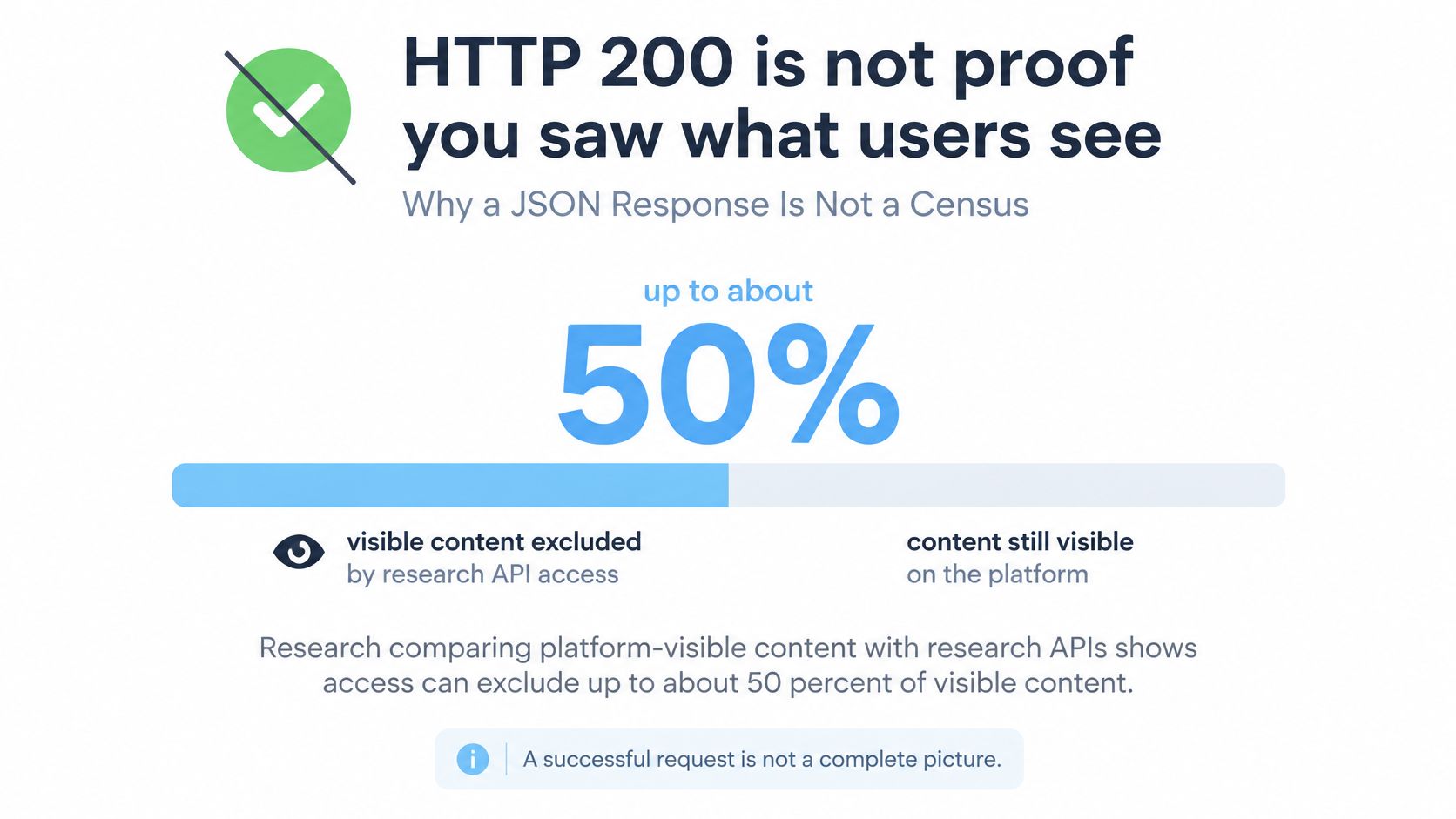
Preserve enough context to audit the sample
A peer-reviewed review of social-media collection identifies restrictions on available data types and quantities, alongside ephemerality as posts and platform policies change. Your storage model needs to distinguish a new observation from a changed underlying reality.
Persist:
- Provenance: Source identifiers, retrieval timestamps, and endpoint versions.
- Query context: Parameters, eligibility filters, and pagination state.
- Missingness: Explicit null, unavailable, and failed-retrieval states.
- Observation history: Prior snapshots where retention is justified.
Rerun equivalent queries on a controlled schedule and compare identifier overlap. That measures retrieval churn, although it doesn't by itself prove completeness. When comparing engagement, keep the denominator and observation period explicit.
Attach a confidence note to consequential outputs. Base it on freshness, repeated observations, missing fields, and the endpoints that returned usable records, not an arbitrary badge.
Collection isn't the same as justified inference
A post-API social-media analysis emphasizes privacy safeguards and the risks of platform-controlled evidence. Combining account history, follower-quality assessments, and lead-fit scores can produce a durable profile that goes beyond any individual public field.
Define retention and deletion rules before collecting those fields. Send an AI tool only the fields necessary for its task, and provide a human review or appeal path when an automated assessment affects someone.
Decision check: What evidence shows this account, hashtag, or location sample is complete enough for the decision being made?
Don't label a returned hashtag or follower list as the whole population. If coverage can't be demonstrated, state the limitation in the report rather than hiding it in an engineering log.
Pick the Access Model That Fits the Job
If your product must publish or retrieve permitted insights for an account that opts in, start with Meta's official Instagram platform and budget for authorization and review. If it needs external public observations for creator assessment, monitoring, lead enrichment, or agent tools, evaluate a public-data API against those retrieval requirements.
The choice should survive a concrete acceptance test. An endpoint catalog doesn't tell you whether a returned comment sample is suitable for moderation review or whether a location result contains enough context for a venue report.
Keep the public-read pilot bounded
Our Instagram API is an unofficial REST API for public Instagram data that accepts and returns JSON using a bearer token, without customer Instagram login, OAuth, app review, or business verification. It isn't affiliated with Instagram or Meta. The same key covers profiles, posts, reels, stories, hashtags, locations, comments, followers, following, and search; integration resources include a documentation quickstart, OpenAPI specification, cURL, JavaScript, and Python examples, and an MCP server.
Use those resources to validate the response contract before connecting a production workflow. This explanation of scraping social media can also help your team distinguish collection approaches and their operational responsibilities.
Keep the pilot narrow enough that someone can inspect its output manually:
- Write the decision: Specify what a marketer, analyst, or operator will decide from the returned records.
- Define acceptable evidence: Identify required fields, freshness expectations, and the treatment of unavailable results.
- Test recovery: Confirm that authentication failures, empty results, and interrupted requests produce understandable application states.
A successful pilot isn't merely a request that returns JSON. It's a request whose records support the intended decision, whose limitations are visible, and whose failure behavior your application can handle.
Start with a profile or hashtag call, store the retrieval time and a confidence note, and review the result before building a pipeline.
For public-read workflows, Instagram API offers structured Instagram data through a bearer-token REST interface, with documentation and agent integration resources. Visit the site to try a profile or hashtag request, then inspect the returned fields and missing states against the decision your application needs to support.
Pull Instagram data with one API call
Profiles, posts, reels, followers and more. 50 free credits, no credit card.
Get your free key