
Scraping Social Media: Methods, Risks and Alternatives
Learn how scraping social media works, which methods fit, the operational and privacy risks, and safer API alternatives for your data project.

If you can collect a social media dataset today, can you still explain and defend the conclusions you drew from it months later?
That's the gap in many discussions about scraping social media. Teams compare extraction speed and endpoint coverage, but the harder work starts when a post disappears, a field changes meaning, or someone asks why their information was collected. A useful collector needs more than working requests. It needs a documented sample, traceable observations, and clear limits on what the team will do with personal data.
Table of Contents
- Scraping Methods Compared at a Glance
- How a Scraping Pipeline Runs Step by Step
- Operational Limits, Bans and How to Fix Them
- Keeping Scraped Data Reproducible Over Time
- Privacy, Consent and Legal Limits to Respect
- Choose Your Route and Pilot It
Scraping Methods Compared at a Glance
Social media scraping is programmatic collection of content a person could see or request. People often use the phrase broadly enough to include APIs, although direct page scraping and API access are different collection methods. Your choice determines what you can reach, what context you preserve, and who must repair the pipeline when access changes.
Think of an official platform API as a staff badge that opens a defined set of doors. A hosted data API is a visitor pass issued by a vendor who maintains the access, but that pass isn't proof of platform authorization. Direct page scraping is reading the public notice board at scale. It works until someone moves the board or changes how visitors can approach it.
Social media collection methods compared
| Method | How it collects | Data reached | Stability | Main risk |
|---|---|---|---|---|
| Official platform API | Authenticated requests to documented endpoints | Defined fields within granted permissions | Versioned, with changes generally documented | Limited scope and approval requirements |
| Hosted third-party data API | API-key calls to vendor-maintained endpoints | Structured JSON for profiles, posts, comments, and followers within vendor coverage | Vendor maintains endpoints | Dependence on vendor terms and coverage |
| Headless browser page scraping | Renders pages and extracts elements | Whatever the page displays, including loaded feeds | Breaks when layouts or loading behavior change | Blocks, bans, and terms breaches |
| Browser extension collector | Runs inside a participant's browser session | Personalized feeds and rankings | Fragile across browser and site updates | Consent gaps and sample bias |
| Account data export | User-requested archive from the platform | The account owner's exportable data | Static snapshot, no live refresh | Narrow scope, unsuitable for ongoing monitoring |
The illustration summarizes the main access trade-offs.
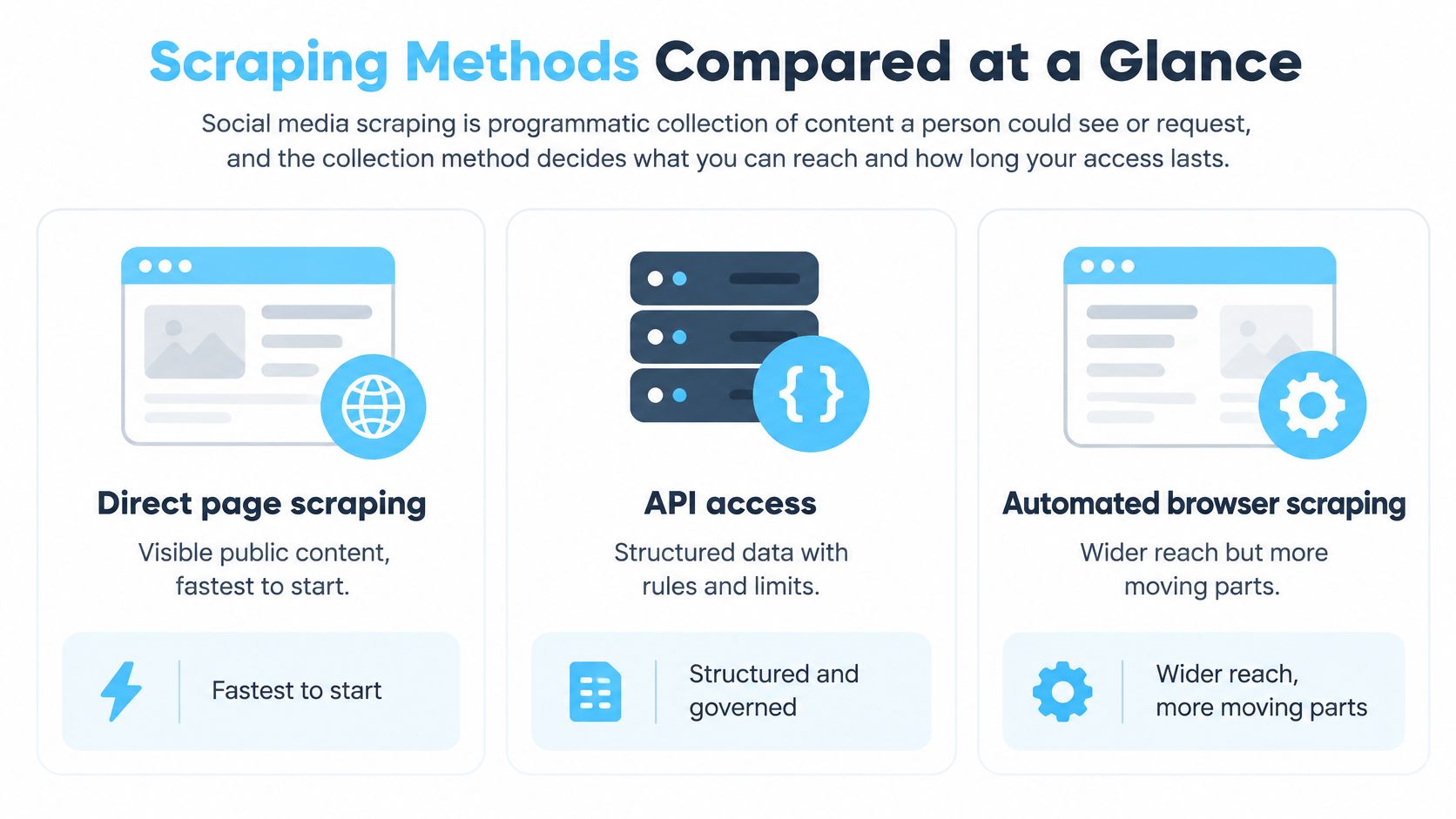
Reach isn't the same as completeness
An API response can be neatly structured without representing every relevant post. A browser can display rich context without exposing everything behind a collapsed comment thread. An export can be appropriate for studying a consenting participant's own activity, but it can't substitute for a platform-wide sample.
A scholarly review in PNAS Nexus describes APIs becoming a principal route for researchers collecting Facebook behavioral data and discusses browser-extension collection of personalized Twitter timelines, showing that feeds and rankings are collection targets too.
Choose your row by answering how deep the data must go and who will maintain the collector. If your question concerns comment conversations, a profile-only response won't answer it, however reliable that response looks.
How a Scraping Pipeline Runs Step by Step
A pipeline turns requests into records you can analyze without guessing what happened along the way. Keep collection, parsing, and analysis separate so a parser repair doesn't require another visit to the platform.
Build the collection contract first
Define the question and minimum fields. For brand-response analysis, you might need post identifiers, comment text, publication timestamps, and collection timestamps, but not commenter biographies. The common slip is collecting every available field before deciding what the analysis needs.
Choose the access method and confirm permission. Check the platform rules, your account permissions, provider terms, and intended downstream use before implementing requests. A successful response confirms technical access, not permission to use the result for any purpose.
Map fields and pagination. Write down which endpoint or page element supplies each field, what it means, and how the next page is requested. Missing a cursor or treating the first loaded page as the entire result creates silent gaps.
Set bounded collection behavior. Use a conservative worker pool, the documented request limits, and exponential backoff for retryable failures, honoring server retry instructions. Don't retry an authorization denial as though it were a temporary network problem.
The process illustration provides a checklist from defining the question through documenting the result.
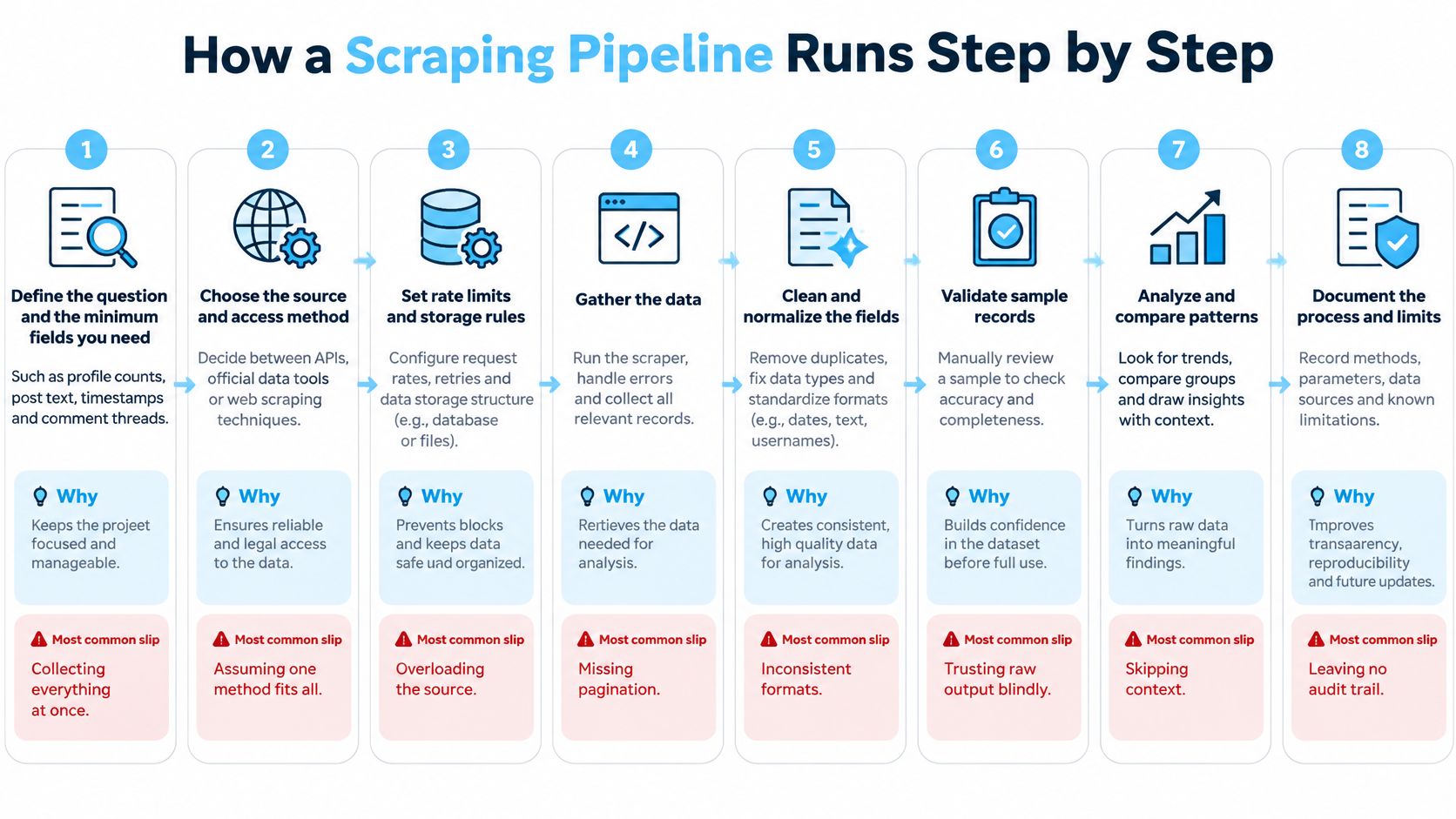
Preserve evidence before transforming it
Store authorized raw responses unchanged before parsing. Keep them in access-controlled storage under the project's retention policy so you can investigate parsing errors later. Don't interpret unchanged storage as permission to retain personal data indefinitely.
Normalize into a fixed schema. Use stable platform identifiers, typed counts, consistent timestamp formats, and explicit missing-value reasons. A missing count isn't zero, and a username isn't a dependable permanent identifier.
Validate completeness and uniqueness. Compare received records against totals the source exposes, check pagination continuity, and deduplicate by stable identifiers within each observation. Don't confuse the number of successful requests with the number of usable records.
Schedule runs and review failures. Record failure categories, checkpoint progress, and assign an owner to inspect collection health regularly. A scheduled job that exits successfully can still produce unusable output if its parser returns empty fields.
For example, a comment-analysis pipeline should preserve parent-comment identifiers when the source exposes them. Otherwise, an analyst may mistake replies for independent reactions and lose the conversational context needed to interpret them.
Practical rule: A collector should report what it couldn't obtain as deliberately as it reports what it obtained.
Finish with a manual inspection of a small sample. Open the source promptly and compare visible values with stored records, using the captured response for collection-time evidence if the live page has already changed. Check text, identifiers, counters, and timestamps, not just whether the record exists.
Operational Limits, Bans and How to Fix Them
Is the fault in your collector, or has the platform changed or blocked access? That distinction determines whether you should repair a parser, retry later, or stop collection.
A 2024 review of Instagram data-collection tools in Frontiers in Big Data reports that scripts need frequent maintenance as APIs and anti-scraping strategies change, and that excessive automated visits can trigger temporary or permanent IP or account bans. Treat access as a monitored dependency, not a connection you configure once.
Collector symptoms, causes and fixes
| Symptom | Likely cause | Fix |
|---|---|---|
| Rate-limit or too-many-requests responses | Request rate or concurrency too high | Lower the rate, add backoff, and use a small worker pool |
| Sudden empty fields across many records | Page markup or endpoint version changed | Check schema version, alert on field-level drop-offs, and update the parser |
| Account or IP restriction | Excessive automated visits or an access-policy issue | Stop the run, review the access method, and move to documented access |
| Login or verification challenges | Anti-automation controls triggered | Stop collection and review frequency and authorization; don't defeat the control |
| Records missing after a page boundary | Pagination cut off or checkpoint lost | Resume from the stored checkpoint and verify page continuity |
| Duplicate records in output | Repeated pages or retried writes | Deduplicate on stable IDs within observations and make writes idempotent |
Diagnose before retrying
For rate-limit responses, reduce the workload before restarting. Adding more retries without changing the request pattern repeats the condition that caused the failure.
For empty fields, compare the raw response with the parsed result. If the value exists in the response, inspect the parser. If it doesn't, check whether the record was restricted, the endpoint changed, or the provider returned a partial result.
For restrictions and verification challenges, stop. Don't treat account rotation or challenge bypass as a normal repair procedure. The production scraping guidance from Clearcote Labs offers an additional operational reference when reviewing collector behavior, while the unofficial API overview is useful for distinguishing access models before implementation.
Repair gaps without rewriting history
A pagination failure requires a stored cursor and query context, not a fresh run that replaces earlier results. Preserve the failed attempt and associate the resumed requests with the same collection job.
Duplicates require a different fix. Make repeated writes safe, but retain separate timestamped observations when the same post is deliberately collected again. Those observations aren't duplicates merely because they share a post identifier.
Finally, accessible doesn't mean representative. Private accounts, restricted fields, ranked results, and unavailable pages can skew the sample. Carry field-level availability flags into the dataset so an analyst can't accidentally interpret an unreachable comment thread as a thread with no comments.
Keeping Scraped Data Reproducible Over Time
Reproducible retrieval means you can explain and repeat the collection procedure. Reproducible results means someone can reconstruct the analysis from the observations you used. The same request can return different content after accounts publish, edit, hide, or delete posts, so a rerun isn't a replay.
The University of Edinburgh's study of data persistence bias in social media studies identifies account suspensions as a primary removal factor and explains why recollected datasets can differ systematically from the originals. More collected records won't solve that problem without snapshots and provenance, the record of where each observation came from.
Provenance fields to store with every collection
| Field | What it proves | Example entry |
|---|---|---|
| Collection timestamp | When the observation was made | UTC timestamp captured when the response arrived |
| Request identifier | Which call produced a record | req-7f3a21 |
| Endpoint and schema version | Which interface and parser definitions applied | posts endpoint, parser release recorded in the job manifest |
| Query definition | What was requested, including filters and pagination boundaries | Hashtag query, top-post ranking, stored page limit and final cursor |
| Raw-response hash | Whether a retained payload matches its recorded fingerprint | SHA digest stored alongside the payload |
| Unavailable-item reason | How the collector classified a missing record | Restricted, not confirmed deleted |
Keep observations separate from conclusions
Store historical observations rather than overwriting engagement counters. Calculate changes between explicitly timestamped snapshots, and preserve the metric definition with each derived result.
Apply scraped data checks from Scrappey when designing validation rules, then record which checks passed or failed. For warehouse workflows, the Instagram-to-BigQuery integration overview provides relevant implementation context. Keep observation history distinct from a table containing only the latest account state.
Attach a confidence note to derived metrics. An engagement estimate based on accessible recent posts should identify that sample rather than imply it describes the creator's entire history.
A hash can verify a retained payload. It can't reconstruct a deleted payload or prove that the original sample was complete.
The minimum defensible evidence package includes the raw-response hash, query and sample definition, derived aggregates, and analysis version. Separate personal fields, restrict access, and apply a retention limit. If exact recalculation is required, retain the necessary authorized inputs while permitted; don't promise reproducibility from aggregates alone.
A creator follower-quality report could use this evidence-note template:
Evidence note: Collected on [UTC collection date] using [endpoint and query]. The audit evaluated [actual sample size] accessible accounts; [actual unavailable share] couldn't be evaluated. The classification is a sample-based estimate, with exclusions and calculation rules recorded in the collection manifest.
Privacy, Consent and Legal Limits to Respect
Public doesn't mean free to collect and reuse. Visibility answers whether someone can encounter information, not whether a business should aggregate it, retain it, or use it to score a person.
A 2025 social-media privacy study published in Proceedings on Privacy Enhancing Technologies, based on 541 usable responses, examines discoverability and privacy expectations as measurable user concerns. A public profile can still reveal historical usernames, location signals, and personal details that someone didn't expect to become a searchable dossier.
The illustration highlights the difference between seeing public information and evaluating its responsible use.
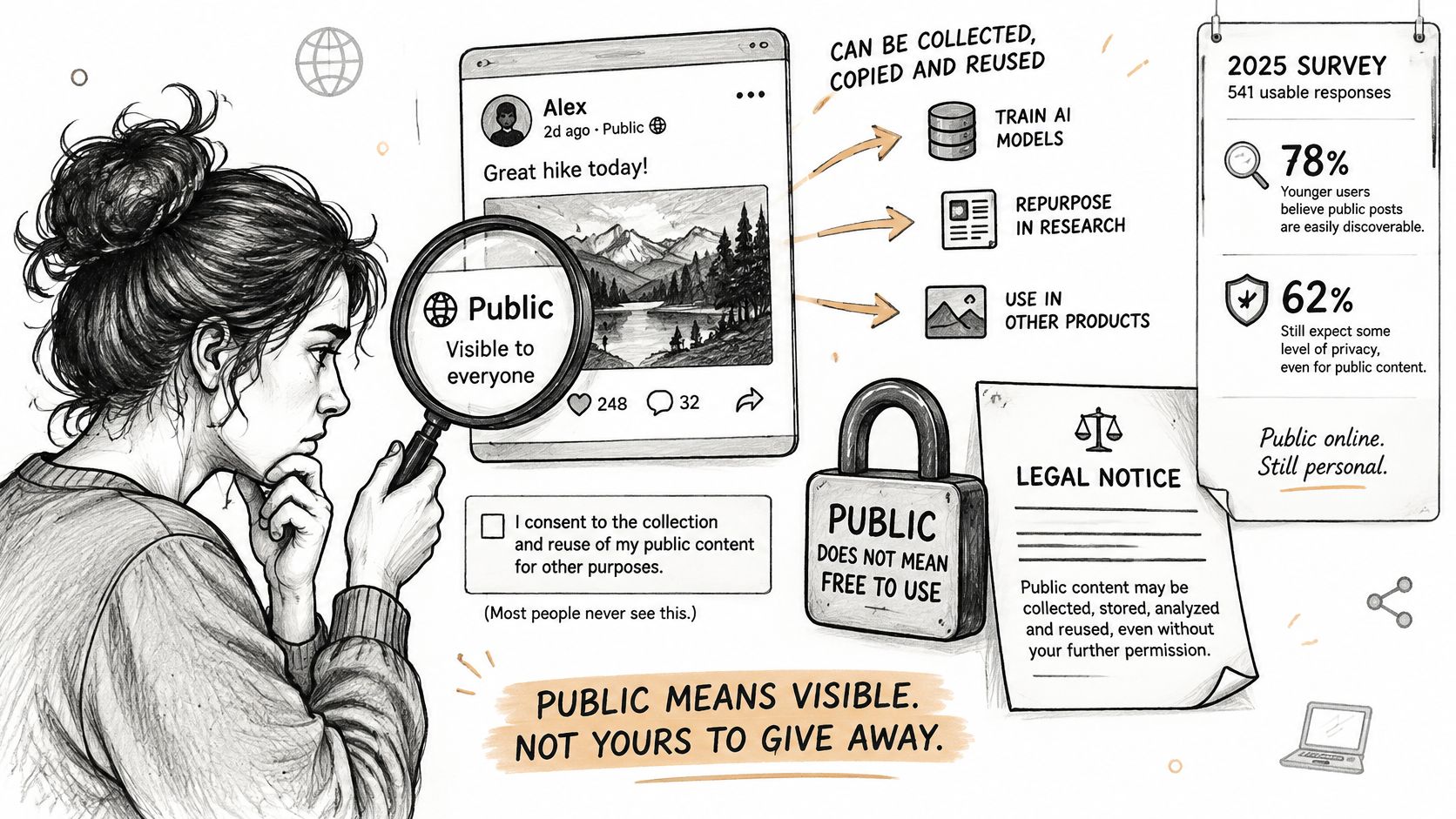
Set boundaries before collection
- Separate access from purpose. Document permission to collect and the specific downstream decision. Permission for analysis isn't automatically permission for outreach, resale, or model training.
- Minimize fields. Collect what the decision needs. Exclude personal contact details and precise locations unless the purpose requires them.
- Set retention limits. Assign deletion rules to raw responses, normalized records, and reports rather than retaining everything by default.
- Document legal obligations. Review platform terms, applicable regional requirements, and the lawful basis for processing with qualified counsel where needed. Public visibility isn't a universal legal exemption.
- Refuse sensitive inference. Don't infer health, religion, political views, or similar traits from posts because a model can generate a label.
- Provide suppression and deletion. Define how requests are received, matched, reviewed, and propagated into downstream systems.
Use the accompanying video as a discussion prompt alongside the project's written privacy review.
Label judgments honestly
Follower authenticity and engagement quality are estimates, not established facts about individual people. Profile-level transparency can also enable re-identification when combined with other datasets, or discrimination when irrelevant personal characteristics influence selection.
Say an agency is vetting a creator. It should label audience authenticity as an estimate, delete unneeded personal fields after the campaign under its retention policy, and avoid recording personal characteristics unrelated to the partnership. A useful report supports the commercial decision without constructing an unnecessary personal dossier.
Choose Your Route and Pilot It
Use cases and the safer route to start
| Use case | Data needed | Safer route to start |
|---|---|---|
| Influencer vetting | Engagement metrics, follower-quality estimates, post history | Documented API or hosted data API, with audience metrics labeled as estimates |
| Brand monitoring | Mentions, hashtag posts, comments with timestamps | Documented API with scheduled, rate-bounded pulls and stored snapshots |
| Lead enrichment | Business profile fields and public contact details | Consent-based sources first; avoid inferring personal traits |
| User-generated content collection | Public posts featuring the brand | Documented access plus written creator permission before reuse |
| Trust and safety impersonation checks | Account history, verification status, profile changes | Documented access with a recorded review procedure and confidence labels |
| Academic research | Sampled public posts over a fixed window | Ethics review, documented sample design, and a platform research route where available |
The right route follows the decision you need to make. Don't start with a scraper and then search for a business question that justifies its output.
Match the collector to the work
Say a brand team tracks daily mentions during a campaign. It needs timestamped counts, relevant comments, and consistent coverage. A documented API with scheduled collection is a better starting point than a page scraper nobody owns when it breaks during the launch.
A small research group studying a hashtag over a defined month has a different problem. A bounded public-page scrape may be a candidate after ethics and terms review, provided the researchers document the ranking, collection window, exclusions, and stopping rule. They should describe the sample as the content their procedure observed, not every post associated with the hashtag.
Apply these decision criteria:
- Recurring collection at volume. Start with documented access and verify that its permissions and coverage answer the question.
- A bounded, one-off public sample. Consider direct scraping only after reviewing authorization, privacy, sample design, and maintenance needs.
- Limited maintenance capacity. A hosted API transfers endpoint and extraction maintenance to a vendor, but your team still owns purpose, interpretation, and privacy obligations.
The guide to APIs for social media provides additional context for comparing integration approaches. Keep official platform access distinct from vendor-documented access when recording your choice.
Compare the full cost
For a custom scraper, estimate engineering time for implementation, testing, parser repairs, incident investigation, and evidence storage. For hosted access, compare per-call or credit charges alongside pagination, monitoring, integration work, and validation. Neither option removes the cost of explaining incomplete results.
At Instagram API, our public-data endpoints cover profiles, posts, hashtags, comments, followers, and search behind one API key, alongside reels, stories, locations, analytics, and other collection interfaces. Our Fake-follower audit insight endpoint estimates real versus suspicious followers from a sample, rather than certifying individual accounts. The live request feature lets you try endpoints directly in the documentation and inspect credit usage before designing the workload.
Make the pilot a decision test
For a hypothetical pilot, set aside one week and about 50 records. Include ordinary profiles, content with comments, and records likely to expose availability limits. This is a proposed test scope, not a claim about statistical representativeness.
Check whether the returned schema supports the intended analysis. Verify identifiers, pagination behavior, request tracing, missing-value reasons, and the ability to inspect a failed collection without running it again. Test deletion and suppression handling too, not just successful retrieval.
End the pilot with a written decision: the access route, the exact fields, the collection schedule, the owner, and the retention limit. For example, approve a hosted route for public profile counts and post engagement during a campaign, exclude follower biographies, and require raw-payload deletion after the project's approved review period. If the route can't support that contract, narrow the question or change the method before scaling.
Instagram API offers structured access to public Instagram profiles, posts, comments, hashtags, and follower data for collection workflows. Visit Instagram API to test the endpoints with live requests, inspect credit usage, and build a bounded pilot that checks provenance and privacy alongside coverage.
Pull Instagram data with one API call
Profiles, posts, reels, followers and more. 50 free credits, no credit card.
Get your free key