
API for Social Media: A Practical Instagram Guide
Learn how an API for social media supports Instagram analytics, monitoring, CRM enrichment, and AI workflows through practical integration guidance.

You're trying to prepare an Instagram report, but the information is scattered. A teammate has profile screenshots, another has copied post links into a spreadsheet, and someone else is checking comments manually. By the time you combine everything, you can't tell which details are current or why some fields are blank.
An API for social media can replace that disconnected process with structured retrieval. The harder part is making the returned data useful: choosing the right access model, understanding what each field means, and keeping freshness, uncertainty, and cost visible.
Table of Contents
- Why Social Media APIs Matter
- Understanding the Core API Concepts
- Exploring Common Instagram Data Patterns
- Following Three Instagram API Workflows
- Applying Instagram Data to Real Workflows
- Comparing Access and Integration Models
- Protecting Data Quality and Integration Reliability
- Planning a Production-Ready Integration
Why Social Media APIs Matter
Consider a team evaluating creators for an upcoming campaign. They need current profile details, recent content, visible engagement, and posts associated with relevant hashtags. Copying these into separate documents leaves the team without a shared retrieval method or consistent record format.
Programmatic access changes the work from collecting screenshots to maintaining records. An application can request data, map the response into its own database, and send selected fields to a dashboard, CRM, or review queue. The important improvement is repeatability, not faster copying.
The scale explains why this matters. In October 2025, global social-media user identities reached 5.66 billion, while 55.1% of online adults in GWI's survey reported using Instagram in the previous month, according to DataReportal's global social-media analysis.
Start with the operational question
Before choosing endpoints, decide what someone needs to do with the information:
- Evaluate a creator: Assemble profile, content, and engagement evidence for a human reviewer.
- Monitor a campaign: Retrieve relevant posts and comments without asking staff to revisit every account.
- Enrich a prospect: Connect an Instagram identifier to a structured record that a sales team can assess.
For broader orientation before narrowing the scope to Instagram, PostPulse's 2026 API guide is a useful companion resource.
Practical rule: Choose an API around the decision your team needs to make, not the longest endpoint list.
Don't assume that different providers expose identical information. Public-profile retrieval, authorized account insights, publishing, and messaging are different requirements. Write those requirements separately so a successful profile lookup doesn't become mistaken proof that the entire product is supported.
Understanding the Core API Concepts
A social media API works like a controlled service counter. Your application hands over a form describing what it needs, the clerk on duty checks your credentials, and you walk away with a structured answer or a written explanation of why the request was refused. The counter is the interface standing between your application and the provider's database, and nothing reaches the data except through it.
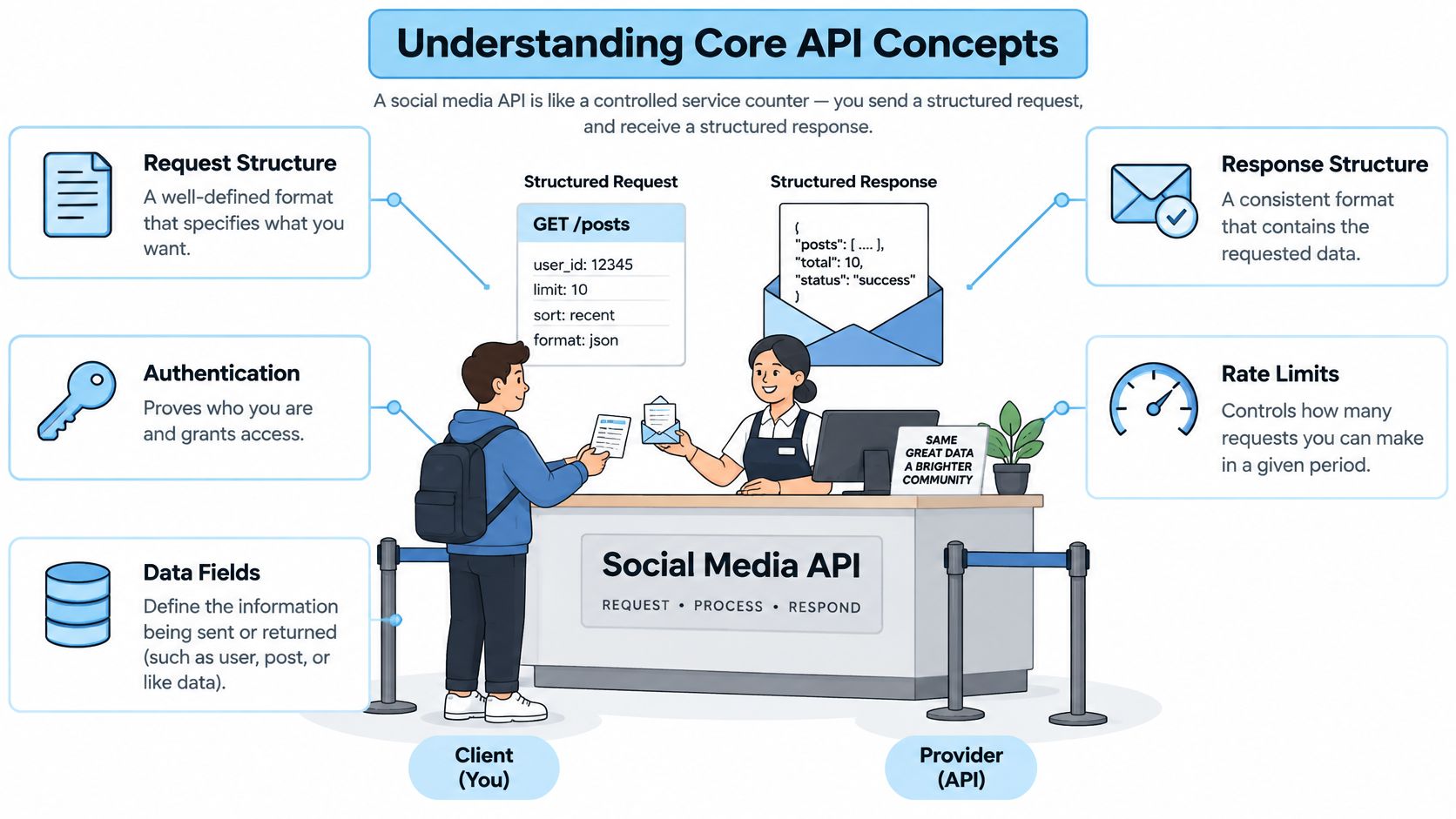
Trace one request through that counter. The client is your application. The endpoint selects the task, such as retrieving a profile. Parameters identify which account you mean or narrow the results you want back. Authentication supplies the credential the clerk inspects before touching anything, and rate limits cap how often the counter will accept your forms within a given window. The response finally arrives carrying the returned fields, plus operational information or an error.
Two jobs hide inside that response, and conflating them causes real bugs. Say your application stores an internal field called account_identifier while the provider returns the same value under a different name. A mapping layer bridges the two, so dashboards and downstream services never need to learn the provider's vocabulary. Retrieval, authentication, normalization, and billing each belong to a separate layer of your pipeline; mixing them makes every future change expensive.
The subtler trap sits in the data itself. Consider a provider response shaped like this:
{
  "username": "example_creator",
  "followers": null,
  "followers_status": "unavailable"
}
A 0 and a null carry different meanings. Zero says the provider looked and counted nothing. Null says nobody counted at all. Code that treats them alike will corrupt engagement averages, and a readable response never guarantees the requested record was available.
That separation pays off later. Once retrieval logic and business meaning live in different places, you can swap providers or endpoints without rewriting what a follower count means to your reports.
Exploring Common Instagram Data Patterns
A brand-tracking tool may begin with one public profile, then expand to posts about a campaign and accounts using a relevant hashtag. These are different data patterns, each suited to a different question. Mapping them before building requests helps keep the resulting records useful for analysis.
Profile data anchors the account record: username, identifiers, follower counts, and other available details. Content data captures posts and related activity. Discovery data finds accounts or posts through searches, hashtags, or locations. Insight data summarizes patterns, while transparency fields add context about an account's history.
| Data pattern | Representative records | Question it can help answer |
|---|---|---|
| Profile | Account details, followers, following | Which account is being assessed? |
| Content | Posts, reels, stories, highlights, comments, likers | What has the account published, and what visible activity surrounds it? |
| Discovery | User search, hashtags, locations, location posts | Which accounts or content match the research question? |
| Insight | Engagement analysis, posting-time analysis, account statistics | What patterns warrant further investigation? |
| Account transparency | Creation details, registration country, previous usernames, verification status | What account-history context should a reviewer consider? |
Treat these categories as different record types, not as interchangeable endpoints. A hashtag request, for example, supports topic-based discovery rather than a complete inventory of Instagram activity. Before building monitoring rules, review the Instagram hashtag API documentation for result scope, pagination behavior, and returned identifiers.
The distinction matters in storage, too. A story may have different fields and retrieval conditions from a profile, and its useful lifetime may be shorter. Followers, following lists, comments, and likers describe separate relationships. Combining them into one audience table can blur who followed whom, who commented, and which account published a post.
Account-transparency fields need careful interpretation. Creation details describe an account's reported origin in time, not its owner's professional experience. A registration country does not establish current residence or audience location. Previous usernames provide history, but do not prove deceptive behavior. Verification status is its own attribute, not a measure of content quality or commercial suitability.
Keep these meanings in the field inventory. Check endpoint availability against current documentation and actual responses, since a feature label alone does not confirm what a request will return.
Following Three Instagram API Workflows
A useful pilot follows complete records from input to application output. With ProfileQuery as the example, that means testing more than whether a request returns JSON.
The diagram shows the retrieval paths. Your implementation should add validation and interpretation around each path.
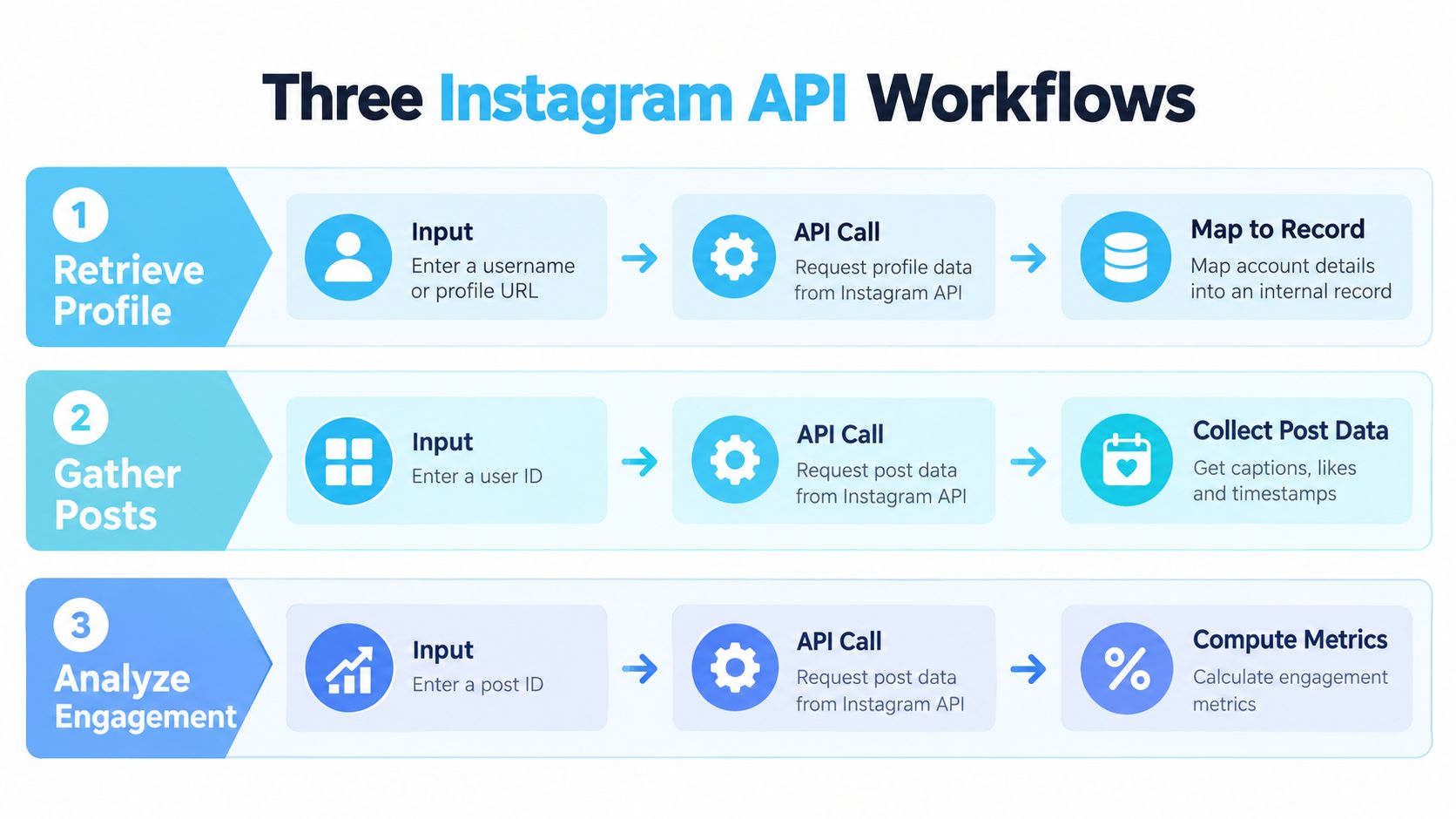
Retrieve and map a profile
Start with a username or profile URL submitted through your application. Validate the input, make the documented profile request, and map the returned account details into an internal record.
Keep the submitted identifier alongside the resolved account identifier. This lets a reviewer understand how the application matched the input to the retrieved account, rather than assuming that every submitted URL produced the intended result.
Gather content for monitoring
For a monitoring workflow, retrieve posts, comments, or hashtag results according to the research question. Preserve source identifiers and retrieval timestamps so analysts can distinguish separate records and understand when your application observed them.
Store the relationship between a comment and its post. Otherwise, downstream analysis can lose the context needed to interpret a response, such as whether someone was discussing the brand, the creator, or an unrelated subject.
Assess a creator with contextual evidence
Combine current engagement information with separately labeled transparency fields. Creation month, account age, registration country, previous usernames, and verification status should remain identifiable inputs, not disappear inside an unexplained credibility score.
A reviewer should be able to inspect the evidence behind the assessment. If a required field isn't returned, the workflow should show that limitation rather than just completing the evaluation.
For implementation, inspect ProfileQuery's documentation, OpenAPI specification, cURL examples, JavaScript and Python examples, and MCP resources. Use cURL to examine a request directly, then test the same behavior in your application language.
- Validate the contract: Check required inputs and expected response types.
- Test failures deliberately: Confirm that your application handles documented error categories.
- Review tool boundaries: An MCP connection gives an agent a retrieval interface, not permission to skip validation.
Applying Instagram Data to Real Workflows
A creator-review queue has 200 profiles, but the team can assess only a few each day. A useful Instagram workflow helps reviewers compare accounts consistently, while keeping each observation tied to its source and retrieval time. The interface should support a decision, not turn incomplete records into confident conclusions.

For creator assessment, a review screen might bring together engagement measures, posting-time patterns, account statistics, and follower-quality signals. The Instagram analytics API can be evaluated for those retrieval needs. Treat any resulting audit as evidence for human review, not as an automatic accusation.
A brand-monitoring workflow has a different shape: a queue of retrieved posts and comments grouped by campaign, hashtag, or location. That queue represents what the integration collected under its search and access rules, not every relevant post on Instagram. A missing post may reflect collection limits or timing, rather than an absence of discussion.
Shape the output around the decision
For sales teams, a username becomes more useful when it sits in a reviewable prospect record. Store observed profile details separately from inferred lead-fit scores, and leave missing contact information blank rather than guessing.
For AI applications, structured retrieval can replace pasted profile text. If an agent uses an MCP server, limit the operations it can call and require source context in its output.
The same records can support several teams, but each needs a different view. Creator reviewers need evidence alongside comparisons; monitoring staff need refresh schedules suited to active research; sales teams need matching controls and retention rules. AI applications need bounded tools and validated results.
This accompanying video offers another way to explore the topic.
A shared API key grants access to a connection, not automatic permission to expose every field or retain every record. Set field access and retention rules for each workflow.
Comparing Access and Integration Models
Choose between direct platform integration and a normalized REST layer based on governance and workload, not the assumption that either route is universally better.
Meta's official platform primarily serves professional accounts. Its standard integration involves an app, user access tokens, account identifiers, and endpoint-specific permissions, as described in the Instagram Platform overview. That route puts first-party authorization at the center of the design, while leaving your team responsible for the associated integration work.
The comparison below provides a starting point, not a guarantee of cost or coverage.
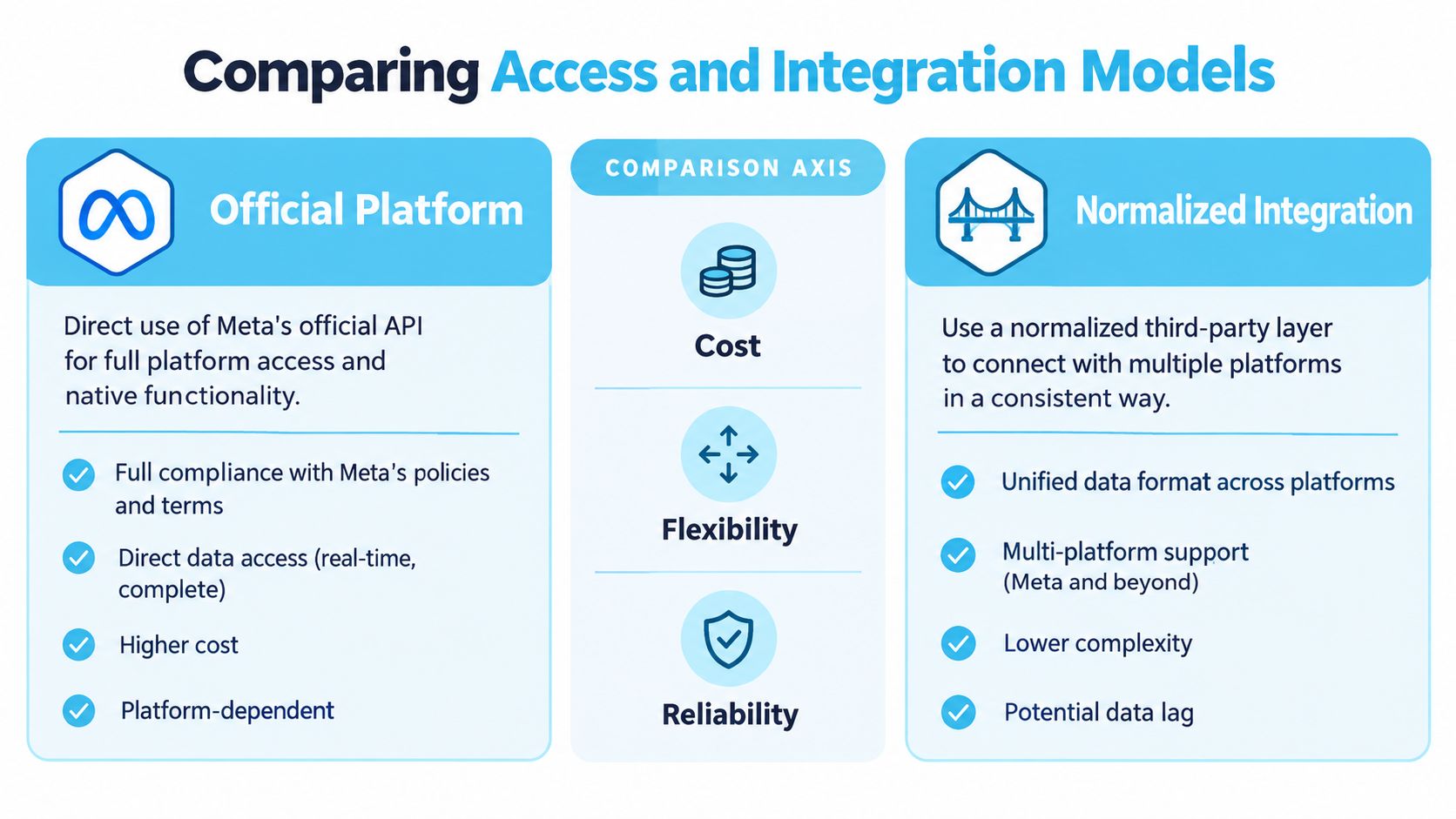
Instagram Integration Model Comparison
| Consideration | Official Instagram Platform | Normalized REST Layer |
|---|---|---|
| Access setup | App, eligible accounts, tokens, permissions | Provider-specific credentials and access terms |
| Authorization | First-party account authorization | Depends on the provider's retrieval model |
| Operational workload | Token lifecycle and platform integration | Provider integration plus application safeguards |
| Response consistency | Your team defines internal mappings | Provider may supply normalized objects |
| Error handling | Interpret platform responses | Validate the provider's error taxonomy |
| Endpoint coverage | Governed by platform permissions | Must be verified against provider documentation |
Separate setup convenience from operating cost
ProfileQuery uses an API key without Instagram OAuth, app review, or business verification; its published prepaid packages include 2,500 credits for $20, 10,000 for $70, and 50,000 for $300, alongside its Instagram access without login information.
Prepaid billing still needs operational controls. Before committing, verify endpoint charges and the treatment of invalid input, upstream failures, and not-found results. Don't assume that a response without usable data is necessarily free.
Ask whether response metadata exposes the charge, remaining balance, request identifier, and processing time. Your application should reconcile usage against jobs and customers so a monitoring spike doesn't become an unexplained balance change.
Neither access model removes your responsibility to review permitted use, retention, and security. Likewise, a normalized response isn't evidence of broader endpoint coverage, lower total cost, or fresher data. Test those requirements directly.
Protecting Data Quality and Integration Reliability
Valid JSON isn't the same as trustworthy analytics. A parser can accept a response even when a metric has changed meaning or the requested information isn't available.
Meta announced Instagram API changes in 2025, including an April 21, 2025 endpoint-update deadline and the introduction of views across Feed, Story, and Reels insights in its Instagram and Marketing API integration announcement. A dashboard that ignores definition changes can compare records that no longer describe the same thing.
Preserve meaning and uncertainty
Keep raw responses separate from normalized records. Maintain a versioned metric dictionary describing each field's meaning, expected type, applicable conditions, and transformation rules.
Unavailable is not zero. Use zero only when the response supports an observed absence of the measured activity.
An empty result might require investigation rather than arithmetic. Record whether information was unavailable, delayed, restricted, or absent for an unresolved reason. Add retrieval time, reporting period where available, and confidence labels to analytical outputs.
Use typed errors to select deterministic actions:
- Invalid input: Return a correction request without repeated retrieval.
- Unavailable account: Preserve the outcome for review.
- Authorization failure: Route the issue to credential or permission handling.
- Transient upstream failure: Retry within a bounded recovery policy.
Control requests rather than multiplying retries
Meta's Conversations API documentation illustrates why event-driven integrations need explicit coverage and response assumptions. Don't assume that webhook notifications replace every scheduled retrieval requirement.
Use per-account queues, caching, concurrency limits, and exponential backoff with jitter. Honor recovery timing when provided, stop permanent failures, and use a circuit breaker when upstream failures persist. Record endpoint, account key, status, retry count, and request identifier for diagnosis.
Security needs its own testing alongside these reliability controls. Use AskYourQA's guide to API security validation when planning checks around credentials, authorization boundaries, and unexpected inputs.
Planning a Production-Ready Integration
A production-ready API for social media begins with an acceptance checklist, not a successful demonstration request. The decision is whether the integration can support your application's actual evidence requirements.
Write those requirements before expanding retrieval volume.
Define what must be true
- Coverage: Identify the profile, content, discovery, insight, and transparency fields the product needs.
- Governance: Decide whether the workflow requires first-party authorization and who approves permitted use.
- Authentication: Assign responsibility for credential storage, rotation, and access control.
- Economics: Confirm endpoint charging rules, budget limits, and usage reconciliation.
- Semantics: Document missing-value states and the conditions under which calculations are valid.
- Operations: Set refresh expectations, retention periods, recovery behavior, and escalation ownership.
Run a small pilot that includes a profile workflow, a discovery workflow, and an analytics workflow. Choose test inputs that exercise ordinary responses and difficult outcomes, including unavailable accounts, incomplete fields, and service failures.
Approve the pipeline only when someone can explain what a record means, when it was observed, and what it cost to retrieve.
Review the pilot with the people who'll use the output. A developer may consider a response complete while a creator reviewer still needs provenance, or a sales operator needs a clear distinction between observed and inferred information.
Choose the simplest access model that meets your governance requirements. Then treat every returned record as operational evidence whose freshness, meaning, and cost must remain visible throughout its lifecycle. That's a stronger foundation than adding endpoints before your team can trust the records already collected.
For public Instagram data, Instagram API offers a REST-based option with structured JSON and prepaid credits for application, analytics, and AI-agent workflows. Visit it to compare the documented endpoints with your field checklist, then pilot profile retrieval, discovery, and analysis before scaling.
Pull Instagram data with one API call
Profiles, posts, reels, followers and more. 50 free credits, no credit card.
Get your free key