
Free Instagram Audit & Fake Follower Check: How to Read It
Free Instagram Audit & Fake Follower Check explained: what each signal measures, how to read the scores, and where public data cannot prove fraud.
If a free tool spits out a single percentage and flags a large share of an influencer's followers as fake, what do you know? You don't know whether those accounts are paid bots, old fans who stopped opening the app, or real shoppers who entered a giveaway last spring. Yet marketing teams and developers routinely treat one percentage as a final verdict, rejecting promising creators or approving weak campaigns on a number no outside tool can prove.
That shortcut grew out of Instagram's own breakneck expansion. According to the Timeline of Instagram on Wikipedia, the app launched on October 6, 2010, drew more than 25,000 registrations on day one, crossed 1 million registrations by December 2010, and climbed to 400 million monthly active users by September 2015. Follower totals became the default yardstick for reach long before brands could verify who sat behind those counts.
A well-run free Instagram audit & fake follower check fixes that blind spot by acting as a screening layer rather than a courtroom judge. Instead of chasing one magic percentage, you gather public clues, rank them by confidence, and send unclear profiles to manual review before money changes hands.
Table of Contents
- Signals a Free Instagram Audit Checks
- How to Run a Free Check Step by Step
- Why Follower Counts Mislead Brands
- How Fake Follower Checks Score Accounts
- Reading Engagement Against Peer Benchmarks
- Interpreting Suspected and Confirmed Results
- Audience Fit and the Go or No-Go Call
Signals a Free Instagram Audit Checks
One rule governs every reliable audit: a free check collects several public signals, and each signal is a clue, not a verdict. No single metric on a public profile can separate a fraudulent network from a quiet human audience on its own. You read the signals side by side so weak evidence stays labeled weak and converging patterns stand out.
| Signal | What It Can Suggest | What It Cannot Prove |
|---|---|---|
| Follower count | Reach size and growth history | Whether those followers are real or active |
| Engagement rate (likes and comments against followers) | Whether the audience interacts with posts | Why engagement is low, such as format, timing or geography |
| Follower-to-following ratio | Possible follow-for-follow tactics or a bought audience | The intent behind any individual account |
| Account age and username history | Whether the account has a stable record | The real identity of the owner |
| Comment quality | Repetitive, generic or copied comments | Whether a commenter is a real person |
| Sudden follower spikes | Possible purchased or giveaway-driven growth | The cause of the spike, which may be a viral post or press coverage |
| Audience location | Whether followers match the target market | Whether the account is fraudulent |
| Profile completeness | Bio, photo and posts are present | Authenticity on its own |
Why Public Profile Signals Stay Incomplete
Every row in that table reflects what an outside observer can see. Public profiles, posts, and comments are readable without an Instagram login, which is why lightweight audits work across most open creator accounts. Private device telemetry, login IP addresses, and direct message logs stay locked inside Instagram's servers.
Account history carries a similar boundary. Instagram only reveals account creation dates at month and year granularity, so no exact day is available. Creation dates work well as stability context, such as spotting a brand-new profile claiming years of authority, rather than a forensic timestamp.
Understanding how automated profiles mimic real users helps you read those limits realistically. Reviewing how bot accounts operate on Instagram makes clear why profile completeness alone no longer separates real fans from scripted profiles that copy bios and stock photos.
Teams deciding when free screening is enough versus when to pay for a deeper agency engagement can also compare social media audit pricing from Rebus to weigh the cost of manual review against campaign risk. Keep the eight signals above as your working checklist whenever you assemble evidence for a profile review.
How to Run a Free Check Step by Step
Running a repeatable manual screen takes a spreadsheet, a public browser session, and discipline around what you record. The workflow below outlines the four main stages of a fast screening pass before you drill into the full eight-step checklist.
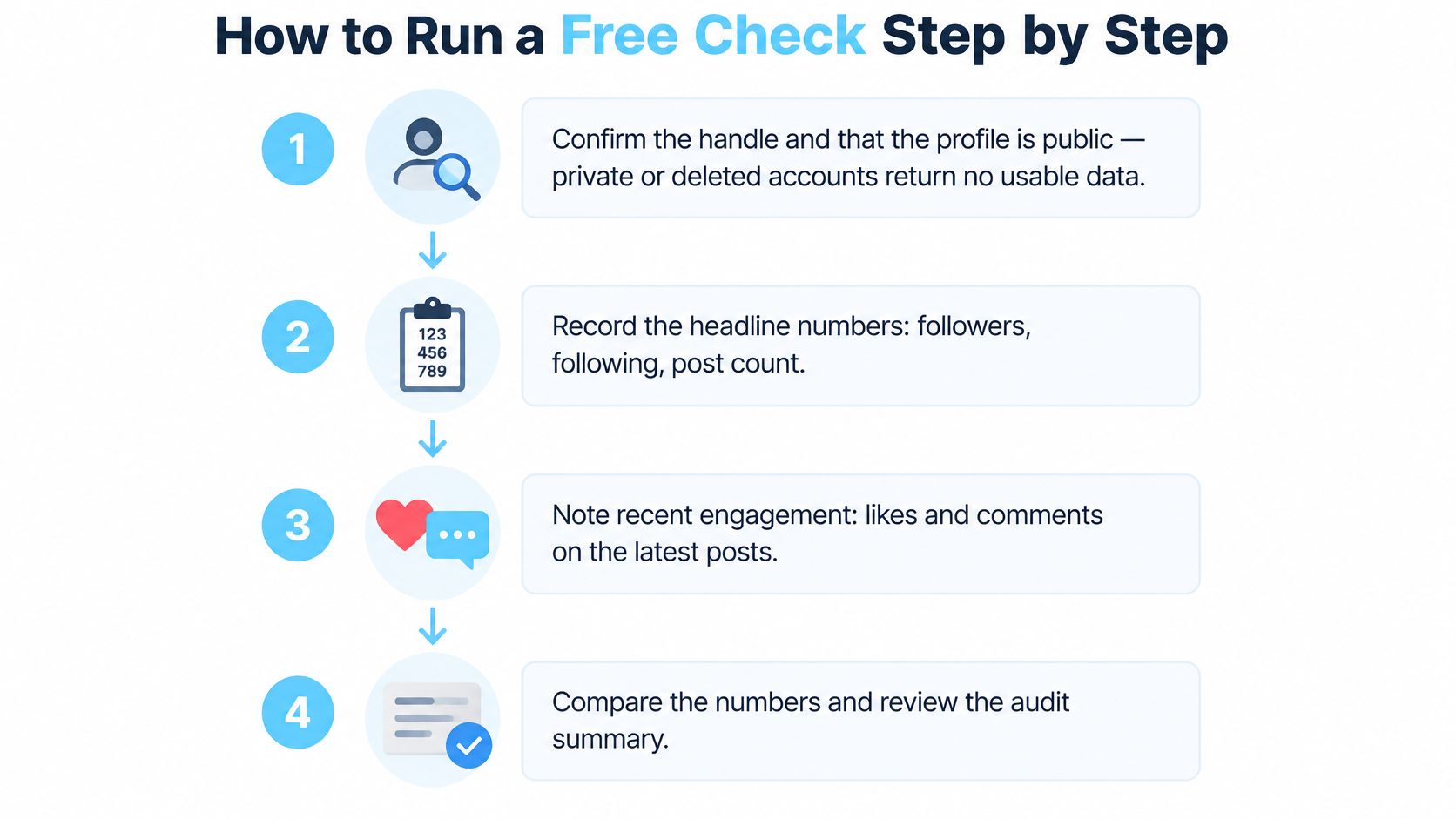
Work through all eight steps in order so your notes stay consistent across candidates:
- Confirm the exact handle and public visibility. Private, deleted, or mistyped accounts return no usable public data, and automated lookups that hit Instagram still burn time or quota when a handle doesn't resolve. Double-check spelling directly against the creator's website or media kit rather than guessing from a search bar.
- Log the headline numbers. Write down total followers, following count, post count, account creation month and year, and any visible username history. Skipping the following count or past handles is an easy oversight that hides follow-for-follow loops or repurposed theme pages.
- Pull several recent posts and compute the median engagement rate. Skip pinned posts because they accumulate likes over months, and divide median likes plus comments by total followers. Judging an account from a single breakout post or from a simple mean lets one viral Reel disguise weeks of flat interaction.
- Read a sample of comments across multiple posts. Look for copied compliments, emoji-only bursts, or the same tiny circle replying within minutes of publication. Counting total comments without reading them misses engagement pods and scripted spam completely.
- Inspect the follower growth timeline for abrupt jumps. Tools like Social Blade display historical follower curves that let you line up sudden vertical spikes against viral posts, giveaways, or press mentions. Assuming every jump equals bought followers leads to false alarms when offline media drove genuine interest.
- Spot-check a spread of individual followers. Open the follower list, sample accounts beyond just the newest top entries, and note their locations, recent activity, and profile completeness. Checking only the first ten names skews your view toward whoever followed in the last hour.
- Benchmark the numbers against three to five peer accounts. Pick creators in the exact same niche and follower size band so your comparison stays fair. Comparing a mid-sized local chef against a global lifestyle celebrity produces meaningless ratios because engagement naturally drops as audiences scale.
- Assign a suspicion band and date your record. Classify the profile as low, moderate, or high suspicion, list the exact signals behind that call, and save the check date. Recording a bare yes-or-no label leaves your team unable to re-check whether an account improved a month later.
Analyst habit: Always use the median across recent posts instead of the average. One viral video can double an account's mean likes while nine ordinary posts sit nearly silent.
Recording a Repeatable Evidence Table
A finished free Instagram audit & fake follower check doesn't look like a gut feeling in a Slack thread. It looks like a compact evidence log pairing each observed signal with the exact place you pulled it from, so a colleague or client can reproduce your work.
| Signal | Source |
|---|---|
| Followers | Public profile header |
| Following | Public profile header |
| Median engagement, recent posts | Post metrics from several recent posts |
| Repeated or generic comments | Comment sample |
| Largest follower spike, 30 days | Follower growth timeline |
| Audience location share | Follower sample |
| Account created, month and year | Profile transparency data |
| Peer benchmark median | Three to five peer accounts in the same niche and size band |
Why Follower Counts Mislead Brands
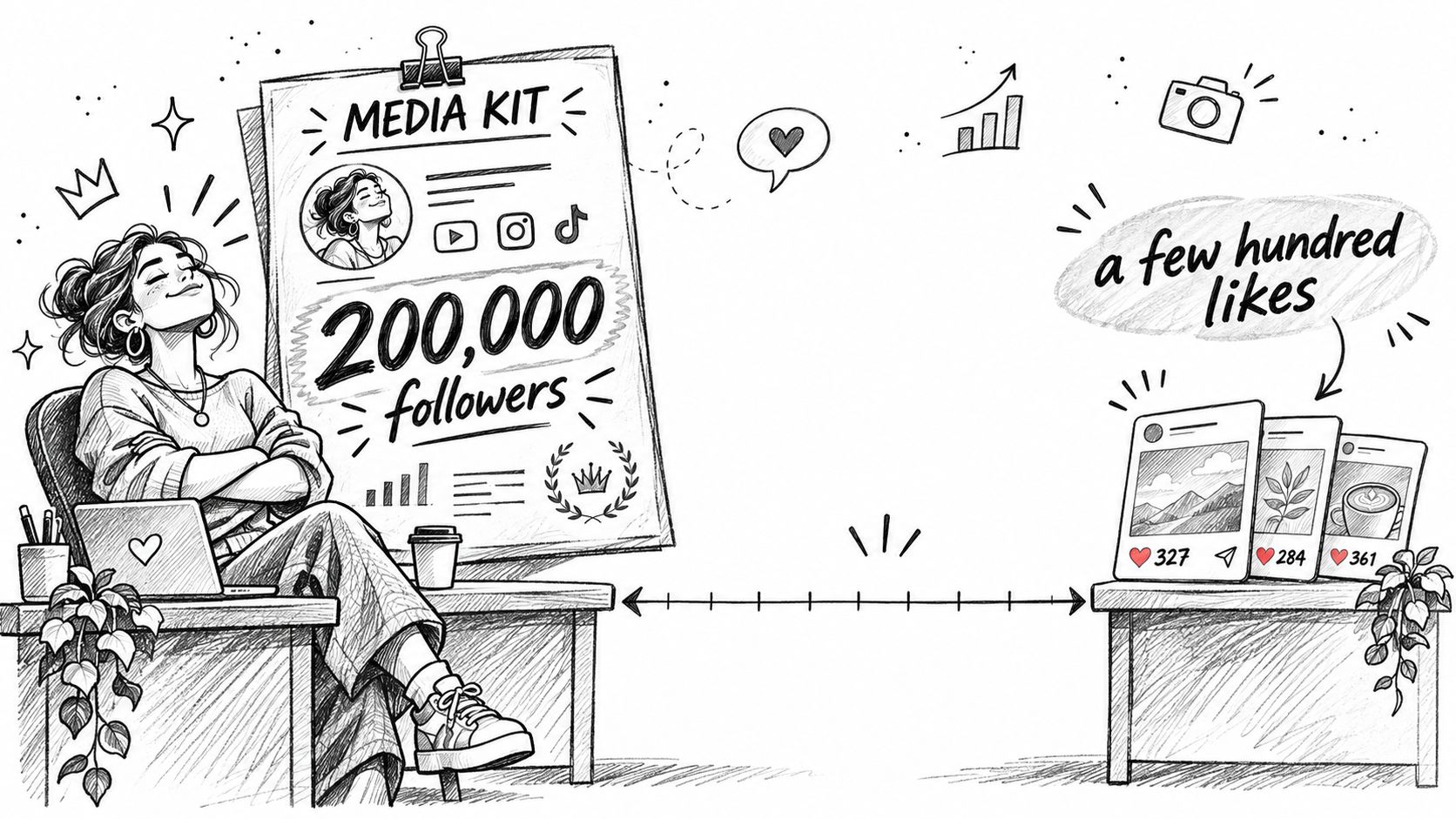
Say a lifestyle creator sends over a polished media kit listing 200,000 followers and quotes a flat fee based on that reach. You open their public profile, scroll past the pinned video, and notice that recent posts draw only a few hundred likes. If a brand prices that campaign on headline followers alone, the true cost per real viewer climbs sharply while reach estimates and sales projections fall apart before the first post goes live.
This gap isn't rare. In a statistical investigation of Swiss Instagram influencers, SRF Data analyzed approximately 7 million follower accounts tied to 115 influencers and estimated that 25.8% to 31.1% of the classified followers in the sample appeared to be fake, summarizing the average as roughly 30%.
That study mattered because the researchers used statistical learning on a representative sample instead of cherry-picking obvious scam profiles. Even so, you have to read that figure with care. Automated models flag behavioral patterns associated with fake profiles, not courtroom proof of who operates every account, and a 25.8% to 31.1% estimate from one Swiss sample shouldn't be treated as a universal baseline for every country, niche, or creator tier.
How Scale Distorts Engagement Calculations
What the Swiss benchmark proves for due diligence is straightforward: headline follower totals can overstate real reach by a wide margin. The distortion gets worse as an account grows from a few thousand followers into the hundreds of thousands. At scale, even a moderate layer of dormant, duplicated, or automated accounts drags down engagement-rate math and hides whether active humans still see new content.
When you spot a wide gap between follower size and interaction, look for clustered warning signs rather than panicking over one number:
- Weak interaction relative to reach: Consistent posts pulling far fewer likes and comments than peers of similar size.
- Repetitive, low-effort comments: Generic remarks that never reference the photo, caption, or product shown.
- Abnormal audience clusters: Large pockets of followers with limited authentic activity or geographic patterns that clash with the creator's market.
Treat a media-kit follower total as an unverified claim until you check it against recent post engagement and a sampled slice of followers.
How Fake Follower Checks Score Accounts
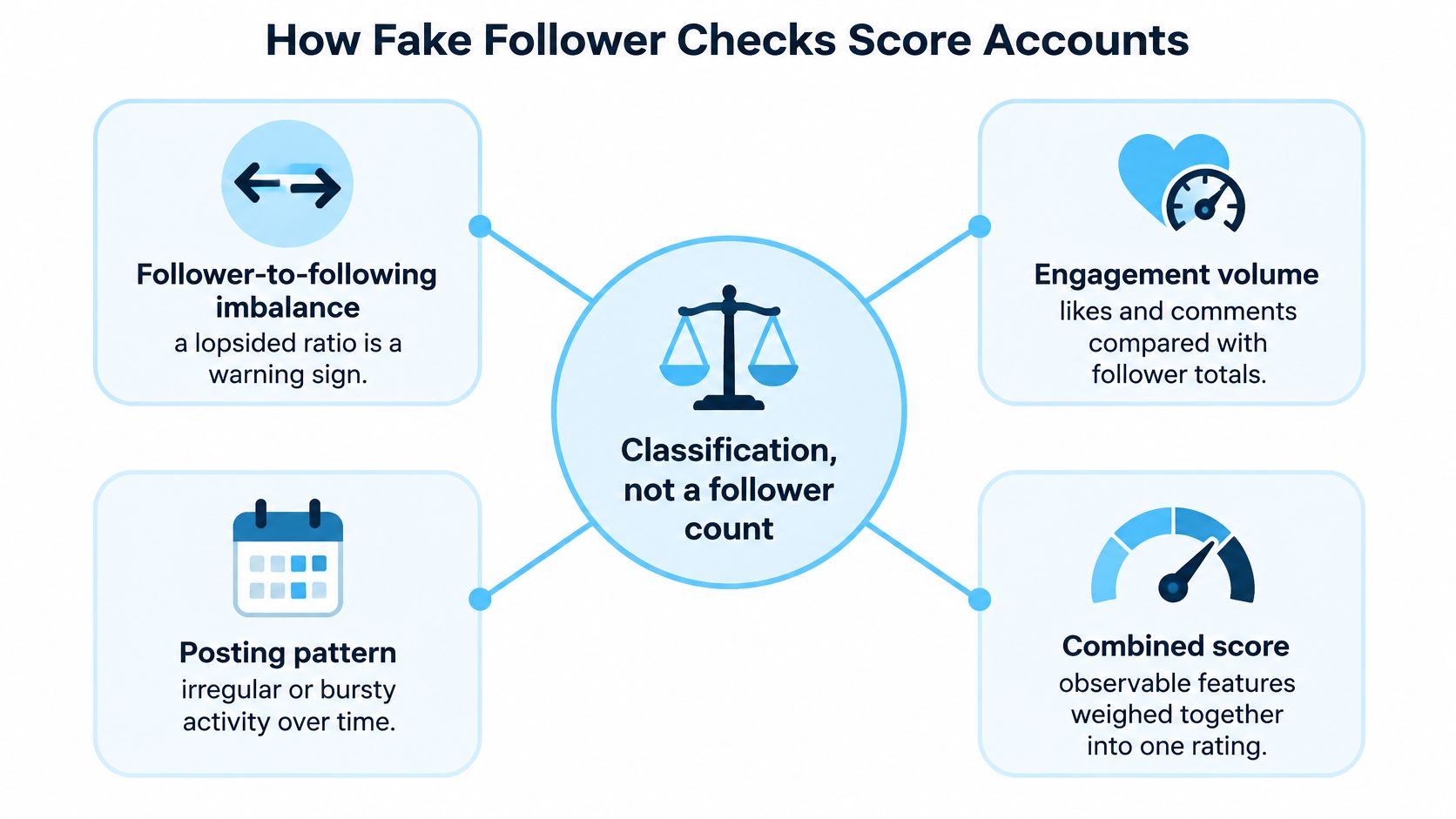
Behind any credible free Instagram audit & fake follower check sits a classification problem, not basic division. Instead of staring at a follower total, detection models weigh multiple observable signals at once, including follower-to-following imbalance, engagement volume, posting cadence, profile metadata, text patterns, and profile images. Each signal carries a different level of confidence. A clustering algorithm that spots hundreds of near-identical profiles following one creator is strong evidence, while a single quiet follower with no posts proves almost nothing on its own. Combining those features helps software sort accounts into dormant, automated, spam, and authentic groups.
The concept map below shows how scoring engines pull those distinct clues together into a single combined rating.
How well do classifiers perform when conditions are ideal? A research paper archived on HAL open science reports that a supervised neural-network model paired with correlation and singular-value-decomposition techniques reached 99.43% accuracy on its evaluated dataset.
Don't mistake lab performance for real-world perfection. Test results come from clean, labeled datasets, while live Instagram checks deal with private accounts that hide data, platform layouts that shift, follower samples that introduce bias, and bot operators who rewrite scripts to dodge known filters. That gap between the lab and the field is exactly why a careful audit treats its output as a screening layer rather than a verdict. Platforms such as HypeAuditor, Modash, and Jem Social all apply their own sampling rules and thresholds, so teams looking to audit creator audience authenticity will notice scores vary across vendors depending on how each tool defines suspicious behavior. When two tools disagree by a wide margin, the honest reading is that the account sits in a gray zone, and gray zones belong in manual review.
For a practical walkthrough of how automated checks compare signals in practice, this video breaks down what screening tools inspect on public profiles.
Separating Four Distinct Audience Categories
Because classifiers work with probabilities rather than certainty, a useful audit returns a risk band instead of stamping every quiet follower fake. Even more important, it separates four audience groups that affect campaign value in totally different ways:
- Suspected bots: Scripted or coordinated accounts that inflate counts without ever reading captions or clicking links.
- Inactive legitimate followers: Real people who followed years ago, stopped opening Instagram regularly, or drifted away from the creator's topic. They lower engagement rates, yet they don't signal fraud.
- Giveaway-driven audiences: Bargain hunters who followed to win a prize and ignore normal posts afterward, creating a temporary dip in interaction.
- Geographically irrelevant followers: Authentic users who live outside the region where your product ships or your service operates.
Notice that only the first group points to manipulation. A creator whose audience is heavy on inactive or giveaway-driven followers may still deliver genuine reach to the right buyers, while a high bot share is a problem no matter how engaged the rest of the crowd looks. Lumping all four categories into one fake-follower percentage hides exactly the distinction you need for a go or no-go decision.
If you're building or reviewing an automated pipeline, calculate rolling engagement ratios across multiple recent posts, watch for temporal bursts and repeated interactions, and store the underlying feature values in JSON. Preserving raw inputs lets a human analyst inspect why a score landed in a given band and reproduce the calculation later. That stored evidence is what turns a fuzzy machine judgment into a decision you can defend: clear cases pass or fail automatically, and the unclear middle goes to a person who can look at the same numbers the model used.
Reading Engagement Against Peer Benchmarks
An account with massive reach and sluggish or mechanically repetitive interaction raises an obvious flag, yet weak engagement on its own doesn't convict a creator. Plenty of legitimate factors suppress likes and comments. Static product photography often earns fewer reactions than short-form Reels, irregular posting cools feed visibility, international time zones scatter when fans see a post, and algorithmic distribution shifts reach from week to week.
To separate healthy fluctuations from inflated audiences, evaluate audience-to-engagement consistency against peers in the same niche and follower tier across several recent posts. Running a creator's recent post totals through an Instagram engagement rate calculator alongside four or five direct category peers immediately shows whether low interaction is a niche norm or a genuine outlier.
A low engagement rate without a peer benchmark is just a floating number. Context from similar accounts turns it into usable evidence.
Modern detection research supports pairing engagement math with content cues rather than trusting numbers alone. In a multimodal study published in JNTETI, researchers evaluated a CNN-LSTM model combining numerical metadata (followers, following, and interaction counts) with textual and visual features across 10,000 manually labeled accounts, reporting 96.8% accuracy, 95.7% precision, 97.4% recall, and a 96.5% F1 score within that experimental setup.
What Belongs in a Due-Diligence Report
Commercial stakes explain why clear reporting matters. The U.S. Federal Trade Commission has described fake followers, likes, and views as tools that can exaggerate social-media influence and enable deceptive conduct. That's why an audit shouldn't blur the line between "suspected" patterns and "confirmed" fraud.
Every due-diligence summary your team generates or buys should include five baseline fields:
- Sample size and post date range: Exactly how many posts and followers were checked, and over which calendar window.
- Median and mean engagement: Both figures side by side, revealing whether one outlier post skewed the average.
- Suspected-follower share: Expressed as a range or risk tier rather than a false-precision decimal.
- Confidence intervals or uncertainty flags: Explicit callouts when hidden like counts, private followers, or small samples weaken reliability.
- Request metadata: The timestamp and parameters used, keeping the check repeatable.
Engagement checks still sit upstream of actual revenue. Once a creator passes audience screening, teams also need to measure what drives sales from social using tracked links or promo codes so vanity metrics never stand in for conversions. Keep manual review firmly in place before rejecting a creator or wiring a deposit.
Interpreting Suspected and Confirmed Results
Most free checkers encourage a dangerous habit: they print a single suspicious percentage in red or green and let users treat it as fact. A "fake follower" score is never a verdict, and it's especially fragile on small or newly launched accounts.
Researchers call this the cold-start problem. Accounts with thin behavioral histories don't produce enough public activity for a classifier to separate a quiet newcomer from a sleeper bot. High-quality labeled Instagram datasets remain scarce, and automated accounts keep evolving to mimic ordinary people. A 2025 ensemble-learning study on Semantic Scholar similarly warns that small datasets, narrow feature sets, and missing text or image cues limit how well detection models generalize outside their test sets.
Micro-creators, brand-new accounts, diaspora communities, and local figures who gained followers after offline press coverage get misclassified most often. Mapping every audit score into an action band prevents automated labels from killing good partnerships or rubber-stamping bad ones.
| Result Band | What It Suggests | Next Action |
|---|---|---|
| Low suspicion | Engagement is steady across recent posts and followers look active | Proceed with the normal brief |
| Moderate suspicion | Mixed signals, such as a growth spike or a few generic comments | Compare with peers and sample more posts before deciding |
| High suspicion on a large account | Weak engagement, repetitive comments and unexplained follower bursts | Request a manual review and an audience report before any spend |
| Thin or unclear data on a small or new account | Too little history for a reliable classification | Treat the result as insufficient and rely on manual review and a later snapshot |
Walking Through a Borderline Giveaway Case
Say you audit a craft creator with 3,000 followers whose two newest posts pulled barely a handful of likes right after a weekend giveaway. A blunt fake-follower tool sees a sharp follower bump paired with weak engagement and flashes a warning.
A structured audit reads the sequence differently. It flags the growth as likely giveaway-driven followers, notes the small sample size, and keeps the account out of the automatic-reject pile. Instead of walking away, you ask the creator about the campaign and schedule a second snapshot in a few weeks to see whether engagement stabilizes once prize hunters unfollow.
"What confidence level should be assigned to a result, and which evidence is missing?" Ask that question every time an automated tool hands you a percentage.
To keep human reviewers in control, require every audit output, whether written in a spreadsheet or returned as JSON from an API, to state four things clearly: the confidence level, the exact signals examined, the sample size, and the threshold that triggers manual review.
Audience Fit and the Go or No-Go Call
Authenticity is only half the screening job. A follower can be a living, breathing person and still hold zero commercial value for your campaign because of location, language, purchasing market, niche, or inactivity. Free audits rarely separate creator risk from campaign fit, which leaves teams paying for real eyeballs that can never buy the product.
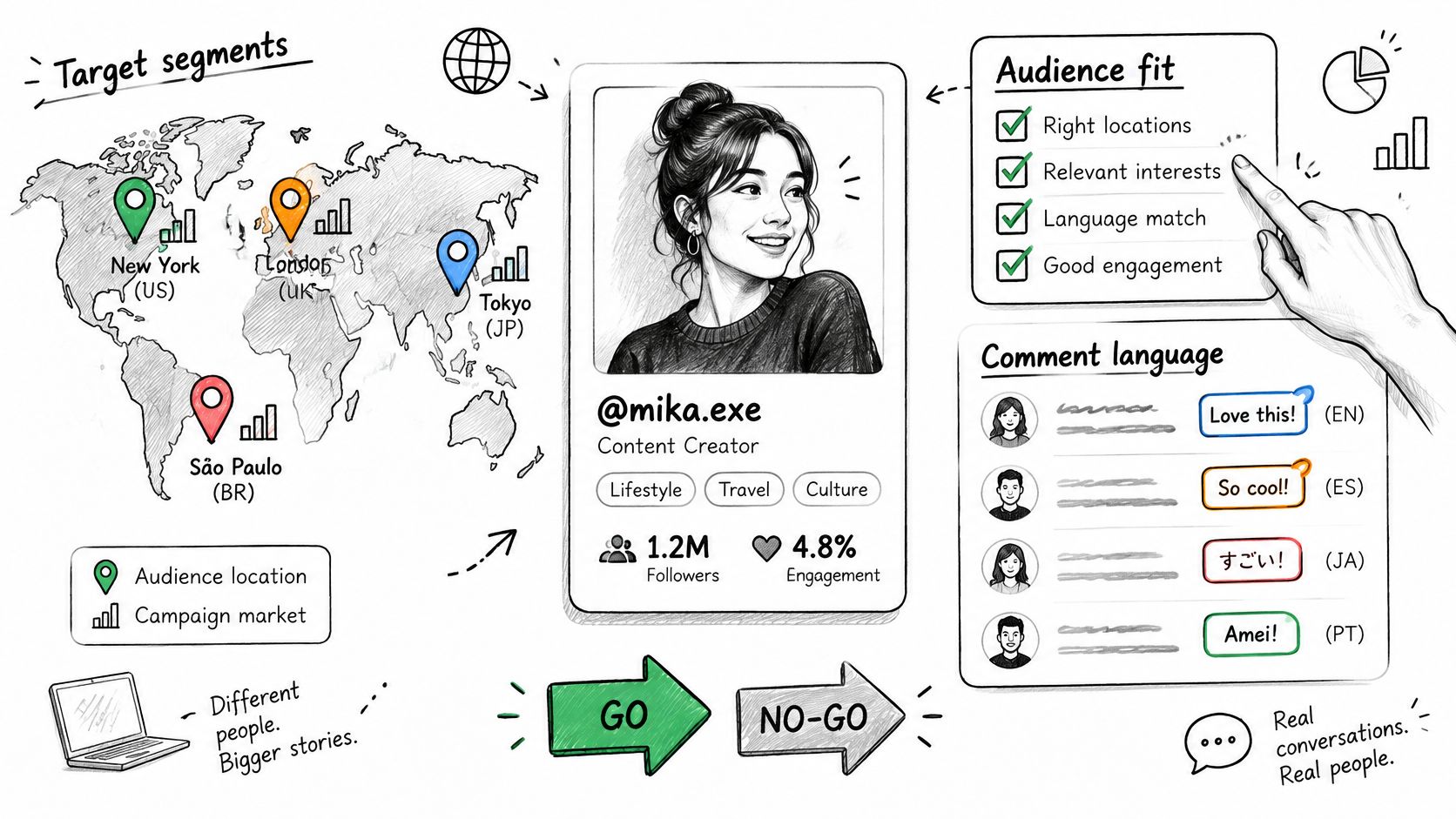
Run the fit check on its own track. Compare primary audience locations against where you sell, scan comment language, check whether engagement comes from your target customer segment, and review account age plus past usernames to confirm the creator's history matches their current niche. Say a fitness creator holds a mostly genuine following in Brazil, while your brand ships exclusively to U.S. shoppers. That creator passes the authenticity screen cleanly yet fails campaign fit, just as a consumer lifestyle page with real followers would miss the mark for a B2B software launch.
Never assume Instagram's own moderation guarantees clean audiences either. Guidance from Favikon flags mismatched audience geography as a key warning sign and cites a 2025 experiment finding that Instagram retained 83.13% of identified inauthentic activity. Public profile and content data can give you structured estimates of geographic and market alignment without claiming access to private demographic records, making fit scoring a practical companion to authenticity checks when vetting influencers across social media.
A Four-Step Go or No-Go Rule
Before approving a brief or integrating automated checks into your app, run every candidate through four final gates:
- Keep every finding labeled suspected, not confirmed. Even strong red flags justify questions or owner-provided Instagram Insights screenshots rather than public accusations.
- Route moderate and high suspicion results to manual review before rejecting or paying. If you automate screening, our Fake-follower audit endpoint estimates real versus suspicious followers from a sample so your team can flag borderline creators without reviewing clean profiles by hand.
- Verify account history and transparency signals. Check the creation month and year, account age in years, registration country, username changes, former usernames, and verified badge. Our API exposes Instagram's 'About this account' transparency panel together with the full public profile in one call, making it simple to spot repurposed accounts claiming a sudden niche pivot.
- Archive the evidence with its collection date and usage cost. Save the structured payload so any teammate can audit why a creator passed or failed months later. When running repeated programmatic checks, log the credits charged and credits remaining from each response's meta object so per-audit spend stays visible as volume grows.
Apply one clear go or no-go rule at the end of every review: move forward only when creator risk and campaign fit both pass. When either gate stays unclear, pause spend and gather direct evidence before signing.
If you want to turn manual profile checks into a repeatable screening pipeline, Instagram API returns structured public profile data, follower-quality audit estimates, engagement metrics, and full 'About this account' history through predictable JSON endpoints with prepaid credits and transparent per-request billing metadata. Explore our endpoints, documentation, and free starter credits at Instagram API.
Pull Instagram data with one API call
Profiles, posts, reels, followers and more. 50 free credits, no credit card.
Get your free key