
Influencer Social Media Marketing: A Practical Guide
Learn how influencer social media works, how creators build audiences, and how brands measure sponsored posts, disclosure, and real audience quality.
In a 2025 survey of more than 3,700 U.S. consumers, 70% said they felt negative toward an influencer when they discovered undisclosed payment or free product, according to BBB Programs' lessons from NAD cases. That single finding reframes influencer social media. You're not buying reach alone. You're buying a relationship that disclosure, audience quality, and credibility can strengthen or gradually damage.
Table of Contents
- How Influencer Social Media Marketing Works
- How Creators Build an Audience Brands Want
- Creator Tiers and What Each One Delivers
- Checking Audience Authenticity Beyond Follower Counts
- Sponsorship Disclosure Rules and Why Trust Depends on Them
- Campaign Metrics Brands Use and How to Calculate Them
- Worked Creator Comparison and the Second-Post Test
- Pre-Signing Checklist and Data Sources
How Influencer Social Media Marketing Works
A friend who understands skincare recommends a moisturiser, explains why it suits dry skin, and tells you what she didn't like. You buy it without reading an advertisement. Influencer social media marketing turns that trusted recommendation into a paid channel.
The scene below captures that shift from private advice to public, sponsored recommendation.
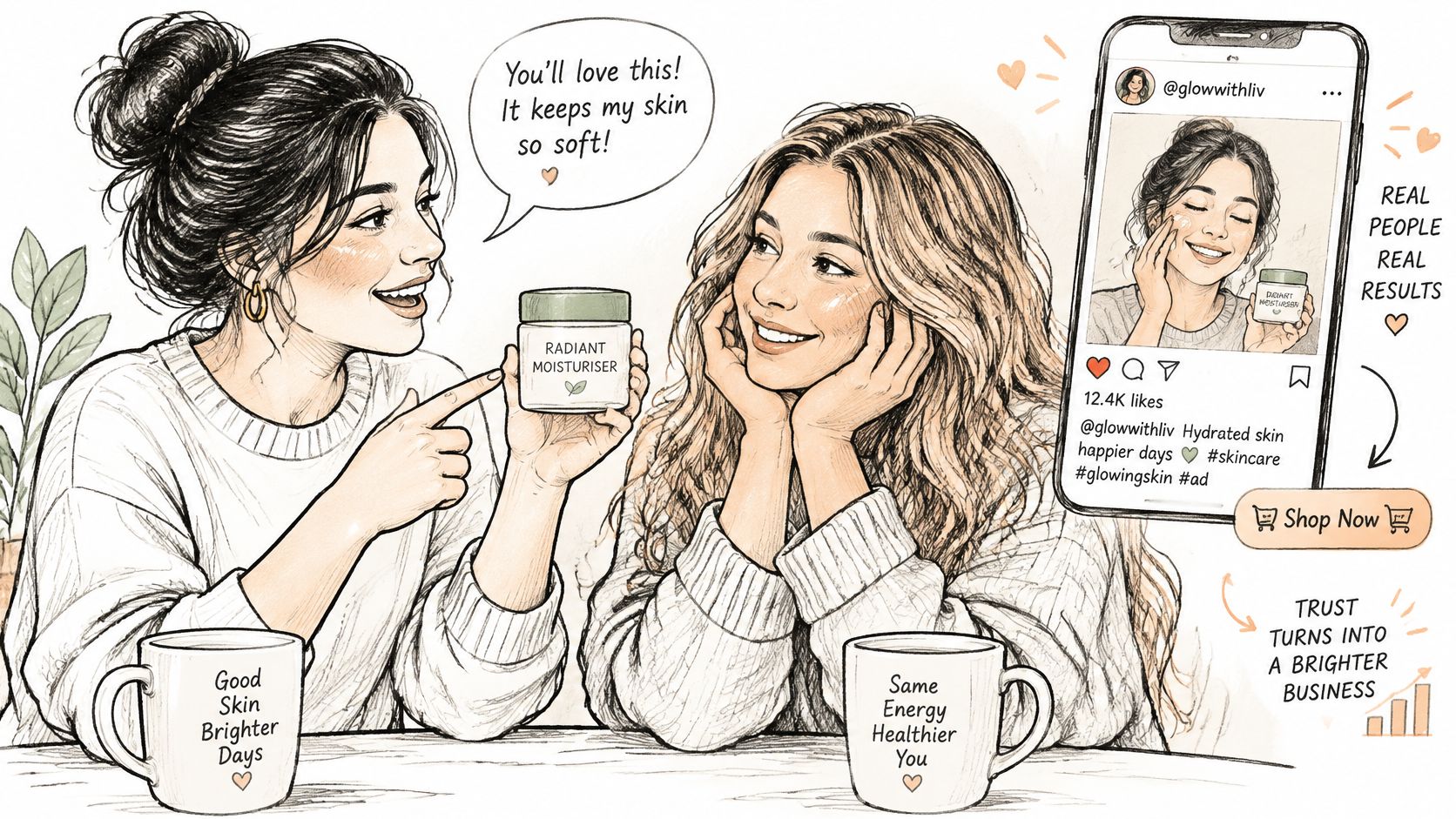
Three roles keep the system moving. The brand supplies a product, a fee, free product, or commission. The creator publishes posts, Reels, Stories, or livestreams in a voice followers already know. The audience gives attention and, if the fit is right, clicks or buys. Value flows in a loop, because the brand rents trust the creator built over time.
Scale and persuasion
Cited estimates in a 2024 meta-analysis in Psychology and Marketing place global influencer-marketing expenditure at approximately $8 billion in 2019 and $15 billion in 2020, an increase of 87.5% in one year, and estimate the market at $16.4 billion in 2022. The same review of 53 academic studies and 250 statistical effect sizes found that influencer credibility, trustworthiness, and perceived expertise are important predictors of consumers' attitudes toward promoted brands and products. It also reported that 56% of consumers had made purchases inspired by social media influencers.
Think of a trusted neighbour recommending a plumber. You don't take the advice because the neighbour is famous. You take it because they've solved your kind of problem before and have no obvious reason to mislead you. A banner ad can't borrow that history.
Three characteristics matter from here on. The channel has commercial scale, it has a measurable relationship with decisions, and it depends on perceived authenticity. Brands that treat approval as part of that system can manage influencer campaign approval workflows rather than approving isolated posts at the last minute.
How Creators Build an Audience Brands Want
Brands don't pay for random attention. They pay for a predictable audience that returns for a recognizable kind of help. A creator builds that asset slowly, through topic discipline and repeated proof that the content is worth saving.
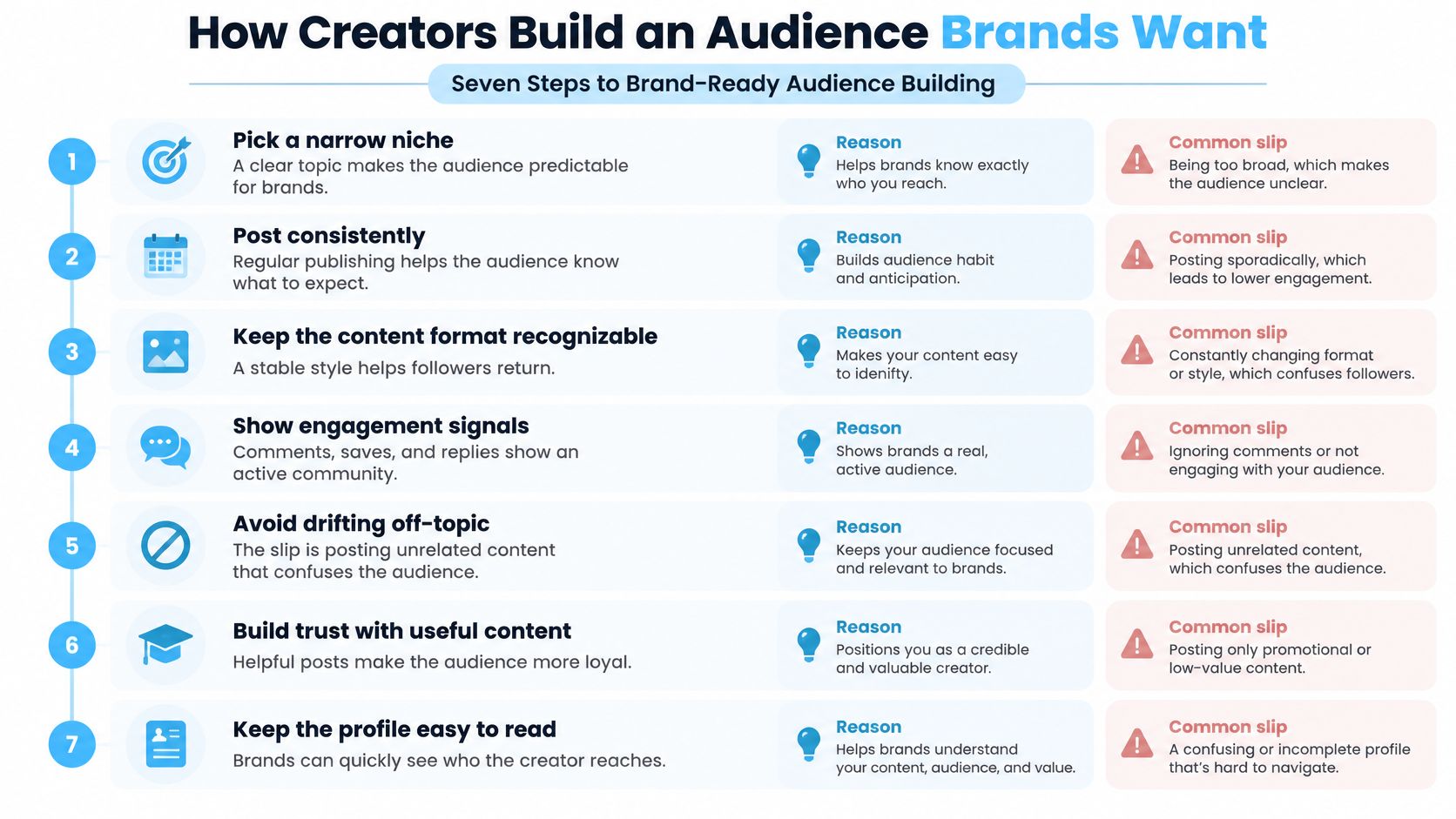
The infographic below summarises the route before the detailed steps.
Seven steps that compound
- Pick a narrow niche. A clear topic, such as meal prep for runners, makes the audience predictable for brands. The common slip is posting across unrelated subjects because each one once performed well.
- Choose one repeatable format. Short tutorials, honest reviews, or weekly comparisons teach viewers what to expect. Consistency of format matters more than novelty in the early months.
- Post on a steady schedule for several months. A rhythm viewers can anticipate compounds discovery and habit. Stopping after a few weak weeks resets both.
- Reply to comments early after posting. Replies show a live relationship, and questions in comments often become the next useful post. Treating comments only as a count wastes that signal.
- Write searchable captions. Name the problem, product type, and audience in plain words, then add relevant hashtags. Viewers who arrive through search need to grasp the niche in seconds.
- Collaborate with creators of similar size. A joint review or shared challenge exposes each account to a comparable, already interested audience. Chasing much larger accounts rarely gives the smaller creator meaningful visibility.
- Track saves and shares, then repeat what earns them. A save suggests future use, and a share suggests the viewer trusts the content enough to recommend it. Repeat the format, not the identical post.
The short video below is a useful companion while you judge whether a creator's growth habits look deliberate or accidental.
Brand-ready test: A brand should understand who the creator reaches, what format they'll deliver, and how past sponsorships were labelled without needing a long explanation.
A ready profile has a clear bio, a consistent visual identity, and past collaborations labelled as sponsored. Growth alone doesn't prove fit. A smaller account whose viewers ask buying questions in the right niche can be worth more than a fast-growing account built on giveaways.
Creator Tiers and What Each One Delivers
Creator tiers sort accounts mainly by follower count. The label is convenient, but it's only shorthand for a trade-off among reach, attention, trust, and cost. Read the table from smallest to largest and notice what you gain and lose at each step.
| Tier | Best use | Main trade-off |
|---|---|---|
| Nano, under 10,000 followers | Local trust and small product tests | Limited reach per post |
| Micro, 10,000 to 100,000 followers | Niche expertise and detailed reviews | Needs several creators for scale |
| Mid-tier, 100,000 to 500,000 followers | Scaled reach with a defined audience | Higher fees and more competition for attention |
| Macro, 500,000 to 1 million followers | Broad awareness and launches | Lower engagement per follower |
| Mega, over 1 million followers | Mass reach and brand building | Weakest audience-to-product fit per viewer |
Nano creators often hold close, local conversations. Followers may know the creator's routines, neighbourhood, or workplace, so a recommendation can feel personal. The limitation is simple arithmetic, because even strong engagement produces few buyers in absolute terms.
Micro creators usually offer narrower expertise and room for detailed reviews. A creator who tests products for one hair type or one sport can answer specific objections. Brands often need several micro creators to reach a useful total audience, which adds coordination work.
Choosing by campaign job
Mid-tier creators balance scale with a still-defined audience. They're easier to brief for a launch than a scattered group of very small accounts, but their feeds carry more competing sponsorships. Macro and mega creators deliver broad awareness quickly, yet each viewer typically gives less attention and feels less personal connection.
Say a skincare brand is testing a new serum. It could work with ten micro creators in one skin-type niche to collect feedback on texture, irritation, and results. Once the claims survive that scrutiny, it could add one macro creator for launch awareness. The order matters, because awareness built on untested claims creates expensive confusion.
Relative engagement usually falls as follower count rises because a larger audience includes more casual viewers. Fees reflect audience size, format, usage rights, and exclusivity, so a short Story, a Reel the brand can reuse in ads, and a category exclusive aren't interchangeable deliverables.
Choose the tier by the job, whether testing, converting, or building awareness, and use a mixed roster so one wrong audience doesn't decide the whole campaign.
Checking Audience Authenticity Beyond Follower Counts
A follower count tells you how many accounts pressed follow at some point. It doesn't tell you whether they're real, reachable, in your market, or interested in buying. Engagement rate helps, but it can also be inflated, recycled, or concentrated among a few accounts.
The Influencer Marketing Hub benchmark report notes that reported fraud issues are dominated by fake or bot followers at 56.5%, while misreported performance metrics account for 5.4% and incentivized or undisclosed reviews for 6.1%. The same source reports that only 74% of surveyed U.S. consumers trust or somewhat trust influencer content, compared with 87% for advertising generally.
Those numbers expose a common confusion. Real followers are not the same as a commercially useful audience. A creator can pass a basic authenticity check and still be wrong for your product.
A seven-part audience audit
- Audience authenticity: Sample followers and estimate the share that look suspicious, inactive, or automated.
- Follower geography: Compare where followers appear to live with the market you can sell and ship to.
- Engagement concentration: Check whether likes and comments come from a broad audience or a small group of repeat accounts.
- Historical sponsorship behaviour: Review how often the creator promotes products and how clearly past sponsorships were disclosed.
- Comment sentiment: Read whether comments show trust, buying intent, scepticism, or only generic praise.
- Account history: Note account age, past usernames, and verification status before you rely on the profile.
- Purchase fit: Judge whether the audience's problems, budget signals, and questions match the purchase you want.
For the first check, our Instagram fake follower checker API for sampled follower audits estimates real versus suspicious followers from a sample. Teams handling larger media buys also validate views before paying creators so traffic quality is checked before invoices are approved.
Say a UK skincare brand finds a creator with genuine followers, strong saves, and warm comments. If most followers live in a country the brand doesn't serve, the campaign can still fail. The audience is real but commercially ineffective.
No audit proves a follower will buy. Use the seven checks to score business relevance and rank creators, not to issue a binary fake-or-real verdict. That ranking is the useful output, because it tells you where uncertainty sits before you spend.
Sponsorship Disclosure Rules and Why Trust Depends on Them
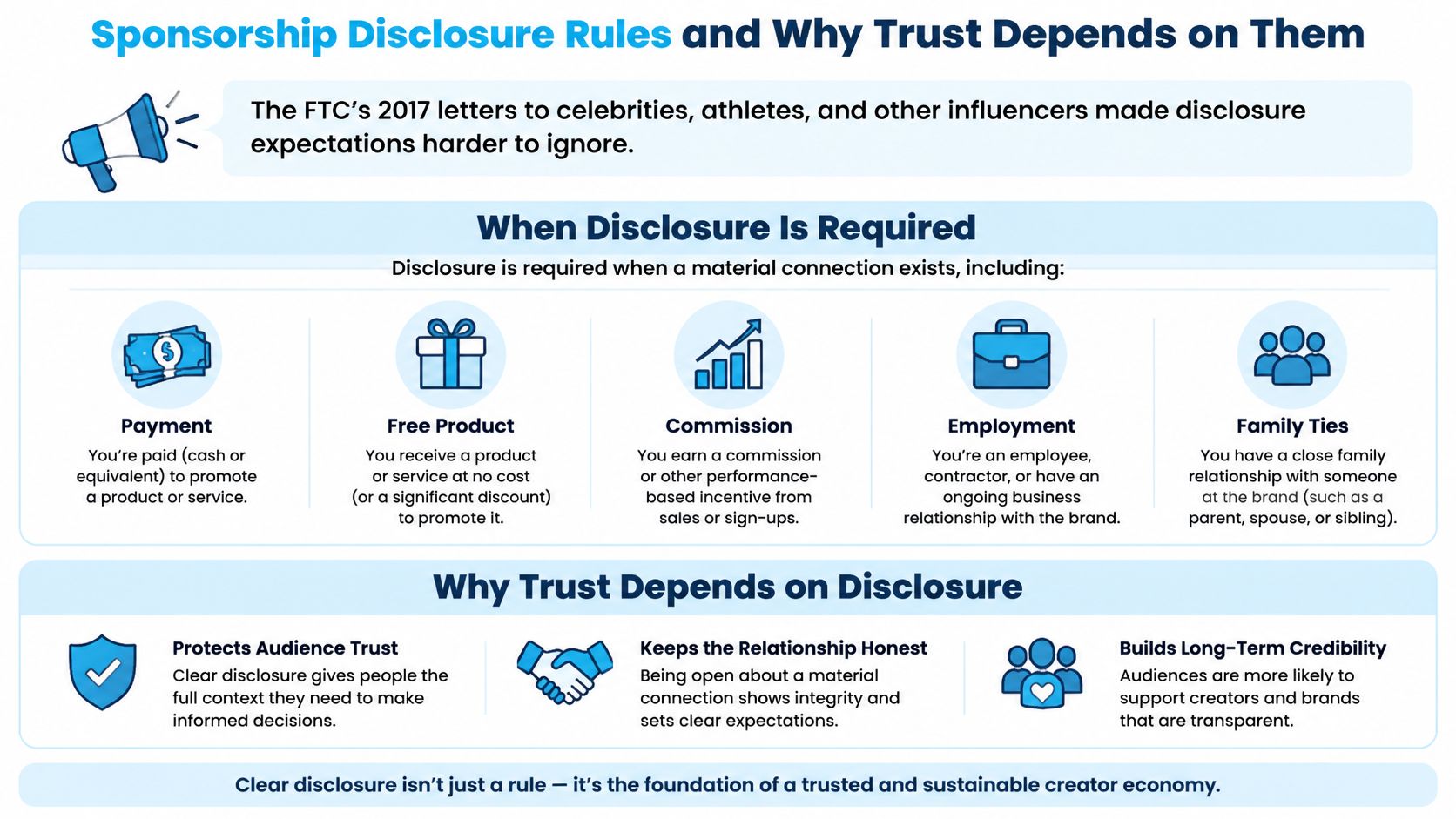
A common beginner mistake is treating disclosure as a hashtag you add when a brand insists. The rule reaches further. A material connection triggers it, and that covers payment, free product, commission, employment, or family ties. Disclosure works like an ingredient label on food packaging: it tells the audience how to weigh what they are about to take in.
In April 2017, the U.S. Federal Trade Commission's reminder to influencers and brands said staff had sent more than 90 letters to celebrities, athletes, influencers, and marketers after reviewing Instagram posts. The agency warned that disclosures should appear above Instagram's "more" cutoff rather than being hidden below it or buried among hashtags and links.
The infographic below separates the connections that trigger disclosure from the trust reason behind the rule.
Later enforcement kept returning to that same question of visibility. The agency has challenged paid Instagram promotions where viewers had to tap "more" before any mention of payment appeared, and it has warned trade groups and health influencers over posts where the commercial relationship behind the endorsement was unclear. A disclosure that exists but goes unseen gets treated as no disclosure at all.
What to do and what to avoid
- Place disclosure first: Put it in the first caption line or first spoken words, before the endorsement gathers momentum.
- Keep it visible: Don't bury it among hashtags, links, or text viewers must expand.
- Repeat it across segments: Each Story or Reel segment should still make the commercial relationship clear.
- Don't rely on platform labels alone: A paid-partnership tool doesn't replace the creator's and brand's own responsibility.
- Explain the experience: State honest likes and dislikes so the label is supported by a credible review.
Responsibility sits with both creator and brand. A brand can't outsource the risk by saying the creator forgot, and a creator can't hide behind a vague brief.
A generic label can satisfy the visible form of the rule without persuading anyone that the recommendation is honest.
That is why disclosure belongs in your performance thinking, not only in a legal checklist. Clear disclosure removes ambiguity, but belief comes from specifics, limits, and consistency with the creator's past opinions. A plainly labelled post can still convert when the endorsement carries real detail, while a hidden sponsorship that surfaces later can damage the creator's credibility and the brand's at once. Missing disclosure also isn't definitive proof of misconduct by itself, because context matters. Before approval, check placement, wording clarity, and persistence across formats on every post.
Campaign Metrics Brands Use and How to Calculate Them
Metrics become misleading when you read them one at a time. A post can reach many people, earn weak saves, and still produce sales through a strong offer. Another can spark comments and send almost nobody to the product page.
| Metric | Formula | What it reveals |
|---|---|---|
| Reach | Unique accounts that saw the post | Size of the audience actually exposed |
| Engagement rate | Interactions ÷ followers × 100 | Response relative to audience size |
| Engagement rate by views | Interactions ÷ views × 100 | Response among people who watched, useful for Reels |
| Saves and shares per 1,000 views | (saves + shares) ÷ views × 1,000 | Intent to return or recommend |
| Click-through rate | Link clicks ÷ reach × 100 | Interest in the offer |
| Conversion rate | Tracked purchases ÷ link clicks × 100 | Sales effect, needs tracked links or codes |
| Cost per sale | Creator fee ÷ tracked purchases | Cost efficiency across creators |
Measure every post at the same age after posting. A Reel checked after three hours and another checked after three days aren't comparable, even if both use the same formula.
Segment before you compare
Don't judge sponsored posts against a creator's organic baseline as if they're the same kind of content. Split posts into three classes, organic content, disclosed sponsorship, and undisclosed sponsorship, then calculate rates separately by class and creator tier.
A 2026 academic study comparing influencer-generated content with sponsored posts found that, among macro-influencers, clearly disclosed sponsored content was positively associated with views, likes, and shares, with reported coefficients of 0.4567, 0.5509, and 0.6242 respectively, each statistically significant at p ≤ 0.01. The same study found that non-disclosed sponsored content produced lower engagement across five measured outcomes, while the negative association was especially pronounced for mega-influencers.
Read that carefully. The results are correlational, so they don't prove disclosure alone caused higher engagement. They provide a benchmark to test with matched creators, equivalent formats, and outcomes decided before launch. Disclosure may reduce ambiguity, while hidden sponsorship may look deceptive once viewers notice it, but your campaign still needs its own test.
Normalised measures make creators of different sizes comparable. Use views per follower, shares per view, comments per thousand views, and bookmarks per thousand views alongside the table's rates. Our Instagram analytics API for engagement and account statistics can supply public account inputs for that comparison.
Attribution rule: Engagement shows response, not purchases, so use unique discount codes or tracked links whenever sales are the goal.
That final distinction protects your budget. Likes can justify more testing. Only tracked revenue, leads, or another agreed conversion can justify calling a creator profitable.
Worked Creator Comparison and the Second-Post Test
One sponsored post can make a creator look brilliant or useless by accident. Timing, a lucky share, or two enthusiastic buyers can swing the result. The hypothetical comparison below shows why you shouldn't scale from that evidence alone.
| Metric | Creator A | Creator B |
|---|---|---|
| Followers | 20,000 | 180,000 |
| Interactions | 1,000 | 3,600 |
| Engagement rate | 5% | 2% |
| Reach | 8,000 | 40,000 |
| Link clicks | 40 | 400 |
| Tracked sales | 4 | 12 |
| Fee | $600 | $2,400 |
| Cost per sale | $150 | $200 |
Creator A is cheaper per sale and engages more intensely relative to followers. But four sales is a small sample. Two extra purchases would change the cost per sale sharply, and two fewer would make A look poor.
Creator B reaches five times as many people and produces a larger sales sample. Its lower engagement rate and higher cost per sale might still be acceptable if those buyers are better matched or spend more later. You don't know that from one post either.
Run a second post from each creator under the same conditions and measure both at the same age. Before scaling, check audience geography against your target market and confirm each disclosure sits above the cutoff.
Scale the creator whose cost per sale holds across both posts. A one-post winner may lose the second test, and a higher-cost creator may become the better buy once enough sales arrive.
Pre-Signing Checklist and Data Sources
Use this checklist before you sign, not after the first post disappoints you. Each item converts a vague impression into a decision you can revisit.
The desk checklist below is a visual reminder to complete the checks while the agreement is still changeable.
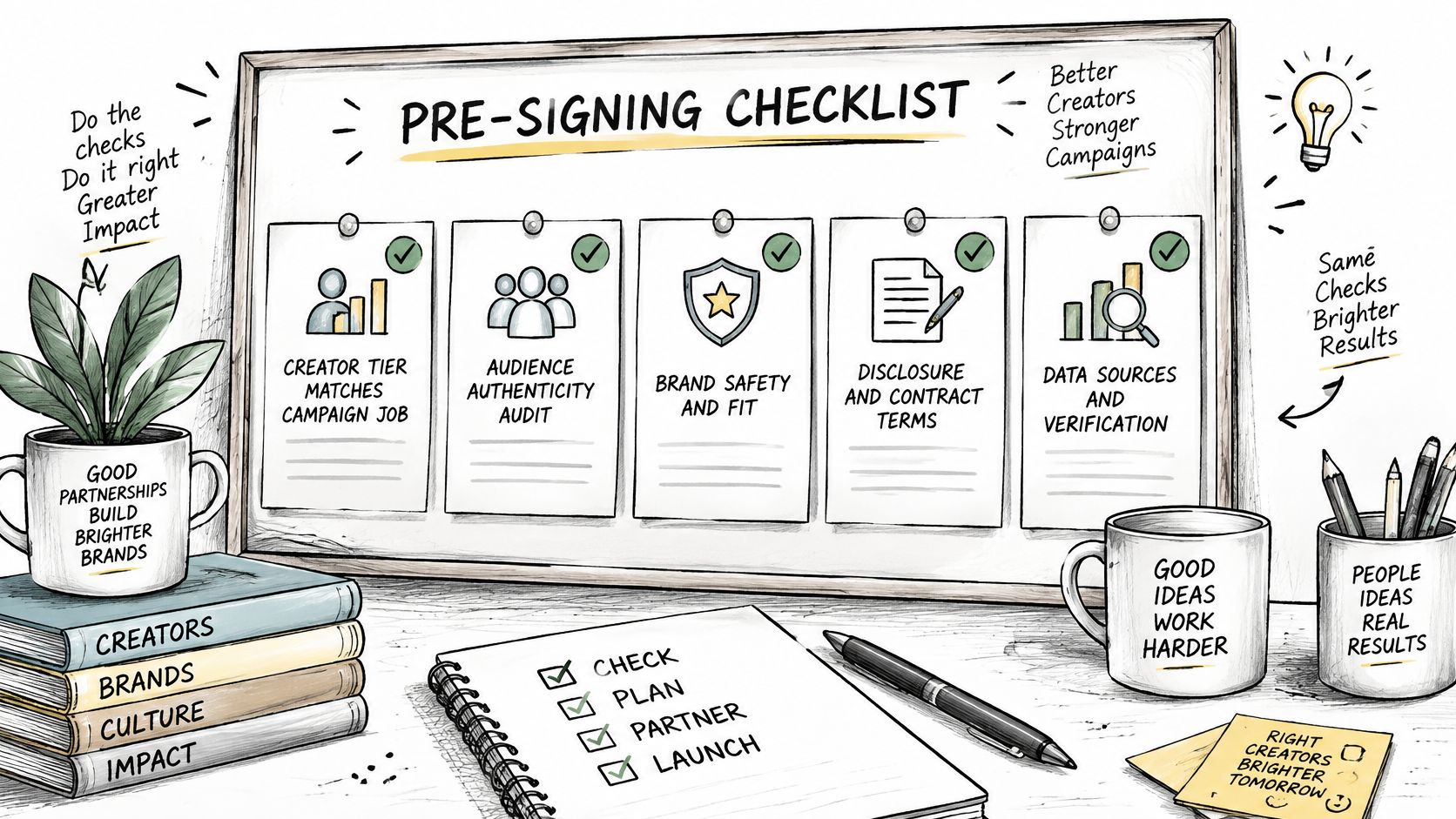
- Match tier to job. Confirm the creator's tier suits testing, conversion, or awareness.
- Audit the audience. Check geography, engagement concentration, and comment sentiment against your buyer.
- Write disclosure into the contract. Require placement above the cutoff on every post and segment.
- Define metrics before launch. Agree the formulas and separate organic, disclosed sponsorship, and undisclosed sponsorship posts.
- Record commercial terms. Write down usage rights, exclusivity, deadlines, and the measurement window.
Where the evidence comes from
Start with the creator's media kit, insights they share voluntarily, and manual review of recent posts and comments. Third-party analytics can add public account data at scale. An Instagram data API is one option, and our Instagram search API for finding users, hashtags, and locations supports discovery before deeper checks.
We provide insight endpoints for engagement rate, best time to post, account stats, fake-follower audit, lead fit scoring, profile summary, and niche classifier. Our account age and country check is built for fraud and trust checks, influencer vetting, and account-marketplace due diligence.
Use those outputs with their limits in view. Registration country isn't the same as current residence, and our API is unofficial and not affiliated with Instagram or Meta. Treat each result as one input to a review, not a verdict.
Shortlist three creators, run the audit and a two-post test on each, then sign the creator whose audience fit and cost per sale hold up across both posts.
Before your next creator test, use Instagram API to check public profiles, engagement, account history, and follower quality in one workflow. Bring three shortlisted usernames, run the audits side by side, and let audience fit and repeat performance decide who earns the contract.
Pull Instagram data with one API call
Profiles, posts, reels, followers and more. 50 free credits, no credit card.
Get your free key