
Bot Accounts on Instagram Signals and Risks
Bot accounts on Instagram can fake reach and damage trust. See which signals point to automation, bought engagement, or a real audience.
Spot a strange follower ratio, declare the account a bot, and move on. That's the most popular advice about suspicious Instagram profiles, and it's the advice most likely to get a brand team into trouble. It brands quiet real people as fake, clears polished fakes that look normal, and treats five different problems as if they were one.
A suspicious profile is a confidence problem, not a yes or no label. Automation, purchased engagement, a compromised human account, and a coordinated network can all leave a similar first impression while calling for very different decisions. Your job isn't to win an argument about whether software touched an account. It's to decide, with dated evidence, whether you can trust the reach, the comments, and the person you're about to pay.
Keep one line clear as you read. A clue is something you can see on a public profile. A verdict is a business decision you can defend later. Bot accounts on Instagram sit between those two points, and the gap between clue and verdict is where most mistakes happen.
Table of Contents
- Why Bot Accounts Undermine Instagram Credibility
- Signals Used to Assess Suspicious Activity
- How Manufactured Engagement Outruns the Bot Count
- Why a Bot Verdict Hides Several Different Risks
- Enforcement Totals and the Evidence to Keep
- Verify Account History Before You Trust Reach
Why Bot Accounts Undermine Instagram Credibility
Say a brand manager is about to pay a creator. The follower count is large, recent posts are full of likes, and the comments look enthusiastic. On a second pass, the same short praise appears under every post, the likers have almost no original content, and the audience can't explain who would buy the product. The numbers were real numbers. They just didn't measure demand.
A bot account is a profile run by software, or by someone controlling many profiles at once, used to post, follow, like, or comment so the wrong party appears to be speaking or so content looks more popular than it is. That definition matters because the harm isn't only a fake profile existing. The harm is what other people conclude from it.
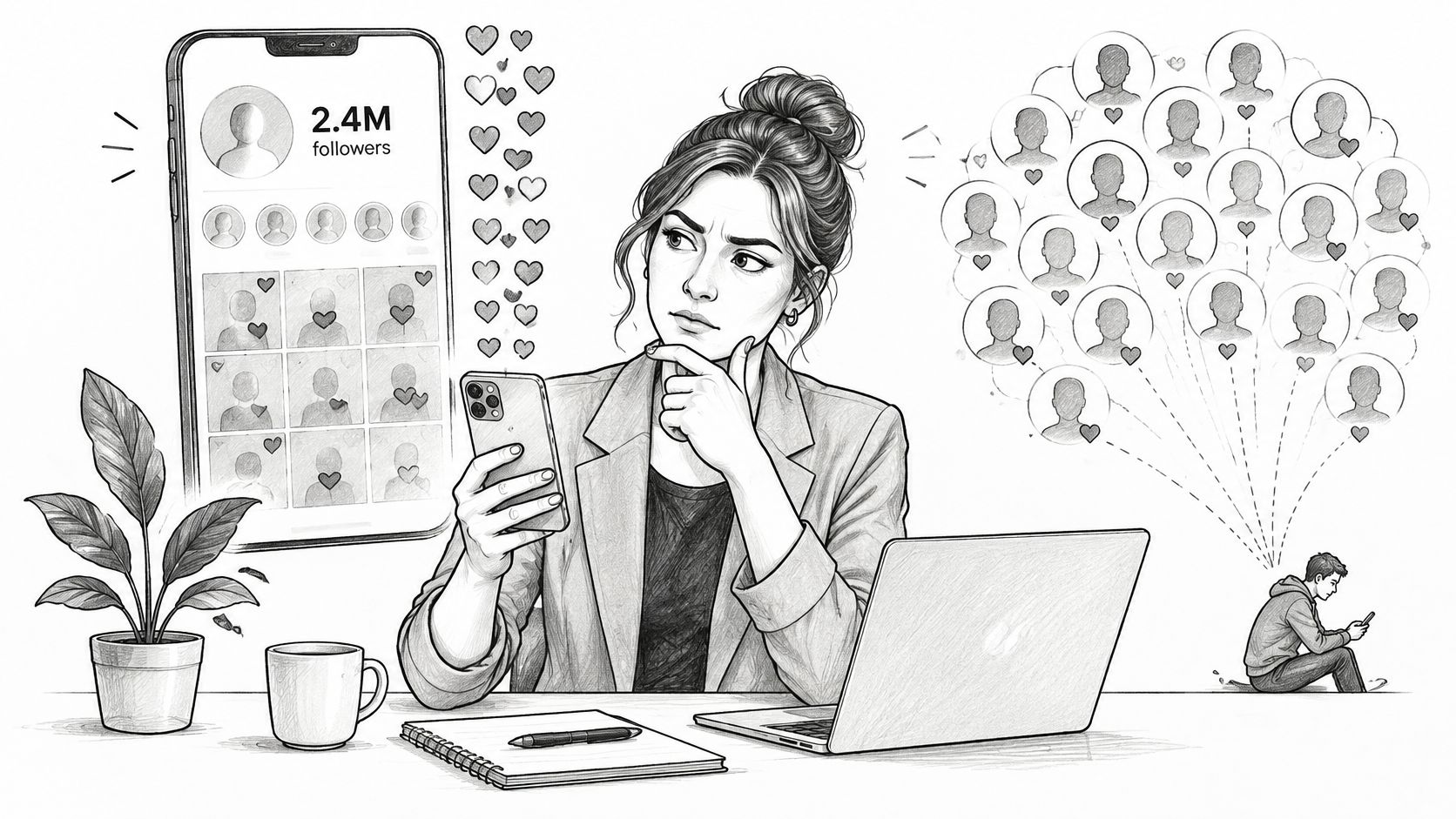
Think of it as a stage with three roles. One puppet is a fake identity, a face with no matching person behind it. A megaphone is artificial engagement, where likes and comments make a quiet post sound loud. A chorus is many accounts moving together, repeating the same line until it sounds like public opinion.
Those roles overlap, and a human can sit inside any of them. A stolen account can hold a megaphone. A real person who sold their credentials can join a chorus. Fully automated profiles can do all three jobs at once.
What a hollow audience actually costs
Once that happens, ordinary metrics stop doing their job. A follower total stops measuring interest. A comment stops proving that a customer cared. A partnership can buy impressions from accounts that will never see, want, or purchase the product.
A number can be accurately counted and still be false evidence about an audience.
One strange ratio doesn't settle the question either. A quiet real person can look empty, with no link, few posts, and a sparse bio. A compromised human account can look busy and established because its old history is genuine.
You need a scan you can apply to any public profile before trusting its numbers. Look at audience shape, content, history, and comment quality together, then decide how much confidence those clues earn.
Signals Used to Assess Suspicious Activity
Run this scan before you look at any model score or checker result. You're collecting visible patterns, noting what each one can support, and refusing to let any single pattern carry a ban, a payment hold, or a public accusation on its own.
Public signals for suspicious Instagram activity
| Signal | What it can suggest | What it does not prove |
|---|---|---|
| Following count several times the follower count | Mass following or growth hacking | That the account is automated |
| Empty bio with no name, niche, or link | A disposable or low-effort profile | That a real person is absent |
| Near-identical comments, emoji strings, or generic praise | Coordinated commenting | That every commenter is a bot |
| Likes or comments far above similar accounts, often in one burst | Bought engagement or a real viral spike | Fraud without a second check |
| Account only weeks old with sudden large reach | A fresh network or a compromised profile | That current posts are inauthentic |
| Several former usernames | Resale, evasion, or an ordinary rebrand | Malicious intent by itself |
| Many follows and almost no original posts | An amplification role inside a network | That a human never operated it |
| High follower count with generic comments | Weak audience quality | That the creator bought followers |
Start with audience shape. A following count several times the follower count suggests mass following, where an account follows widely hoping for follow backs. Real newcomers and community managers can do this too, so record the ratio and keep looking.
Next, check profile completeness. A bio with no name, niche, or link fits a disposable profile built quickly and cheaply. It also fits a private person who uses Instagram only to watch friends and never filled anything in.
Then read for comment texture. The same phrase, emoji string, or generic praise repeated across posts suggests coordination, especially when the words could sit under any photo. Specific comments that mention details in the post carry more weight, even when they're short.
Compare engagement against peers, not against your hopes. Likes that dwarf a creator's usual rate, or arrive in one tight burst, can be purchased. They can also follow a genuine viral moment, a giveaway, or a mention by a larger account. The burst earns a second look, not a verdict.
Reading age, names, and content together
Put account age next to reach. A profile only weeks old with a large audience raises a different question than a years old profile with a slow, uneven curve. Sudden reach needs a plausible story, such as an existing audience arriving from another platform.
Check username history with the same restraint. Several former usernames can point to resale or to evasion after enforcement. They can also show an ordinary rebrand, a name change, or a creator who finally secured a cleaner handle.
Weigh original content volume against following behavior. Dense following with almost no original posts fits an amplification role, where the account exists to boost others rather than publish. Finally, don't let a large follower count excuse thin comments. Hundreds of generic replies under a big account tell you more about audience quality than the headline total does.
If you want a guided walkthrough of the visual side of this work, the resource on how to identify fake Instagram accounts is a useful companion to this manual scan. For teams screening at volume, our fake follower checker API documentation shows how these public fields can be pulled in a structured way instead of copied from screenshots.
Close every scan the same way. Record what you saw and when you saw it. Require three or more independent signals before you escalate, and treat any single row as a question rather than a ban.
How Manufactured Engagement Outruns the Bot Count
When a takedown is announced, teams tend to stare at the number of profiles removed. That number is the smallest part of the story. The damage is the audience those profiles touched, because real people read the comments, saw the follower counts, and adjusted what they believed.
October 2020 networks and the audience they reached
| Operation | Instagram accounts removed | Related assets removed | Audience exposure |
|---|---|---|---|
| U.S.-origin network, October 2020 | 76 | 202 Facebook accounts and 54 Pages | About 22,000 people followed one or more Instagram accounts |
| Azerbaijan-origin operation, October 2020 | 437 | 589 Facebook accounts and 7,665 Pages | No comparable Instagram follower total stated for this operation |
The Meta October 2020 coordinated inauthentic behavior report states that Meta removed one U.S.-origin network consisting of 202 Facebook accounts, 54 Pages, and 76 Instagram accounts, and that approximately 22,000 people followed one or more of the Instagram accounts. In the same report, Meta described an Azerbaijan-origin operation in which 437 Instagram accounts were removed alongside 589 Facebook accounts and 7,665 Pages.
Read those rows slowly. Seventy six Instagram accounts is a small meeting room. Twenty two thousand followers is a town. If you count only profiles, you underestimate how many people saw manufactured social proof and treated it as genuine popularity.
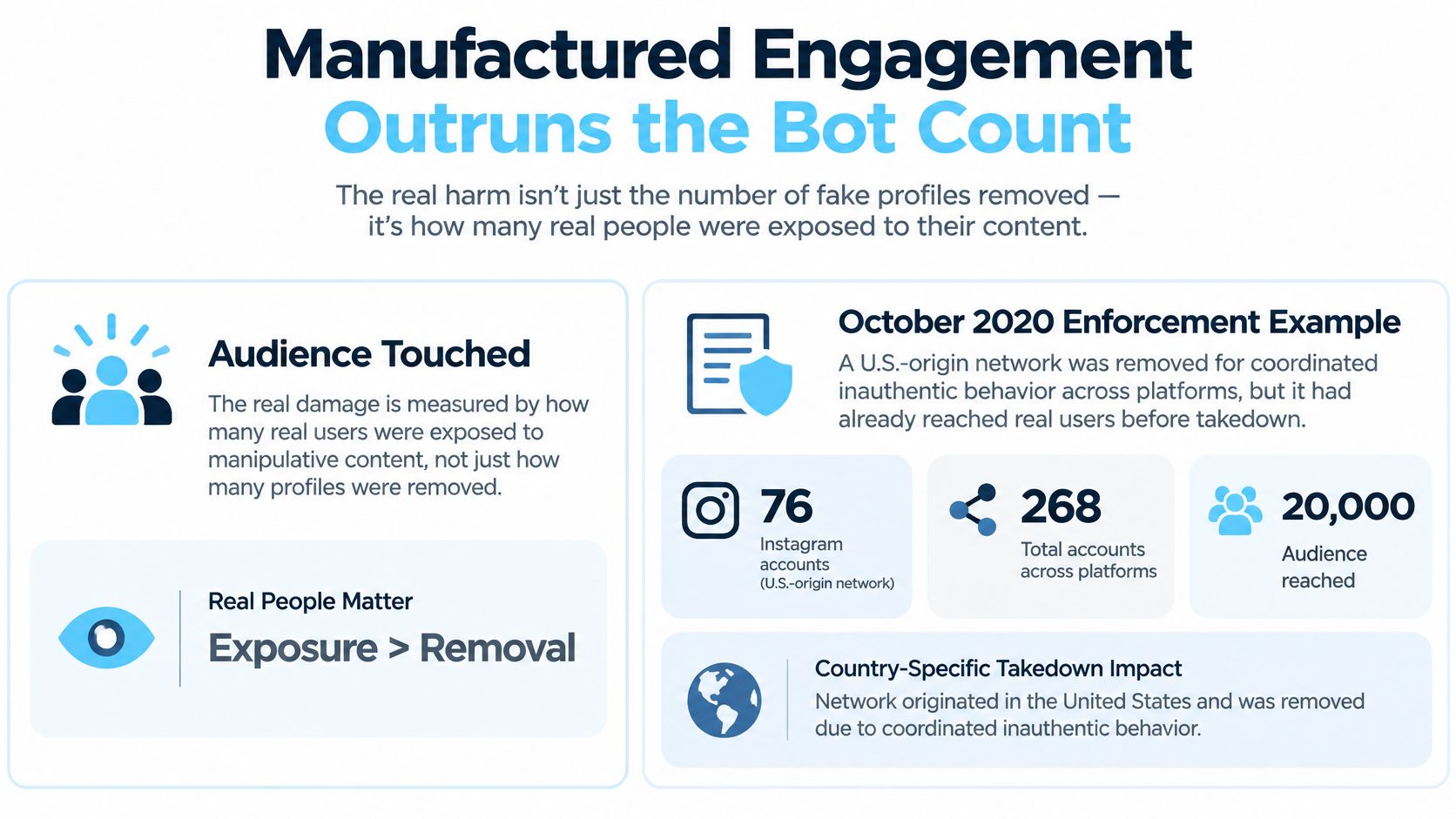
The second lesson is about what the accounts did. The people behind the U.S. network used fake accounts to comment on other users' content, and many of those accounts had already been automatically removed by Meta's systems. Bots aren't limited to publishing their own posts and waiting for an audience to find them.
Coordinated commenting is often the more valuable tactic. A comment sits under someone else's trusted content, borrows that creator's audience, and makes a claim, a product, or a narrative look widely endorsed. The original poster may have done nothing wrong.
Think of a quiet shop with a few hired applauders at the door. Passersby don't count the applauders. They hear noise and conclude the shop is busy. A small set of accounts can create that impression for everyone who walks past a post.
That's why follower totals and visible likes can't be read as audience quality without checking who produced them and when they arrived. If you're comparing creators, look at the pattern behind the engagement, a habit supported by the structured fields in our profile engagement insights documentation.
Count the audience exposed, not just the profiles removed. A small network can manufacture a large impression.
Before you price a partnership, ask a plain question. If the loudest comments disappeared tomorrow, would this post still look wanted by real customers? If you can't answer that from the evidence you've saved, you don't have an engagement rate yet. You have a display.
Why a Bot Verdict Hides Several Different Risks
Calling every odd profile a bot feels decisive. It also erases the information you need to act fairly. A purchased like burst, a stolen account, and a sleepy real audience may all disappoint a brand, but they don't call for the same response, and they don't carry the same blame.
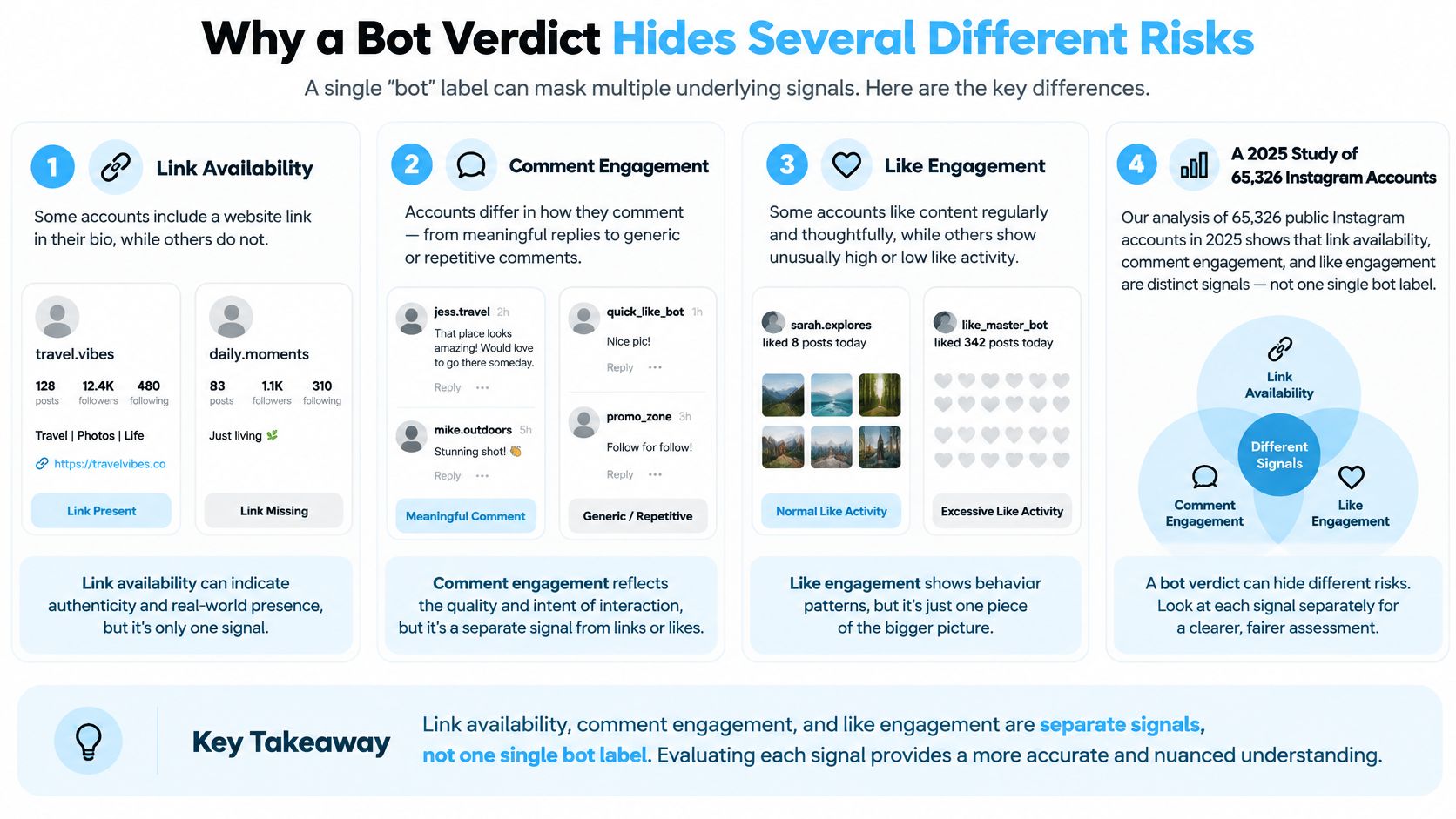
The 2025 study of 65,326 Instagram accounts reported that link availability, comment engagement, and like engagement were among the most predictive features, with its strongest model achieving F1 scores of 0.91 for real accounts and 0.90 for fake accounts. Those scores show that public features can separate classes inside a labeled set. They don't show how many accounts on Instagram are bots.
There's a second caution inside that result. The study notes that "fake users" can include genuine people who sell or surrender account credentials, so the category is broader than automated bots. A model can be accurate about its label and still leave you unsure who acted, or why.
Smaller benchmark sets deserve even more restraint. A balanced lab set, built with clear examples of each class, flatters a classifier in a way a messy live feed won't. High accuracy there tells you the signals carry information. It doesn't tell you your false positive rate among small creators in a new market.
Five verdict buckets and their decisions
| Bucket | Typical public evidence | Edge case | Decision |
|---|---|---|---|
| Automation | Scheduled posting or following at a machine rhythm | Real creator using a scheduling tool | Flag for review, do not label as fake |
| Purchased engagement | Likes or followers arriving in a burst unrelated to content | Popular human who bought a follower burst | Discount the metric and keep the account under review |
| Compromised or sold account | Old authentic posts followed by off-brand new comments | Stolen account whose history is genuine | Pause payment and verify with the account owner |
| Coordinated inauthentic behavior | Same narrative or comment pattern across linked accounts | Network members who are partly real people | Escalate and map linked accounts |
| Inactive or low-quality audience | Sparse bio, few posts, weak comment quality | Real micro-creator with a sparse bio | Lower the score; reach is weak, not proven fraudulent |
Name the bucket before you choose the action. Automation matters because software pacing can distort activity, yet a human using a scheduling tool is not a fake person. Purchased engagement means you should discount the metric, even when the creator themselves is real and reachable.
A compromised or sold account is the bucket binary tools handle worst. Say an account posted family photos for years, then suddenly pushes off brand comments in a new voice. The history is authentic and the current operator may not be. Verifying with the owner protects a victim instead of punishing them.
Coordinated inauthentic behavior shifts your focus from one profile to linked accounts repeating a pattern. An inactive or low-quality audience is different again. It lowers the value of reach without proving fraud, which matters when you're pricing rather than accusing.
Replace the binary label with a risk score, a short reason, and a confidence level. Dense following plus low original content is a reason a reviewer can check. Bot, by itself, is not.
False positives can damage legitimate creators who can't easily prove a negative. False negatives can make a brand pay for artificial reach. Naming the bucket keeps both errors visible, and it tells the next reviewer exactly what would change your mind.
Enforcement Totals and the Evidence to Keep
Enforcement numbers look like answers. Used carelessly, they become a shortcut that replaces account level evidence with platform scale. Used properly, they teach you what kind of problem you're dealing with and why you still need your own record.
Start with a milestone that changed how the problem was framed. The Meta March 2021 coordinated inauthentic behavior report states that Meta removed 14 CIB networks operating across 11 countries, including 290 Instagram accounts, 255 Facebook Pages, and 34 Facebook Groups. Bot activity there wasn't treated as isolated spam. It was treated as organized, cross border manipulation.
Read the scope carefully. Those counts cover accounts connected to a detected operation, not a census of every automated profile on Instagram. Enforcement can also remove authentic accounts, Pages, and Groups directly involved in the coordination, because fake accounts are central to these operations but real participants can join them.
That distinction gives you three categories that can overlap without being identical. Automated behavior describes how actions are produced. Fake identity describes who the account claims to be. Coordinated manipulation describes accounts working together to mislead an audience. An account can show one without the others.
What large totals can and cannot tell you
The scale since then is far larger, and it still doesn't settle a single profile. Meta's policy enforcement page states that Meta took action against 692 million fake accounts in Q3 2025 and 1.1 billion in Q4 2025 on Facebook globally, while stating that 99.9% of Q4 removals were proactively detected. Meta also reported removing 10.9 million accounts associated with scam centers in Southeast Asia and the Middle East during 2025.
Use those figures only as scale. They show that automated enforcement operates at enormous volume and that scam operations are industrial, not artisanal. They don't provide a comparable public estimate of Instagram's remaining bot population.
They also don't give you an account level confidence score, a false negative rate, or a promise about the creator in your spreadsheet. A network can be created, adapted, or compromised after your check. Platform removal is an integrity action. Business risk management is your own, separate job.
The absence of enforcement is not proof of authenticity, and a later removal is not proof that every past interaction was automated.
That second limit protects you in disputes. If an account is removed months after a campaign, you can't claim every like it ever delivered was software. If it was never removed, you can't claim Meta certified it genuine. Your dated evidence is what fills the space between those two overclaims.
The evidence record to keep after a suspicious finding
Keep the record while the profile is still visible, because posts get deleted, usernames change, and follower lists move. A folder you build in ten minutes today can save a payment argument you would otherwise lose from memory.
- Save the visible profile. Capture screenshots or exports of the profile, follower and following counts, recent posts, and repeated comments, with the date each item was seen.
- Note the history markers. Write down account age, former usernames, and the day the anomaly first appeared, so a later reviewer can separate old behavior from new behavior.
- Compare across checks. Record engagement quality at several points over time rather than relying on one inspection, including whether comments stay specific or turn generic.
- Map linked accounts. Look for other profiles pushing the same comment, narrative, or spike, and save how they connect through timing, wording, or shared audiences.
- Recheck before payment. Run the scan again before money moves on a live campaign, because a clean check at shortlisting doesn't cover the week of delivery.
Write your conclusion in the same file, in plain words. State which bucket you suspect, which three or more signals support it, what would weaken your suspicion, and what decision you took. That short paragraph turns a screenshot pile into evidence another person can audit.
Pay special attention when a campaign spans languages or regions. A comment pattern that looks generic in translation may be copied word for word in the original language, and linked accounts may operate across platforms. Saving the original text, not only your summary of it, preserves the detail that makes coordination visible.
Verify Account History Before You Trust Reach
The decision usually arrives in an ordinary form. You're about to pay an influencer, report an impersonator, or follow up a lead that came to you only as a username. That is the moment to slow down, not after the invoice clears.
Pause if your scan produced three or more independent clues, if engagement appeared in a burst with no matching content event, or if the account can't show a plausible history for its reach. Proceed with ordinary caution when the oddity is a single weak clue on an otherwise consistent profile. A sparse bio alone shouldn't end a partnership.
The history worth checking is public and month level, not a secret exact date. Look for the creation month and year, the account's age in years, its country of registration as distinct from current residence, whether the username ever changed, any former usernames, and verification status. Instagram reveals creation only to the month, so no honest workflow should demand an exact day.
We expose Instagram's About this account transparency panel together with the full public profile in one call, including creation month and year, age in years, country of registration, username change history, former usernames, and the verified badge. Our Account age & country API is built for fraud & trust checks, influencer vetting, and account-marketplace due diligence. It returns public data only and never opens private or protected accounts, and our service is unofficial and not affiliated with Instagram or Meta.
Pair that history with your saved engagement record. Our profile audit insights documentation is useful when you're deciding which fields to store alongside your screenshots, so the file stays comparable from one check to the next.
- History agrees with content: An older account, a stable name, and a slow audience curve support proceeding with normal contract protections.
- History disagrees with content: A young account with sudden reach, several former names, and burst engagement needs a human review before payment.
If history, content, and audience quality point in different directions, don't pay for the reach until a person reviews the file. That's not an accusation against the creator. It's a refusal to price an audience you can't yet describe.
Before your next creator payment or impersonation report, pull the public account history behind the username, including creation month and year, registration country, former usernames, and verification status, and save it beside your engagement evidence. Visit Instagram API to run that check in one call and make your next trust decision from a record you can show, not a follower count you have to take on faith.
Pull Instagram data with one API call
Profiles, posts, reels, followers and more. 50 free credits, no credit card.
Get your free key