
10 Influencer Marketing Platform Options Compared for 2026
Compare 10 influencer marketing platform options on creator discovery, campaign management, performance measurement, and audience-quality analysis for 2026.
The creator list looked solid on paper. Twelve names, follower counts between 40,000 and 300,000, media kits with clean screenshots, and a spreadsheet column labeled engagement with nothing underneath it to say what the denominator was. Six weeks into the campaign, three of those accounts turned out to have audiences that barely responded, and one had been a travel account until it pivoted to beauty that spring, keeping every follower it picked up on cheap hotel content.
Choosing an influencer marketing platform is mostly a decision about four jobs: finding relevant creators, running the campaign without dropping deliverables, measuring what happened, and checking whether the audience is real. Most buyers judge the first two during a demo and discover the last two after they've paid. The industry's spending makes that mistake expensive. Statista estimated the global influencer marketing industry at approximately $24 billion in 2024, up from about $9.7 billion in 2020, according to its market size estimate.
The ten options below are compared on those four jobs rather than on feature counts. Each entry names the team it suits, the cost or sales-process barrier to expect, and the checks to run before you trust the numbers a dashboard puts in front of you.
Table of Contents
- 1. GRIN
- 2. Aspire
- 3. CreatorIQ
- 4. Upfluence
- 5. Modash
- 6. HypeAuditor
- 7. Traackr
- 8. Later Influence
- 9. Influencity
- 10. Heepsy
- How the Influencer Marketing Platforms Compare on Core Workflow Criteria
- Choosing a Platform by Verification Needs, Not Feature Lists
1. GRIN
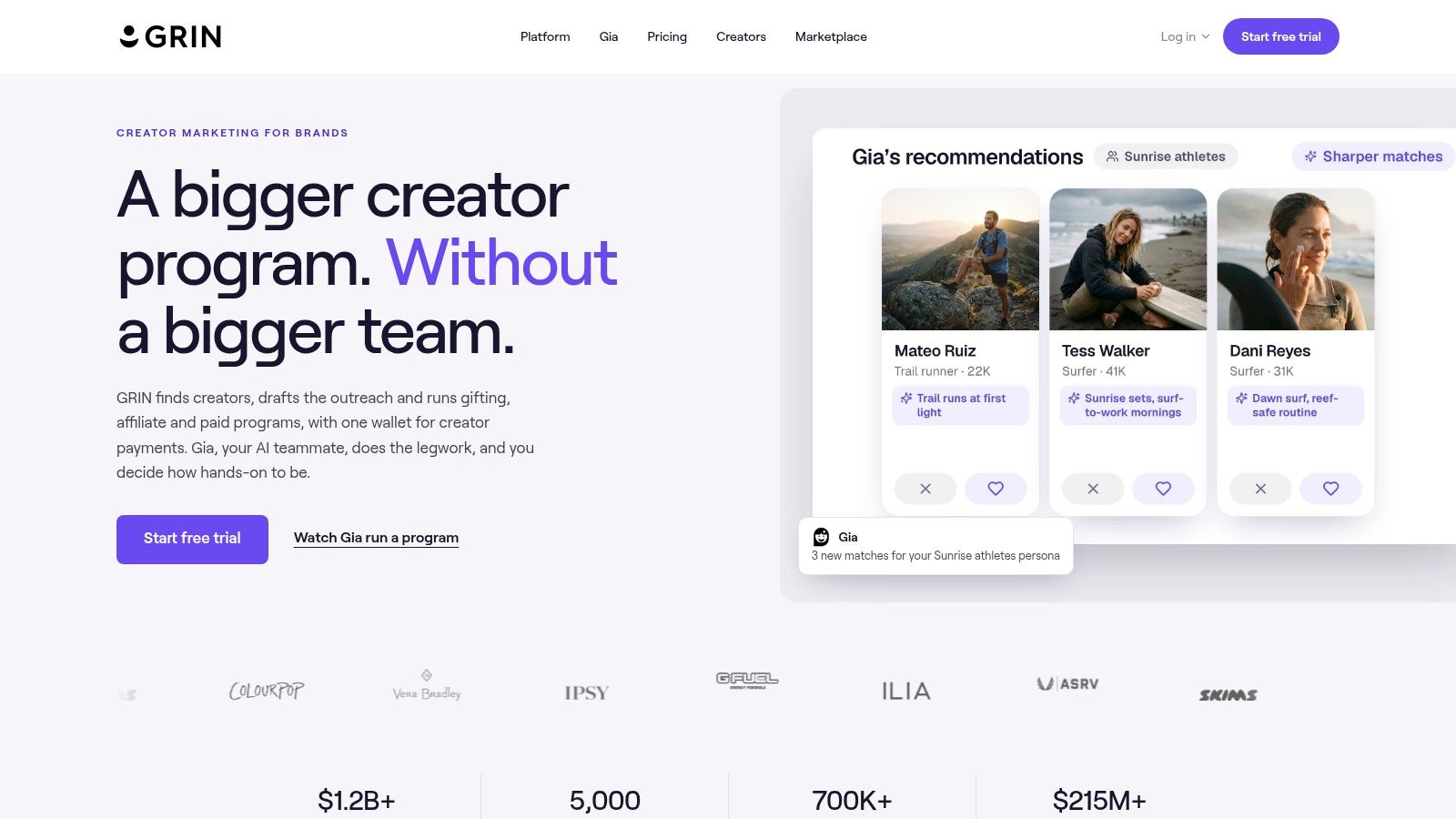
GRIN fits an ecommerce brand that already sells through Shopify and wants creator partnerships run as a channel, not a string of one-off posts. Discovery, relationship management, gifting, affiliate links, sales tracking, and creator payments sit in one system, and order data flows back from the store, so a shortlist can be judged on revenue per creator rather than reach.
Most of the value lands in the tedious middle of a program:
- Seeding at volume: a hundred packages out and twenty posts back, tracked without a shared inbox.
- Draft approvals: creator content reviewed where the brief already lives.
- Payments: creator payouts without a finance ticket for every single person.
GRIN's platform publishes its plans, which is rarer than it should be, so you can build a budget before anyone gets on a call.
Two costs matter more than the headline number. The subscription is advertised. The management fee on creator-wallet deposits is the part teams forget when they model spend at scale. And the feature set runs wide enough that a three-person team pays for affiliate infrastructure it never configures. If your program is ten creators a quarter on flat fees, a lighter tool and a careful spreadsheet will cost less.
Platform choice and platform strategy aren't the same question. This guide to working across influencer social media channels helps you work out where a creator's audience lives before you commit budget to reaching it.
2. Aspire
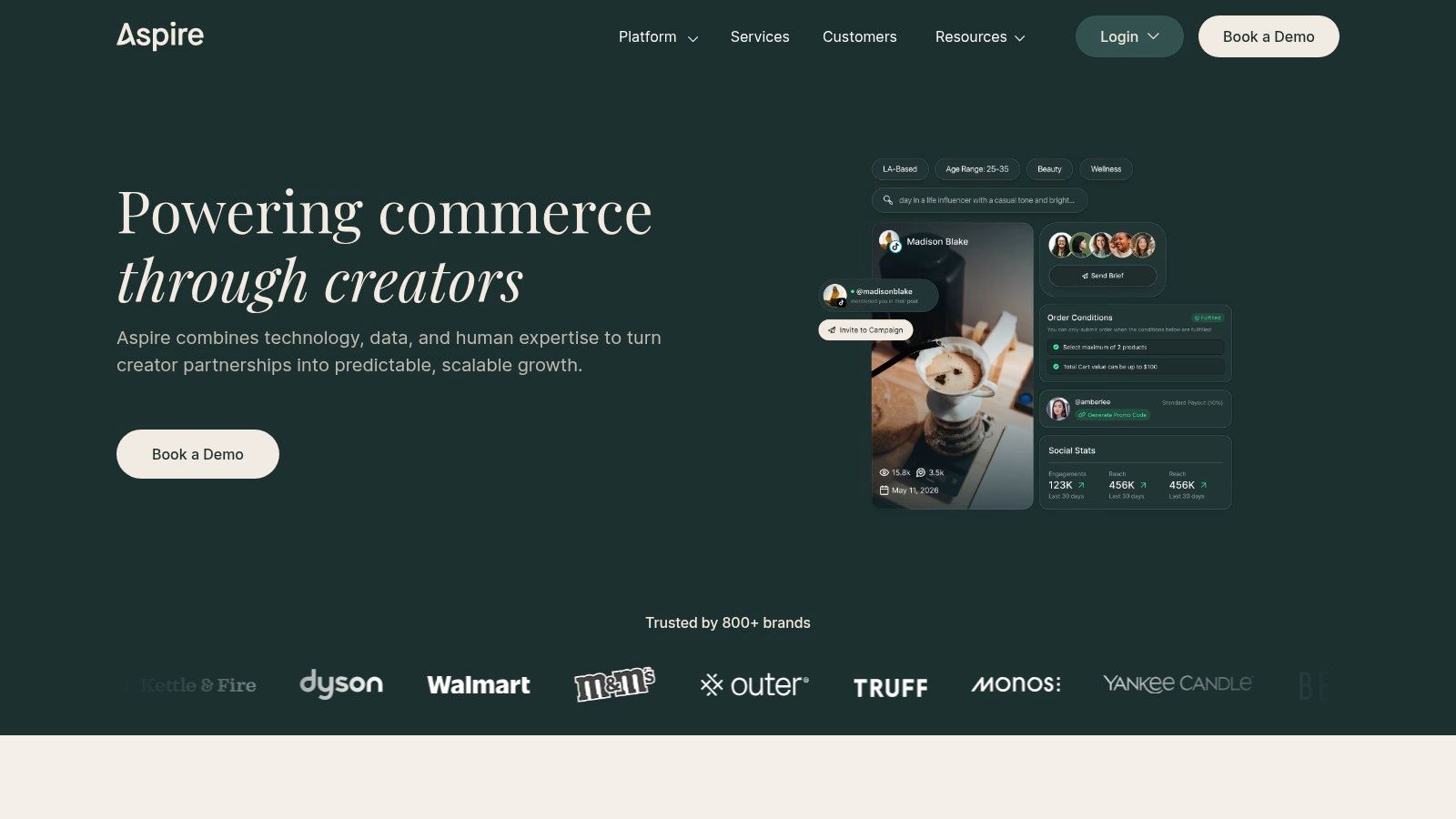
Aspire's angle is community. Rather than only hunting through a database, brands open an opt-in Creator Marketplace and let creators apply, which moves some prospecting onto the people who want the partnership. The model has history behind it. The record of how influencer marketing platforms developed traces marketplaces to PayPerPost in 2006, which paid bloggers for branded content, before the structure reached social networks through SocialSpark in 2008 and SponsoredTweets.com in 2009.
Operationally, Aspire handles influencer, ambassador, affiliate, and product-seeding programs, keeps a content library for reusing creator assets, connects to Shopify, and sells managed services for brands that want execution rather than software. The content library matters more than it sounds. A creator who produces six usable assets from one shoot pays for the relationship twice.
Two things to weigh. Standard pricing isn't posted, so a sales conversation comes before the budget. And a marketplace is only as useful as the creators who opt into it. If your niche is narrow, search quality carries the program and the application flow adds little.
Ask before signing: what the annual floor is, whether managed services are bundled or billed on top, and what happens to unused credits at renewal.
3. CreatorIQ
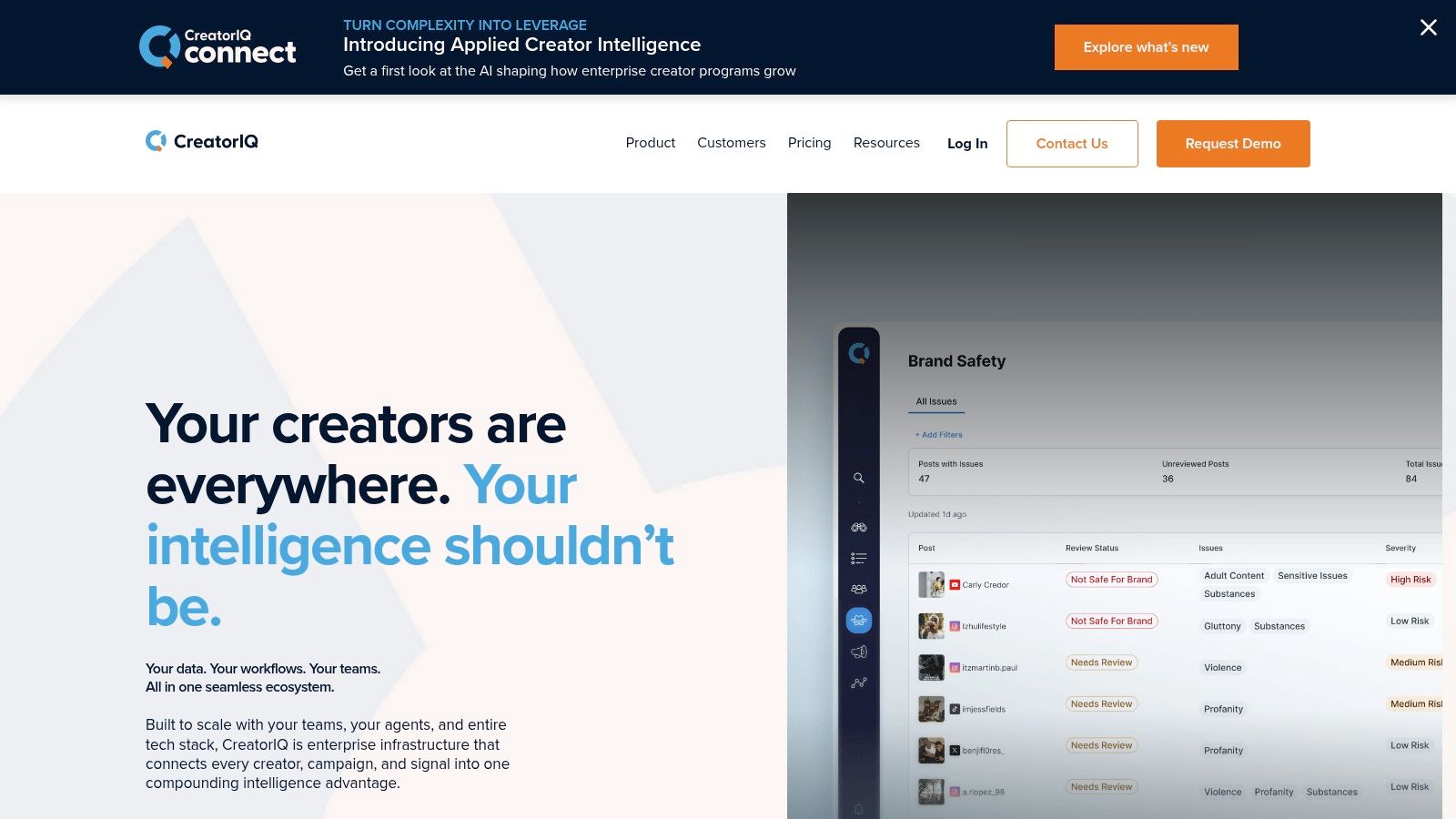
CreatorIQ is aimed at the organization where three brands, two regions, and a central team all need the same creator records. Discovery, vetting, monitoring, campaign execution, program-level reporting, and competitor benchmarking sit in one place, with role-based workflows so a regional lead and a global brand director see consistent data.
The market it sells into is enormous. Grand View Research's estimate of the influencer marketing platform market puts it at $34.2 billion in 2025, projecting $116.2 billion by 2033 at a 14.4% compound annual growth rate, with search and discovery taking 33.9% of the market. Enterprises accounted for 75.3% of revenue in the same estimate.
Governance is the product
What you're buying is consistency: the same scoring logic across markets, lookback monitoring on creators after a campaign ends, and API connections that push creator performance into a BI stack or data lake. That last part is also the cost. Integrations are only as good as the analyst who maintains them, and a team without one ends up exporting spreadsheets and calling it a data strategy.
Pricing is quote-based and enterprise procurement moves slowly. Small teams and occasional campaigns should look elsewhere. The platform's strengths are wasted when there is nothing to govern.
4. Upfluence
A retail brand already holds the buyer list. Upfluence's useful move is matching those customers to creators who also have an audience worth a partnership, then running discovery and outreach on the same ecommerce spine. Search covers the major networks. The first message is warmer than a cold database query, because the creator already buys from you or follows people who do.
That match is the discovery test. Campaign work stays modular, so a team can take discovery and outreach without the rest of the stack. Higher-tier setups add payments in multiple currencies. Measurement is the sales view that ties creator activity to store results. Before you trust those numbers, the audience check is simple: are the matched accounts in your order file?
Pricing arrives as a quote. Plans often carry a multi-month minimum commitment, so ask for the term and the exit clause in writing before the trial starts. What you get on day one is a configured trial after an initial call, not a self-serve sandbox.
Point the existing-customer search at your own orders during that trial and read the match rate. A poor match means the ecommerce story is marketing rather than mechanics. Awareness-led teams with no store to connect will find half the product idle.
5. Modash
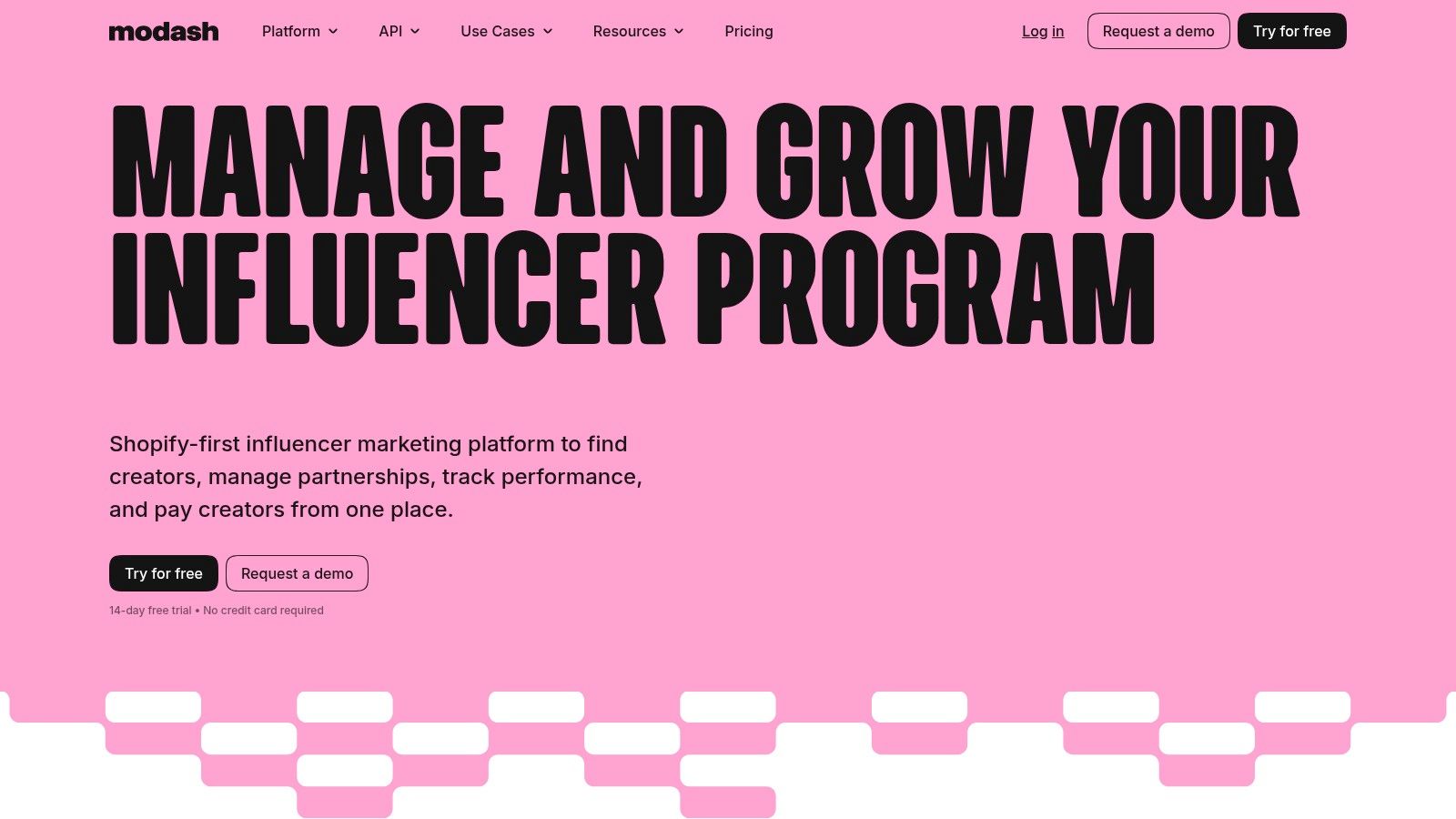
A two-person team that needs a shortlist this week, not after procurement, will see what Modash puts first. Search runs on a large creator database, with a CRM, profile evaluation, outreach, and content tracking behind it.
Published plans let you compare cost before a call and start small. Monthly profile views decide how many accounts you can inspect. Emails you can reveal are usually the binding limit, not search. Tracked-creator allowances decide how many relationships you can follow, which matters more than how many profiles you can find.
That mix suits a discovery-heavy team of one to five. Shopify, gifting, affiliate management, and payments appear on applicable plans only, and an MCP connection lets AI tooling query the data. Content tracking measures performance. Audience-quality work holds only when view caps cover the accounts you will judge. A six-market program will outgrow it. Before trusting the numbers, confirm views cover the shortlist, email access lasts past the first wave, and tracked creators match the roster you report on.
6. HypeAuditor
HypeAuditor is the option to reach for when the question is whether an audience is real. Discovery across Instagram, YouTube, TikTok, Twitch, and X sits alongside audience demographic analysis, fraud and suspicious-engagement detection, and campaign reporting, so vetting and execution share one record.
Benchmarks help you interpret what the scores find. Sprout Social's 2024 benchmark report, drawing on an analysis of 20.4 million Instagram posts, put the average Instagram engagement rate at 2%, against 2.46% for TikTok, 0.86% for YouTube, and 0.18% for Facebook. A creator sitting at 0.4% on Instagram is not underperforming by a small margin. That's a different relationship with the audience.
Read the denominator
An engagement rate means nothing without its base. Engagements divided by followers is not the same as engagements divided by reach or views, and a 30-day window is not a 12-month window. Ask any platform which denominator and window it uses, then confirm the definition stays consistent when you compare creators across networks.
Quality scores are estimates, not verdicts, and advanced features depend on your plan and usage limits. Pair platform scores with comment reading and audience geography, and treat fake-follower percentages as one input. This breakdown of how fake followers hide in normal-looking accounts shows why a single ratio can mislead.
7. Traackr
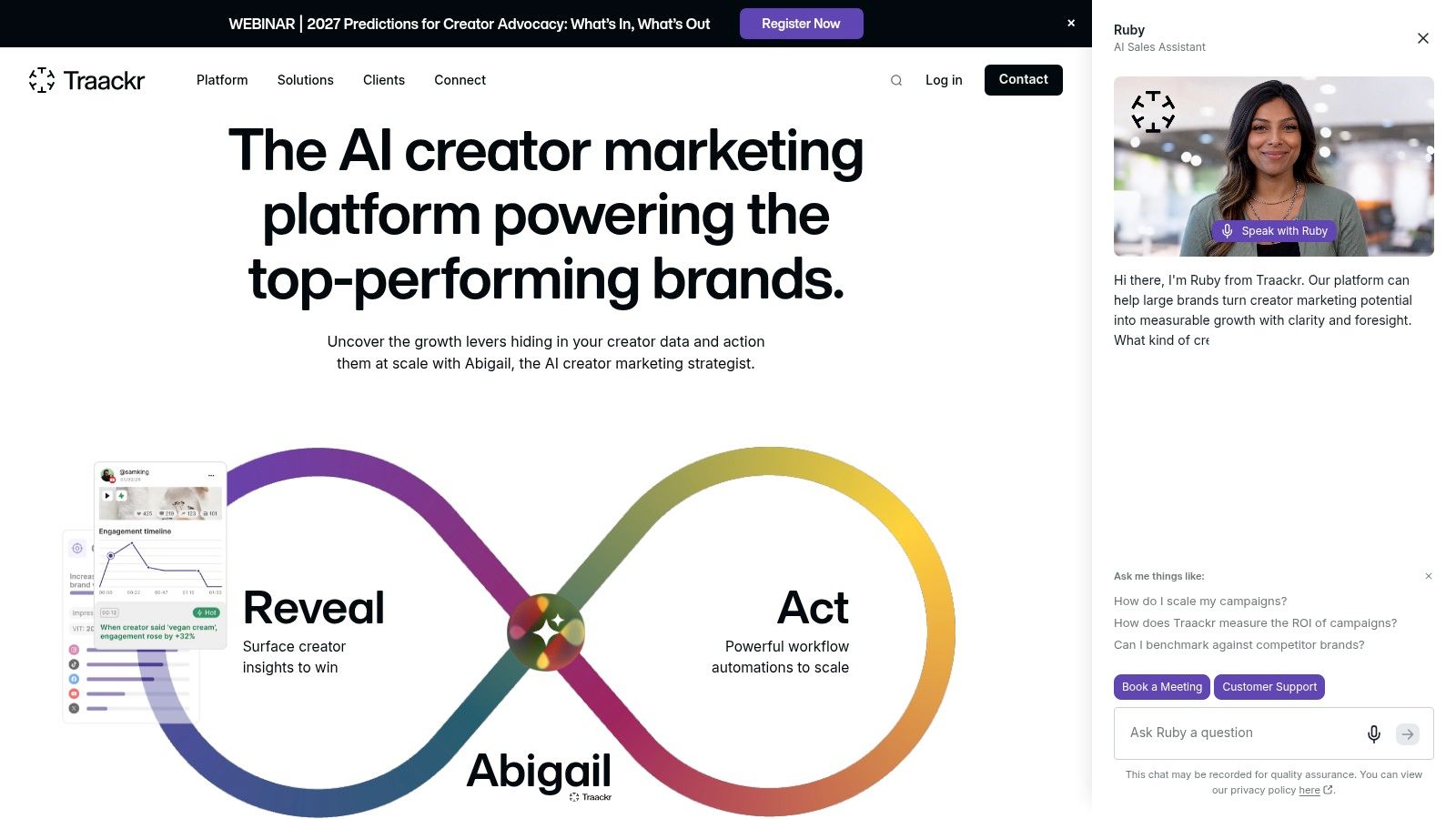
Traackr sells creator intelligence rather than a list. Discovery and activation sit next to measurement, and the platform leans on historical creator and campaign data to plan the next program, compare performance across categories and competitors, and support budget decisions with evidence instead of instinct.
That focus lands where buyers are stuck. Among U.S. creator-ad buyers in 2025, 40% ranked overall ROI among their top three KPIs, 39% named proving ROI as a leading measurement challenge, and 34% struggled to attribute sales to creators, per Statistics Global's influencer marketing statistics.
Here's the discipline I'd apply. Separate three outputs: descriptive performance (reach, engagement, views), attributed conversions (last-click, codes, affiliate links), and incremental lift (what would not have happened otherwise). Most platform reporting stops at the first and presents it as the third.
Attribution check: ask the vendor to walk through one campaign where reporting separated incremental sales from sales that would have happened anyway. The answer is more revealing than the dashboard tour.
Pricing is quote-only and the strategic layer needs an owner. Benchmarking data nobody opens is the most expensive line item in the contract. Official platform partnerships help with first-party campaign data, but confirm exactly which networks and integrations a proposed plan includes.
8. Later Influence
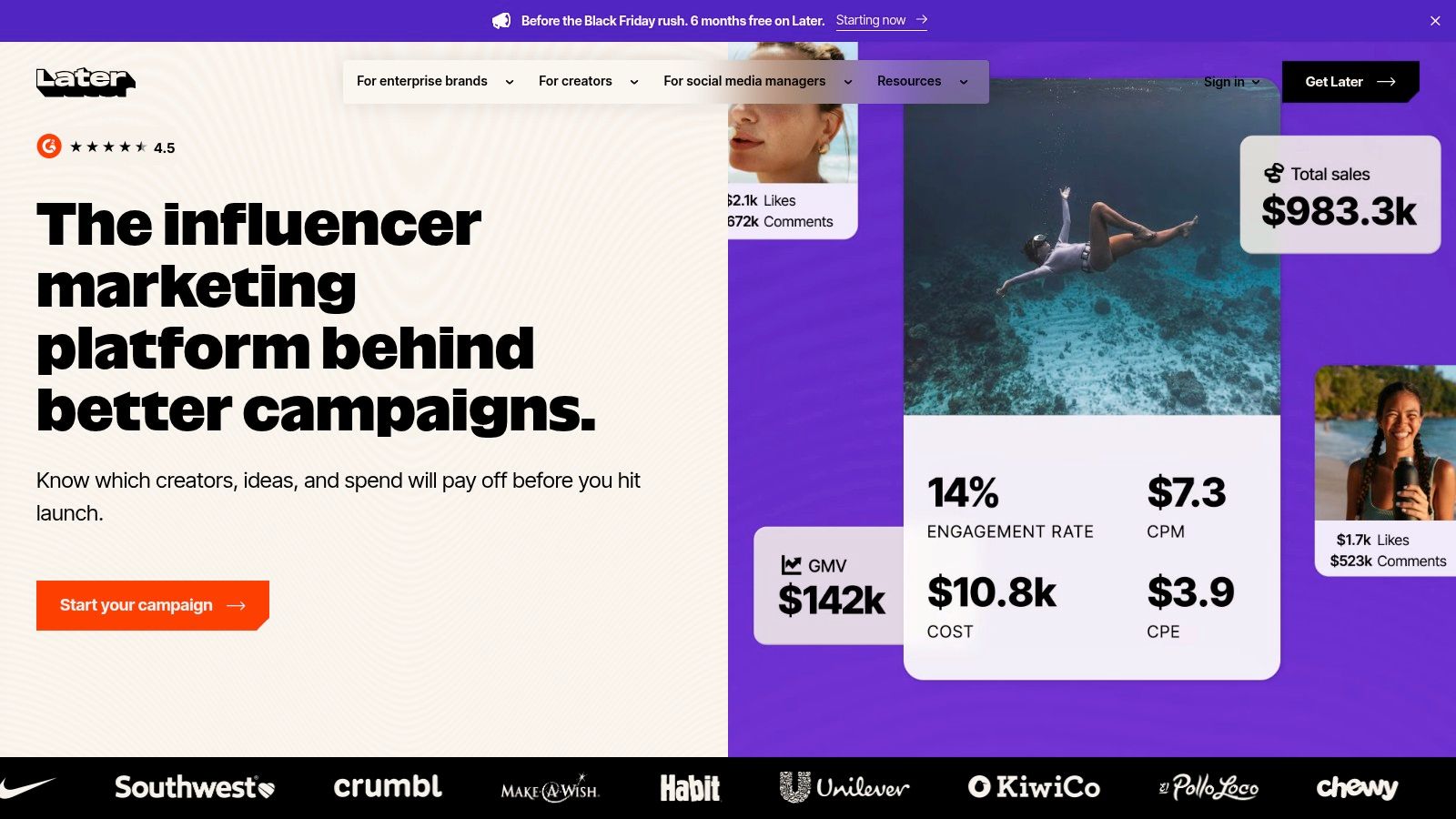
Later Influence is the influencer product inside a wider social publishing suite, which makes it the natural pick when the same team also runs the brand's organic calendar. Creator discovery and campaign setup, communication automation, draft review, and performance tracking cover the lifecycle from shortlist to results deck.
Software or software plus a team
Two purchase shapes exist: platform access alone, or platform plus strategy, planning, and execution support. Take the second if nobody internally can write briefs, chase deliverables, and read the numbers without dropping something. Take the first if the influencer program already has an owner who wants tooling rather than a partner.
Pricing requires a request and there is no current free trial, so evaluation costs time before it costs money. Ask for a walkthrough built on three of your own creators instead of stock examples.
Confirm which social networks and metrics the reports cover for your workflow. Influencer reporting gets thin quickly outside the major networks, and a metric shown in a demo can turn out to be an add-on in your contract. Social teams of two to five get the most from the workflow features. Enterprise governance across regions is not what this product is built around.
9. Influencity
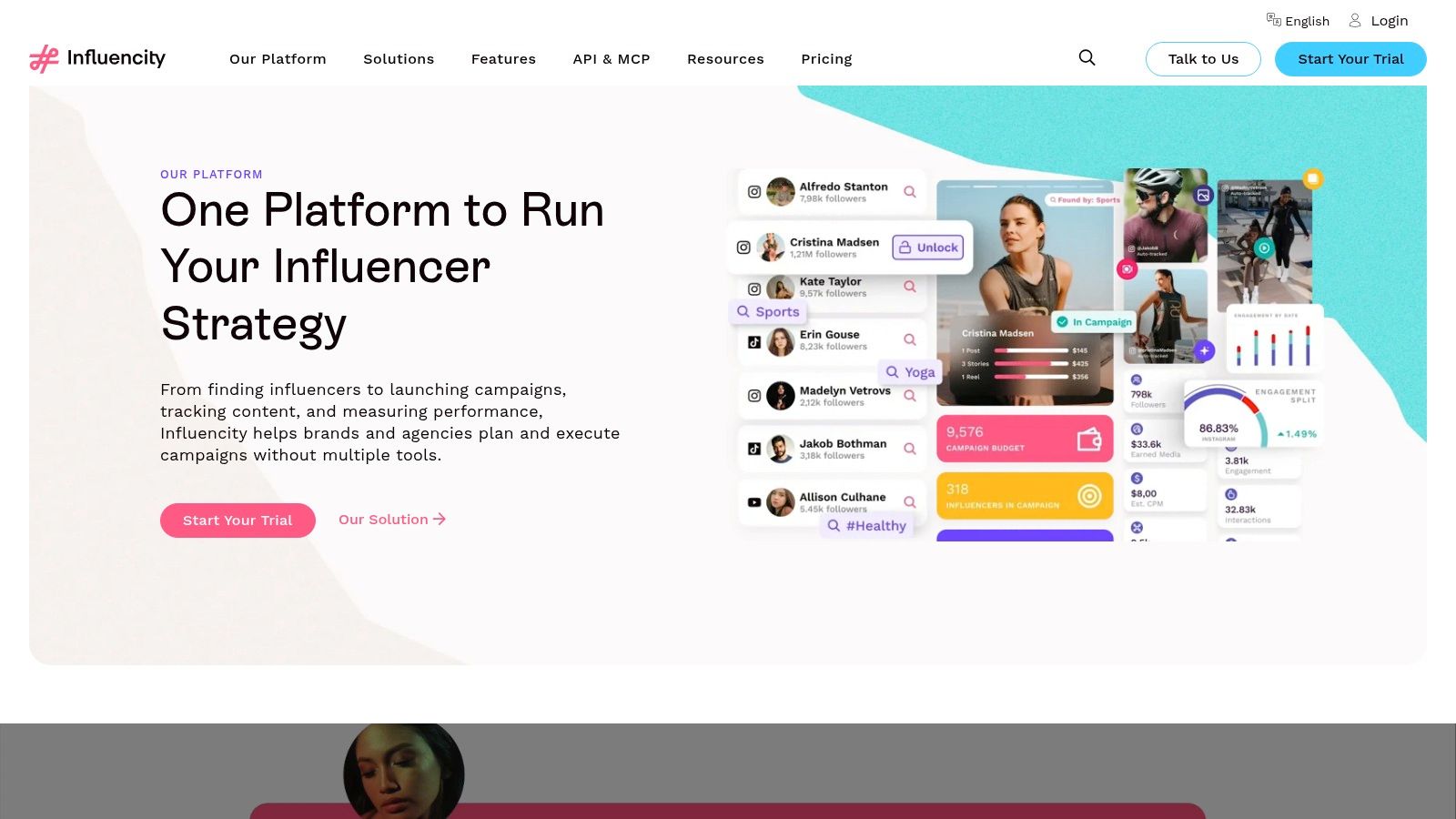
Influencity tries to be the whole desk. Creator discovery and audience analytics sit with CRM, outreach, campaign workflows, deliverable tracking, approvals, reminders, and reporting on reach, impressions, engagement, and clicks, plus social media management and listening tools for teams that want fewer tabs open.
The administration features are the reason to consider it. Customizable workflows that assign deliverables, chase approvals, and remind creators about deadlines take the weekly chase off a coordinator's calendar. If your problem is missed posts rather than weak discovery, that's the part to test in a demo.
The breadth is also the risk. A suite covering discovery, campaign management, and social publishing has more settings than a team of three will configure, and pricing varies by plan rather than presenting as one simple fixed tier. Verify data coverage for the networks and markets where you sell.
Buy the workflow you'll really run, then check whether the creator data behind it holds up where you operate.
10. Heepsy
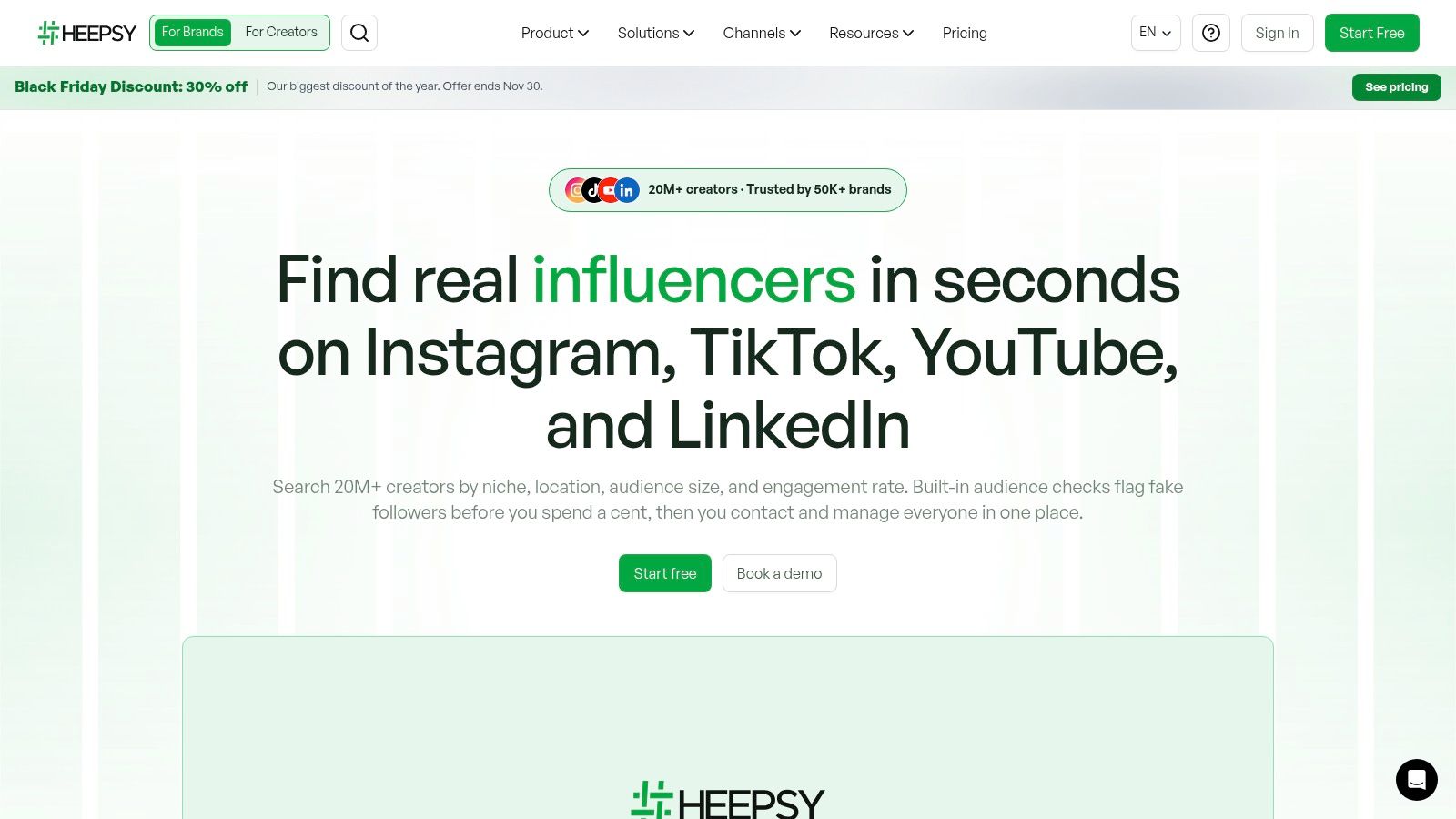
Heepsy is the entry point. Creator search across Instagram, TikTok, YouTube, and LinkedIn, with filters, AI search, lookalike search, profile analysis, outreach, and campaign tracking, sold on self-serve monthly plans that include a free option requiring no credit card.
That free tier is useful for a first look. Run a handful of searches, check whether the filters return creators who match your niche, and judge the data before you pay. Paid tiers add outreach, creator tracking, and campaign features progressively, and creator payments, marketplace listings, and ecommerce integrations appear on selected plans.
Know where the ceilings are:
- Published limits: monthly caps on searches and profile views decide how big a research project you can run.
- Marketplace listings: a listing on the marketplace is not the same as access to every creator in the search database.
- Scale: teams screening hundreds of accounts a month will hit the caps before they hit the feature wall.
For a solo operator or a small agency, the arithmetic is easy. For a team running continuous discovery, count the searches before you count the features. And sanity-check any number a creator quotes you with a calculator you trust, such as this Instagram engagement rate calculator, rather than the headline on a media kit.
How the Influencer Marketing Platforms Compare on Core Workflow Criteria
| Item | Discovery Focus | Campaign Workflows | Audience-Quality Checks | Public Pricing |
|---|---|---|---|---|
| GRIN | Creator search and ecommerce-focused discovery | CRM, gifting, affiliates, content, payments, and reporting | No prominent audience-quality analysis described | Published plans; creator-wallet deposit fees apply |
| Aspire | Creator search and opt-in marketplace | Influencer, ambassador, affiliate, seeding, and content workflows | No prominent audience-quality analysis described | Not publicly posted; contact sales |
| CreatorIQ | Enterprise discovery, vetting, and monitoring | Campaign management, governance, reporting, and integrations | Creator vetting and monitoring | Quote-based; contact sales |
| Upfluence | Social search and discovery of existing customers or followers | Outreach, campaign management, payments, and sales tracking | No prominent audience-quality analysis described | Quote-based; 12-month minimum contract |
| Modash | Large creator database search and profile evaluation | CRM, content tracking, gifting, affiliates, and payments | Profile evaluation; no specific fraud checks described | Public pricing; plan limits apply |
| HypeAuditor | Multi-network creator discovery | Campaign management, reporting, and sales-impact measurement | Audience quality, authenticity, and suspicious-engagement analysis | Free tier for basic functions; advanced pricing may require a quote |
| Traackr | Creator discovery informed by historical data and benchmarks | Creator activation, measurement, and planning | No specific audience-quality checks described | Not readily visible; contact Traackr |
| Later Influence | Creator search for social campaign teams | Campaign setup, communications, draft review, and reporting | No specific audience-quality checks described | Request pricing; no current free trial |
| Influencity | Creator discovery and audience analytics | CRM, outreach, approvals, campaign management, and reporting | Audience analytics; specific quality checks not detailed | Varies by plan; no simple fixed tier presented |
| Heepsy | Search, filters, lookalikes, and creator analysis | Outreach and campaign tracking on paid tiers | Creator profile analysis; specific fraud checks not detailed | Free plan and published entry pricing; usage limits apply |
Choosing a Platform by Verification Needs, Not Feature Lists
How many people will operate the tool? How much sales process can you absorb? And how much verification does this campaign need before money moves?
A team of one to three running discovery-heavy programs should start with published pricing and self-serve access: Modash, Heepsy, or a HypeAuditor plan that puts audience analysis ahead of campaign workflow. Once you need payments, gifting, and affiliate tracking in one system, GRIN or Upfluence earns the subscription, provided you can live with a 12-month term and a quote-based start. Multi-brand organizations with governance to enforce should look at CreatorIQ or Traackr and budget for the analyst who makes either work. Social teams already publishing daily will get more from Later Influence or Influencity than from a discovery-first tool.
Then pilot. Pick two or three from the shortlist, give each the same ten creators, and compare outputs side by side. Don't evaluate on interface. Evaluate on whether each tool noticed the same things you noticed when you read the comments yourself.
The test that matters most: take one creator per shortlisted tool, pull a manual sample of their followers and their last thirty comments, and check whether the platform's audience-quality output matches what you found. A tool reporting a very high share of real followers on an account whose comment section is emoji-only replies from accounts with no posts is telling you about its model, not about the creator.
Compliance belongs in the same conversation. The FTC's guidance on endorsements says compensated endorsements and other material connections should be disclosed, and its Endorsement Guides were revised in 2023 to address modern social media and review practices. Ask each vendor how it monitors disclosure language, preserves evidence, and routes uncertain cases to a human reviewer. Separate an account's registration history from where the creator currently lives, too, because a creator who moved countries looks identical to a purchased audience on a naive check.
Get contract details confirmed in writing before the pilot ends: which integrations are included, which metrics are native versus derived, how the platform defines engagement rate, and what happens to your data if you leave. Then add independent signals on top of whatever score you're shown. A fake-follower audit built on a sample, an account-age check, a registration-country check, and a previous-username review for repurposed accounts will catch the cases a single authenticity score misses.
Instagram API's account transparency endpoint returns those fields together, creation month and year, account age, registration country, previous usernames, and verification status, and it keeps registration country separate from current residence so a relocated creator isn't mistaken for a bought audience.
Teams that treat scaling influencer campaigns with verified views as an operating discipline rather than a software purchase end up with shorter shortlists, fewer surprises mid-campaign, and reporting their finance team believes.
Instagram API gives developers and marketing teams programmatic access to public Instagram data through a REST API, covering profiles, posts, followers, engagement-rate analysis, fake-follower audits, and account age and country checks, all returned as structured JSON. If you're building the verification layer this article describes, one API key replaces the separate retrieval interfaces you'd otherwise maintain for discovery and due diligence. Start with the 50 free credits and test the endpoints against accounts whose audience you already know at Instagram API.
Pull Instagram data with one API call
Profiles, posts, reels, followers and more. 50 free credits, no credit card.
Get your free key