
How Many Fake Followers Does an Account Really Have?
Learn how many fake followers an Instagram account likely has, using published audit rates, a five-step estimate and the limits of follower-quality signals.
41.8% of analysed Instagram followers were classified as fraudulent or inauthentic in SociaVault Labs' 2026 influencer analysis. That's a finding about followers in a selected influencer sample, not a count of fake accounts across Instagram. To answer how many fake followers an account really has, you need to distinguish what an audit measures from what its headline appears to promise.
Table of Contents
- Published Fake-Follower Rates Compared
- How to Estimate Fake Followers in Five Steps
- Signals That Predict Fake Followers Best
- Types of Inauthentic Followers and Their Risk
- What a Fake-Follower Percentage Cannot Tell You
- Confirm the Estimate Before You Decide
Published Fake-Follower Rates Compared
No single published figure gives the number of fake followers on Instagram. Published audits classify different populations using different rules: some count influencers with suspicious audiences, while others estimate the share of followers displaying inauthentic characteristics. Those percentages aren't interchangeable.
The SociaVault Labs analysis examined creator accounts across Instagram and TikTok, but its Instagram-specific result concerns followers, not the proportion of creators who bought them. The likely-authentic category is also a classification, not a guarantee that every remaining follower represents an engaged buyer.
Published fake-follower rates by source
| Source and year | Scope | Reported share | What it measures |
|---|---|---|---|
| HypeAuditor, 2020, as summarised by Nurdd | Instagram influencers with 5,000 to 20,000 followers | 48.21% of influencers | Accounts with some inauthentic followers, not the share of followers |
| SociaVault Labs, 2026, cited above | Influencer accounts across Instagram and TikTok | 41.8% of analysed Instagram followers | Followers classified as fraudulent or inauthentic |
| Instagram audit, discussed below | 425,859 accounts with at least 10,000 followers | 23.3% with at least one red flag; 2.3% with two or more | Accounts showing warning patterns |
| Industry analysis summarised by Shopify, 2025 | More than 100,000 influencer accounts | Over 37% | Accounts showing signs of fake, purchased, or otherwise inauthentic followers |
Compare denominators before percentages
The HypeAuditor finding doesn't mean that nearly half of each creator's followers were fake. An influencer with a small suspicious audience segment and an influencer with extensive audience manipulation could both appear in the same account-level category.
Likewise, the industry analysis offers corroborating context, not an independent measurement to average into the other results. Without establishing whether its underlying accounts overlap with another dataset, combining them would imply more independent evidence than you have.
The denominator is the first audit check: Ask whether a percentage describes creators, followers, commenters, or accounts triggering a detection rule.
Applying a sample-wide follower rate to an individual creator would produce a scenario, not an account-specific finding. It wouldn't produce an honest starting range either: a range requires evidence about that account and a stated method for representing uncertainty.
The commercially useful conclusion is narrower than the headline. Follower totals need validation, but published prevalence alone can't tell you which creator deserves rejection.
How to Estimate Fake Followers in Five Steps
Start by defining the outcome as suspected inauthenticity, not confirmed fraud. In Virev's audit of 425,859 Instagram accounts with at least 10,000 followers, 23.3% triggered at least one warning pattern, while 2.3% triggered two or more independent red flags. That gap supports separating weak warnings from corroborated concerns, though neither category proves a follower was purchased.
Use this visual workflow to keep collection, review, and reporting distinct.
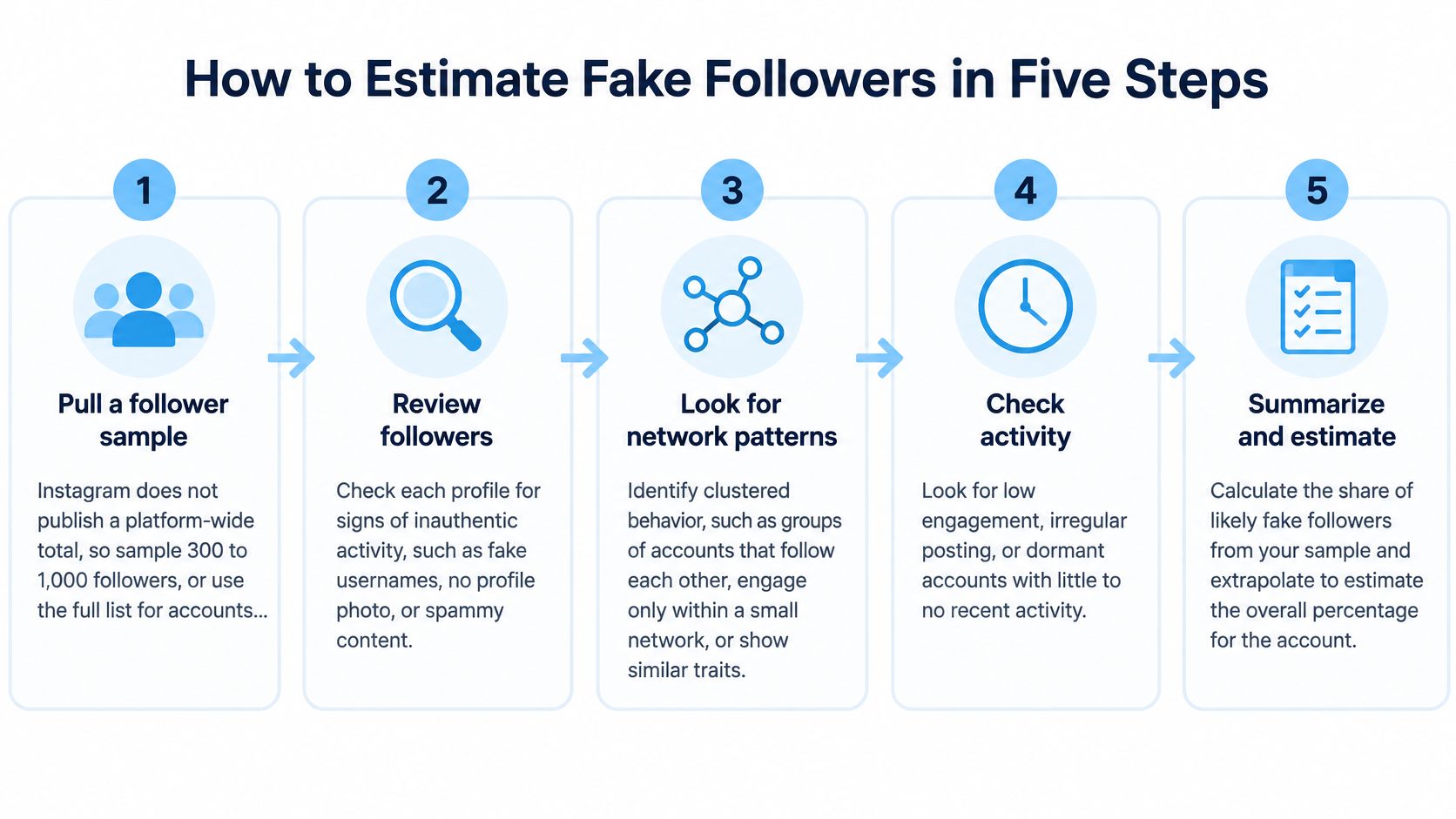
Pull a follower sample. Record how you selected accounts, what access you had, and whether the list was complete; the follower retrieval documentation provides implementation context for paginated collection. Don't substitute visible commenters for followers without relabelling the analysis, because active commenters aren't a representative cross-section of the whole audience.
Review profiles for supporting clues. Check biographies, posting histories, profile images, and follower-to-following patterns, recording unavailable information as missing rather than suspicious. The common mistake is treating an empty biography or an unfamiliar username as a verdict instead of a prompt for further review.
Score interactions separately. Review comment specificity, repeated wording, shared timing, and overlap among participating accounts, while keeping these observations separate from profile-level labels. Otherwise, you can accidentally count the same underlying pattern repeatedly and mistake repetition for independent corroboration.
Separate isolated flags from corroborated signals. Maintain distinct groups for accounts needing manual review and accounts with multiple independent concerns, with a written explanation for each classification. Don't transfer a profile-level anomaly, such as weak overall engagement, to every individual follower.
Report an estimate with explicit uncertainty. Divide the flagged followers by the reviewed followers, but describe the result as the suspicious share of that sample unless your sampling design supports broader inference. Don't invent a confidence interval by rounding outward: sampling error, selection bias, and classification error require different treatment.
Make uncertainty useful
A statistical interval can describe sampling variability when selection is sufficiently representative. It can't repair a sample drawn only from convenient profiles, nor can it establish that your detection labels are correct.
For a nonrandom sample, give a sensitivity range instead: explain how the result changes when ambiguous profiles are included or excluded. Label that range as an analyst-defined scenario, not a statistical confidence interval.
JoinBrands' guidance on how to vet creators before a brand deal is useful for placing this review inside broader creator due diligence. Audience authenticity should inform a partnership decision alongside commercial fit, rather than replace it.
For a complementary video walkthrough, use the demonstration below while keeping your own classification rules documented.
Signals That Predict Fake Followers Best
Comment quality was the strongest single indicator, with 87.3% reported accuracy, in SociaVault Labs' cross-platform detection study. The same study reported the signal metrics below, including combined results that measure different aspects of detection performance.
Detection signals and their reported accuracy
| Signal | Reported accuracy or detection result | What it catches | Main weakness |
|---|---|---|---|
| Comment quality | 87.3% accuracy | Generic, repeated, or emoji-only comments | Genuine fans can also write short comments |
| Commenter authenticity | 84.1% accuracy | Commenters with bot-like profiles | Requires checking the commenters themselves |
| Engagement-rate anomalies | 82.6% accuracy | Interaction out of line with follower-tier expectations | Giveaways and viral posts can distort rates |
| Follower-growth spikes | 79.4% accuracy | Sudden jumps without matching reach | Campaign launches can also produce spikes |
| Comment quality, commenter authenticity, and engagement anomalies combined | 89% of fraudulent accounts identified | Joint evidence across comments, participants, and engagement | Detection coverage isn't overall accuracy |
| All those signals triggered | 93% classified as fraudulent | Corroborated evidence among jointly flagged accounts | Doesn't describe accounts outside that group |
The mechanism matters more than the ranking. Purchased or automated audiences can increase follower counts without producing proportional, varied interaction. Coordinated participants can manufacture activity, but repetition, timing, and limited relevance can expose the coordination.
Comment quality therefore deserves a contextual review. A short reaction to a visual joke means something different from identical praise appearing beneath unrelated product demonstrations. Score whether comments refer to the actual post, not merely whether they contain enough words.
Turn signals into testable checks
For engagement analysis, calculate a rolling measure across recent posts and retain the individual post results. A single average can conceal whether ordinary posts receive consistent responses or whether an exceptional post accounts for most activity.
The engagement calculation documentation can help developers structure that part of the workflow. Keep the engagement definition consistent when comparing creators, including which interactions enter the numerator and which audience measure supplies the denominator.
For growth checks, compare changes against content performance and campaign events. A jump with a plausible distribution event deserves a different interpretation from a jump with no corresponding explanation.
A detector's accuracy is not the probability that its verdict is correct for every account you submit.
The reported metrics depend on the study's labelled control set. Their usefulness outside that setting requires validation against account size, niche, geography, language, and campaign history.
Don't rank the combined results as though every row were the same metric. Identifying fraudulent accounts describes detection coverage; classification among jointly flagged accounts describes the flagged group. Neither statistic, by itself, supplies a universal error rate for your application.
Types of Inauthentic Followers and Their Risk
The better campaign question isn't how many fake followers an account has. It's which kind of inauthenticity could affect the outcome you're buying.
A follower-quality review should distinguish inflated audience size from manipulated interaction and identity abuse. It should also preserve categories for genuine people who don't behave like highly active fans.
The diagram separates these audience types before you attach a risk label.
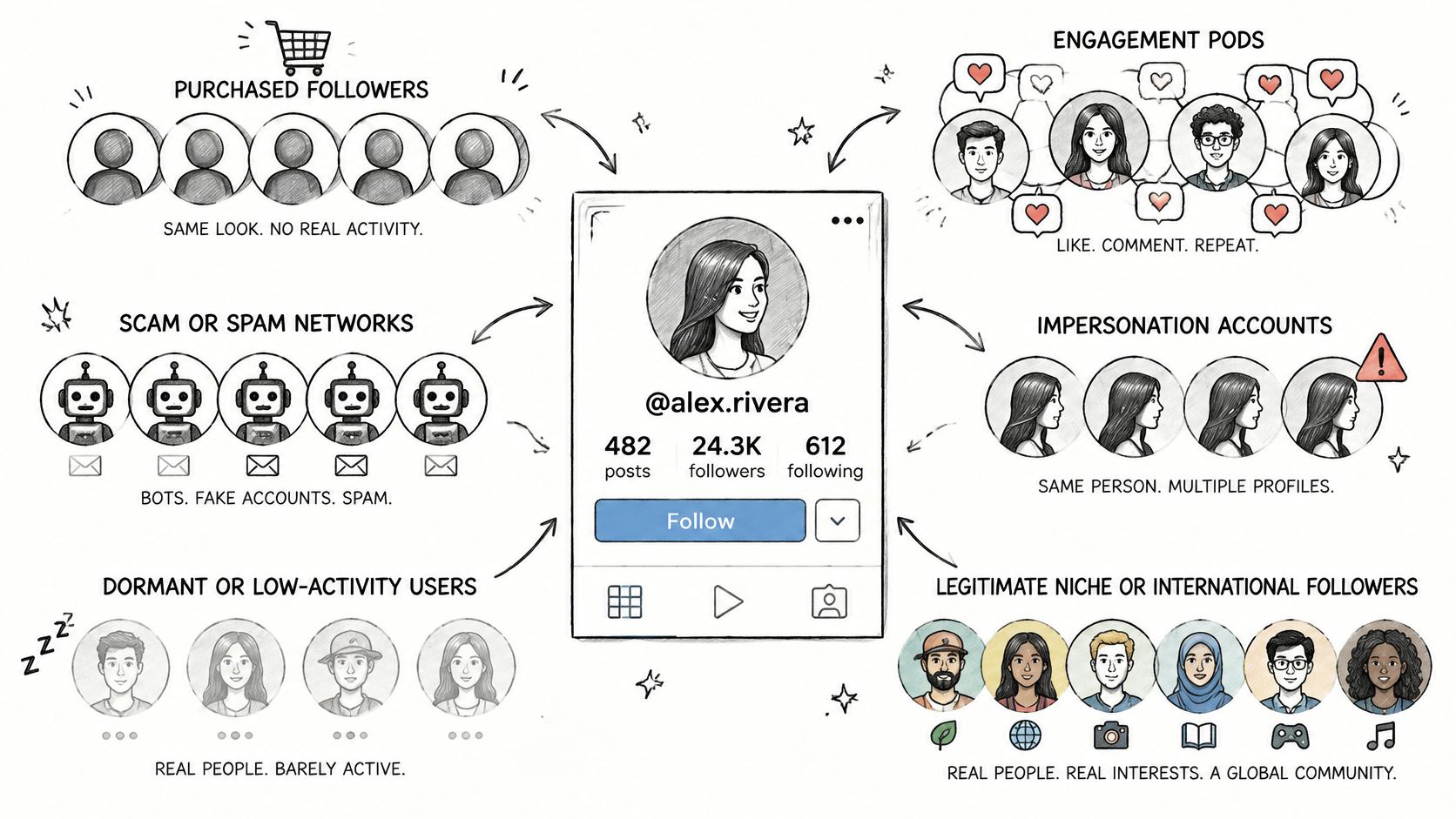
Types of inauthentic followers and campaign risk
| Type | Typical pattern | Campaign risk |
|---|---|---|
| Purchased followers | Mass-created or dormant-looking accounts; growth without proportional interaction | Inflated audience expectations and unreliable conversion forecasts |
| Engagement pods | Accounts liking and commenting in coordinated groups | Manufactured interaction that can resemble genuine interest |
| Scam or spam networks | Shared posting, messaging, or link patterns | Brand-safety and reputational exposure |
| Impersonation accounts | Names and photographs mimicking a brand or creator | Fraud and identity confusion |
| Dormant or low-activity real users | Little posting and rare visible interaction | Limited observable activity, not evidence of fraud |
| Legitimate niche or international audiences | Unfamiliar location or language patterns | Potential targeting mismatch, but not necessarily inauthenticity |
Coordination can survive a profile inspection
Research on Instagram crowdturfing, meaning paid or incentivised artificial engagement, collected 1,293 profiles from 11 providers and achieved a 95% F1 score with a semi-supervised detector. That result concerns a particular detection task, not the accuracy of a generic visual profile check.
F1 summarises the balance between precision and recall. It doesn't mean that the same share of all Instagram accounts can be correctly classified, and it doesn't turn an ordinary-looking profile into evidence of authenticity.
For an operational review, inspect relationships between accounts: repeated participation, similar comments, clustered timing, and overlapping interaction networks. Compare those observations with account history where available.
A creator can have an audience that looks plausible individually while receiving coordinated engagement. Conversely, an audience with many quiet profiles may contain genuine people who mainly consume content.
Match the response to the risk. Suspected audience inflation calls for cautious reach assumptions and performance verification. Impersonation or scam activity calls for identity checks and brand-safety review before any association proceeds.
Also keep authenticity separate from market fit. A genuine international audience may be commercially unsuitable for a local campaign, but describing those followers as fake would misdiagnose the problem and unfairly penalise the creator.
What a Fake-Follower Percentage Cannot Tell You
The central misreading is treating platform enforcement totals as an Instagram follower-prevalence rate. They measure different things.
In its public enforcement reporting, Meta reported taking action against 1 billion fake Facebook accounts in Q1 2025 and 687 million in Q2 2025. Those are Facebook enforcement counts, not the suspicious share of an Instagram creator's followers.
Enforcement activity doesn't provide the denominator needed for that calculation. You'd need a relevant population, a compatible measurement period, and a definition of what counts as fake. Removal totals alone supply none of those account-specific ingredients.
A percentage without a defined population and classification rule is a score, not an interpretable measurement.
Separate suspicion, intent, and exposure
A suspicious follower label doesn't establish who created the account, whether money changed hands, or whether the creator knew about it. Even a well-supported audience-quality concern shouldn't automatically become an accusation that the creator purchased followers.
Nor does a suspicious-follower percentage equal wasted campaign spend. Followers aren't the same as viewers, viewers aren't the same as buyers, and content can reach people who don't follow the creator. Use audience quality to qualify forecasts, not to mechanically discount every commercial outcome.
Time adds another limitation. Platform removals and changes in the follower population can alter both the flagged group and the total against which it is measured.
Require a measurement contract
An interpretable result should disclose:
- Target population. State whether the estimate concerns followers, commenters, or the profile's overall behaviour.
- Classification meaning. Distinguish suspicious signals from independently confirmed fake accounts.
- Collection method. Describe selection, access limitations, exclusions, and the number of accounts reviewed.
- Detection evidence. Preserve the rules triggered and distinguish missing information from adverse findings.
- Uncertainty and timing. Explain the interval or sensitivity method and record when collection occurred.
These disclosures let another analyst challenge the result without reverse-engineering the tool. They also prevent a polished dashboard from implying stronger evidence than the underlying collection supports.
An exact-looking percentage isn't more credible than a qualified range. Precision in presentation is useful only when the method justifies it. If a provider won't explain what its percentage represents, don't treat the output as a verified count.
Confirm the Estimate Before You Decide
Pause spending when corroborated concerns remain material after manual review. If the findings consist only of unexplained isolated anomalies, investigate and monitor rather than reject the creator automatically.
Don't use a range merely being above zero as a rejection threshold. The relevant question is whether the supported risk could change the campaign decision, considering the suspected category, the planned deliverables, and the reliability of the evidence.
Keep a reviewable decision record
Attach the audit to the campaign file with:
- Collection details. Preserve the audit date, sample size, and whether selection came from followers or visible participants.
- Evidence groups. Keep isolated warnings separate from independently corroborated concerns.
- Uncertainty statement. Record the range, its method, and any confidence level the method supports.
- Decision rationale. Explain why the reviewer accepted, paused, or rejected the partnership and what would change that decision.
For a manual companion workflow, Sup Growth's guide to check Instagram for fake followers can help organise the inspection. Use a checklist to gather evidence, not to turn every unusual profile into a fraud label.
For programmatic review, our Fake-follower audit endpoint estimates real versus suspicious followers from a sample. Treat its output as an input to the documented review, not as proof of misconduct.
Re-run the assessment before campaign activation and resolve material discrepancies with the creator. A decision based on a traceable estimate is more defensible than one based on an unexplained authenticity score.
Instagram API offers sampled fake-follower estimates and account-transparency information, including creation month and year, registration country, and username history. Visit Instagram API to build a review workflow that combines audience-quality evidence with account context before you commit campaign spend.
Pull Instagram data with one API call
Profiles, posts, reels, followers and more. 50 free credits, no credit card.
Get your free key