
Fake Account Detection: Signals, Audits and Red Flags
Learn fake account detection step by step: spot red-flag signals, audit follower quality, check account history and act on uncertain results.
If an account has a polished profile, convincing comments and a large audience, what would prove that it's genuine? Most checklists stop at appearances, even though an operator can copy those details and a legitimate user can look suspicious.
Fake account detection is a confidence assessment, not a verdict. Your job is to collect evidence, test reasonable explanations and choose an action proportionate to the risk. That means separating an account's identity, its audience quality and its connections to other accounts instead of treating them as the same question.
Table of Contents
- Red-Flag Signals That Separate Fake From Real Accounts
- Why One Signal Is Never Enough
- How to Audit Follower Quality Step by Step
- Checking Account History and Transparency Fields
- Why Scores Mislead and How to Act on Uncertain Results
- Worked Example Combining Signals
- Decide Which Accounts to Escalate
Red-Flag Signals That Separate Fake From Real Accounts
| Signal | Normal pattern | Suspicious pattern | Weight on its own |
|---|---|---|---|
| Engagement rate | Steady likes and some real comments, in line with follower count | Likes with almost no comments, or spikes with no matching growth | High |
| Follower-to-following ratio | Gradual growth, with a reasonable share of followers following back | Following far above followers, or abrupt mass-following activity | High |
| Comment quality | Specific, varied replies that refer to the post | Generic emojis, repeated phrases or copied text | Medium |
| Posting pattern | Irregular, human-paced posting across different times | Identical timestamps, bursts of many posts or reposted captions | Medium |
| Profile details | Consistent photos, a filled bio and a readable username | Stock or stolen photos, empty bio or long digit-heavy usernames | Low alone |
| Account history | Few or no username changes, creation history consistent with audience growth | Several username changes or a recent creation date with a large audience | High |
Treat the table as a screening checklist, not a validated scoring model. High means worth investigating promptly, not sufficient proof of deception. Count the signals that appear together, but keep their context attached.
Read patterns rather than appearances
For engagement, compare recent posts rather than choosing the strongest or weakest performer. Likes without meaningful conversation deserve a closer look, but a quiet audience isn't automatically artificial. A sudden engagement burst warrants checking what happened around that post.
The follower-to-following ratio describes an imbalance, not intent. Keep its direction clear: following far more accounts than follow back may suggest mass-following, whereas having far more followers than accounts followed is ordinary for many creators.
For comments, read the words. A reply about the recipe's ingredients tells you more than generic praise repeated across unrelated posts. For posting rhythm, distinguish repetitive execution from a planned publishing schedule.
Profile details deserve the least weight alone. A private person may have an empty biography, while an impersonator may copy a complete identity. Our guide to bot accounts on Instagram helps distinguish automation clues from broader authenticity concerns.
Record what needs investigation
Account history can make an otherwise ordinary pattern more concerning, especially when identity changes accompany audience changes. Record what you can observe and label anything you can't verify as unknown.
For teams operating their own signup systems, detection also has a preventive counterpart. MANDATE's guide to prevent fraudulent account creation provides context for addressing abuse before accounts become established.
Before continuing, write down the count of observed signals, the evidence behind each and any plausible innocent explanation.
Why One Signal Is Never Enough
A single cough doesn't diagnose an illness. A cough accompanied by fever and fatigue changes the assessment because the symptoms reinforce each other. Account signals work similarly, although repeated observations aren't necessarily independent evidence.
A polished profile is cheap to imitate. Purchased followers can make an audience look established, while legitimate agencies, prolific creators and fan communities can produce unusually coordinated activity. The important question is whether the behavior supports a deceptive explanation better than a legitimate one.
Meta's adversarial threat report describes an approach that considers account behavior and social connections, including unusual activity and coordination, rather than judging profile completeness alone. That distinction matters because an account can look ordinary in isolation while participating in a suspicious network.
Move from the account to its connections
An analyst starts with account-level features, meaning observations about an individual account. These might include rapid follow requests, repeated captions, concentrated mentions or abrupt changes in activity.
Then the analyst examines connected-group features, meaning patterns shared across related accounts:
- Timing similarity: Accounts repeatedly publish or engage together, beyond what a shared event reasonably explains.
- Reciprocal engagement: The same accounts circulate likes and comments among themselves with little outside conversation.
- Shared targets: Profiles repeatedly direct attention toward the same creators, products or discussion threads.
- Common lifecycle: Accounts with similar creation histories become active together and perform matching actions.
Say a creator receives enthusiastic comments after announcing a product. That's unsurprising. If the commenters also repeat the same wording on unrelated profiles and consistently act together, the combined pattern deserves investigation.
Separate coordination from deception
Coordination alone isn't abuse. A campaign team may share approved copy, and supporters may organize around a public event. Check whether the accounts misrepresent their identities, conceal their relationship or manufacture apparent independent support.
Practical rule: Examine who acts together, what they do together and whether there's a credible explanation for that relationship.
For automated pipelines, aggregate account observations into connected groups, then set review thresholds according to the consequences of a mistake. A decision to delay outreach needs less evidence than a decision to publicly accuse someone of fraud. Check connections and group behavior before judging the individual profile.
How to Audit Follower Quality Step by Step
A follower audit asks whether the audience looks credible. It doesn't establish who controls the creator account or prove that the creator purchased followers. Keep those questions separate throughout the review.
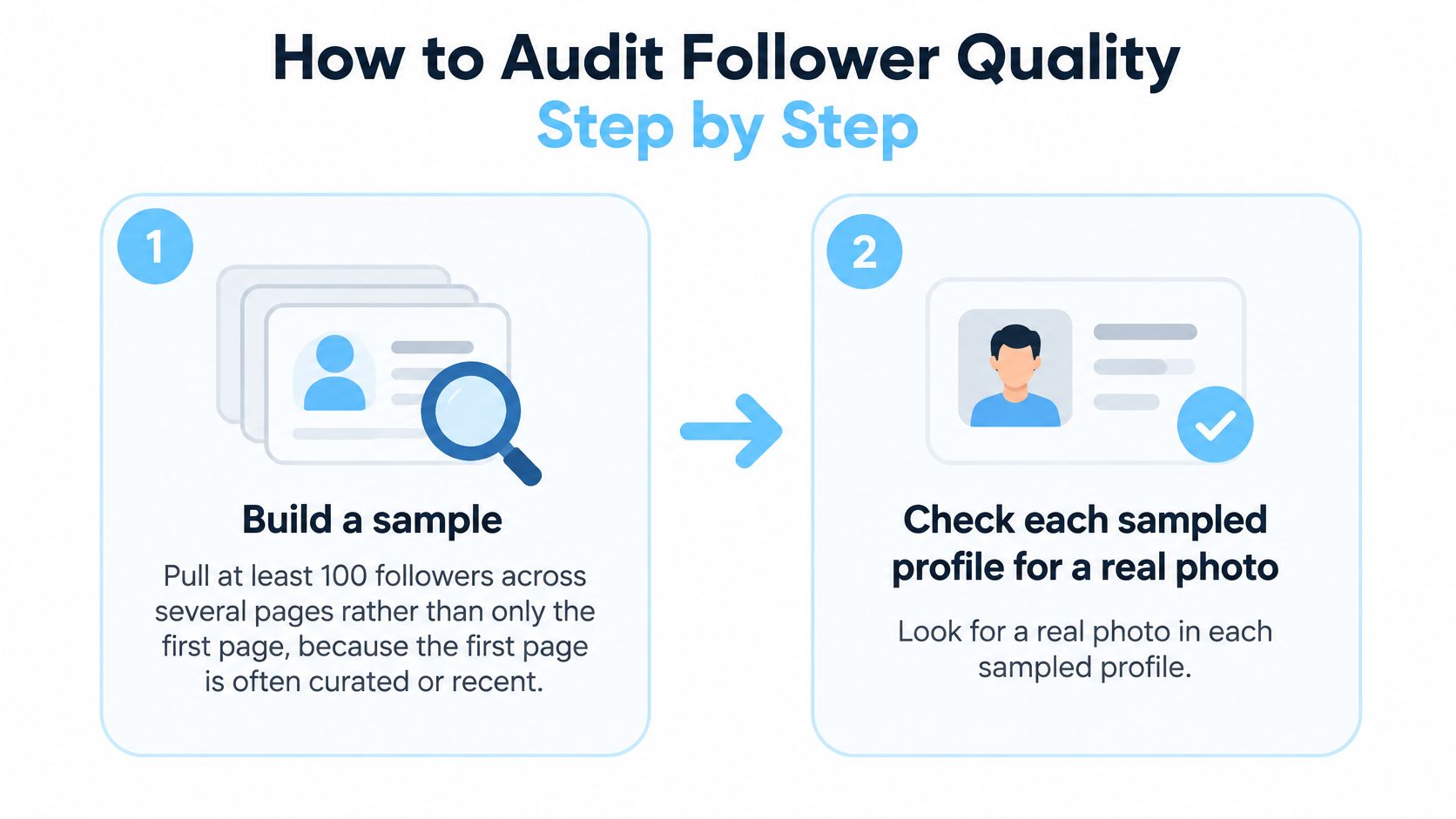
Use this visual as a reminder to sample first and inspect second.
Collect and inspect the sample
Build a spread-out sample. Collect followers across several available pages rather than inspecting only the accounts displayed first. Record the selection method so another reviewer can understand its limitations, and don't describe a convenience sample as representative.
Check profile completeness and visible activity. Look for a photo, biography, posts and evidence of ongoing use, recording unavailable information separately from absent activity. A private profile is an unknown, not an inactive account, and a reader who rarely posts may still be genuine.
Flag concrete anomalies. Note apparently copied portraits, digit-heavy usernames, extreme following imbalances and repeated profile text. Group related clues rather than counting an empty biography and missing profile details as separate, independent discoveries.
Choose relevant comparison accounts. Compare the sample with audiences from a similar niche, creator size, language and market. A broad celebrity audience is a poor benchmark for a local specialist, and your own comparison sample may also contain suspicious followers.
Test audience patterns against activity
Examine growth timing. Use historical observations where available to distinguish gradual audience development from abrupt changes. Check for a plausible cause, such as publicity or a widely shared post, rather than assuming every jump represents purchased followers.
Normalize engagement. Compare likes and comments relative to follower count across comparable posts and creators. Keep content format and post age reasonably consistent, because comparing a fresh video with an older giveaway can produce a misleading result.
Read comments in context. Look for replies that refer to the actual content, then flag repeated praise, unrelated links and recurring wording across different posts. Don't classify a short emoji response as automated just because it's brief.
Record findings and assign risk. Preserve the sample method, observations, comparison group, missing information and review date. Choose a provisional risk tier and describe what additional evidence would change it instead of returning a real-or-fake label.
The central discipline is traceability. A reviewer should be able to tell which accounts were inspected, why they were flagged and whether the conclusion came from audience quality, engagement behavior or missing information. Avoid collecting unnecessary personal details when a profile identifier and the relevant observation will suffice.
For a visual companion to the inspection process, use the video below.
Treat a sampled audit as a reason to investigate, not a precise census of the whole audience. If the sample is narrow or relevant fields are unavailable, say so explicitly in the result.
Checking Account History and Transparency Fields
Account history helps you assess continuity: does the profile's present identity fit its visible past? A snapshot may show a convincing creator, but historical observations can reveal a change in subject matter, a dormant period or a transition to an unrelated identity.
A survey of fake-profile detection identifies gaps in detecting different forms of deception and a shortage of diverse labeled datasets. That's a reason to examine longitudinal evidence rather than expect a profile-only classifier to recognize every impersonator, dormant account or artificially inflated audience.
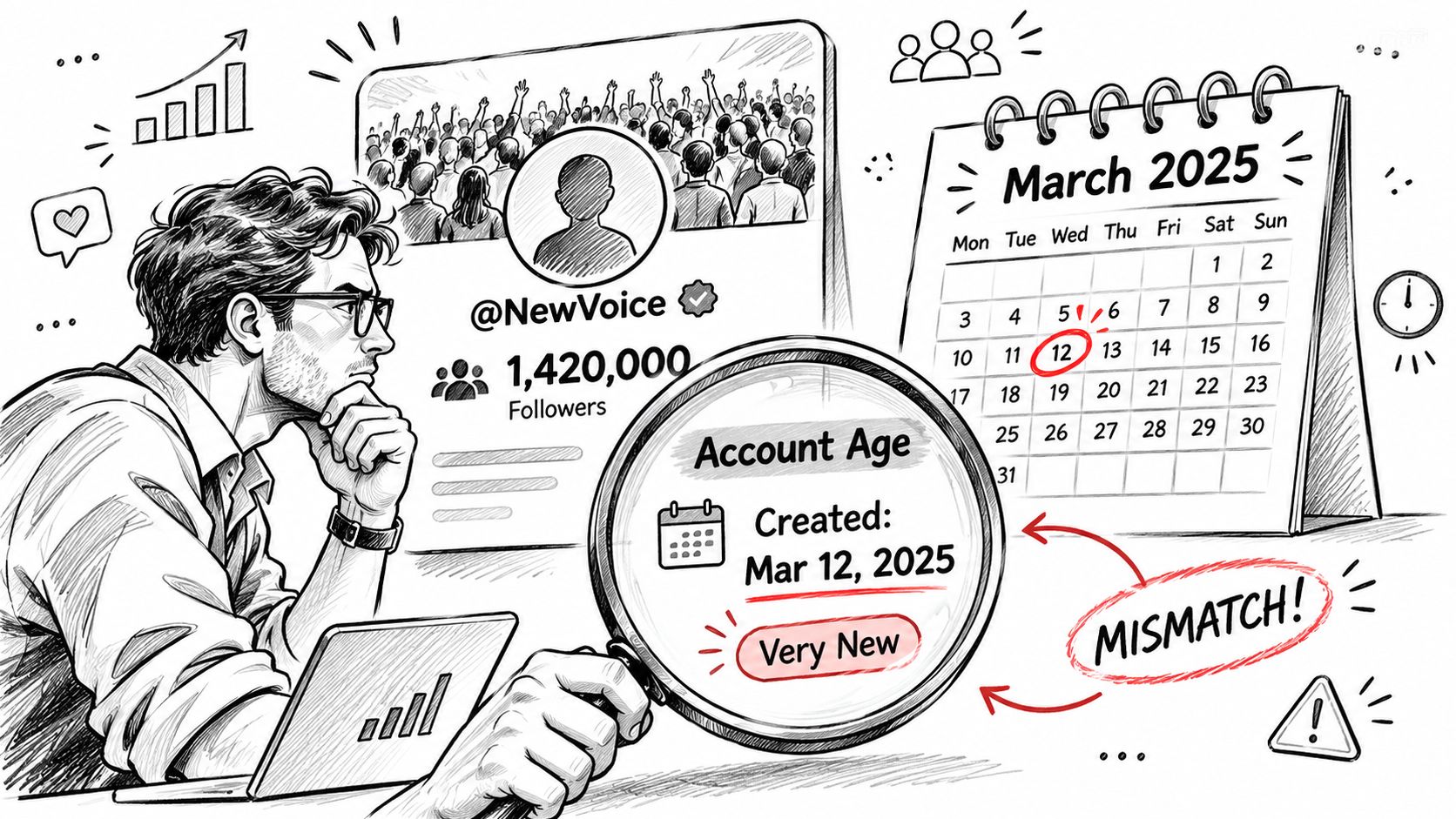
The illustration below depicts an extreme mismatch worth investigating. It isn't evidence about an actual account, and an exact creation day shouldn't be inferred from month-level transparency information.
Understand what each field establishes
| Field | What it helps you judge | Limit |
|---|---|---|
| Creation month and year | Rough account age and whether a new account already has a large audience | Shown at month level only, with no exact day |
| Account age in years | A quick screen for recently created accounts | Derived from the creation date, so the same month-level precision applies |
| Country of registration | Where the account was created, as one clue about its origin | Not necessarily where the owner lives now |
| Username changes | Possible impersonation or resale when an account has been renamed | Many genuine users rename, so a change alone isn't proof |
| Numeric account id | A stable identifier for tracking an account across renames | Identifies the account, not whether it's genuine |
| Previous usernames | Rebranding, past identities or possible resale | Old names can be legitimate, so read them alongside the audit |
| Verified badge | Confirmation of platform verification | Doesn't confirm that followers are real |
Use the numeric account identifier as the tracking key when maintaining historical records. A username is a label that can change; joining records only by that label can fragment the account's history. The Instagram account age checker guide provides context for interpreting age-related checks.
Reconstruct the sequence
Consider a hypothetical profile that stops posting, changes its username and returns with unrelated promotional material. Each event has legitimate explanations, but their sequence creates a specific question: did the same person rebrand, or did control change?
Check whether old content, audience interests and current claims fit a coherent explanation. A creator who openly announces a new business presents a different case from a profile claiming a longstanding identity that conflicts with its visible past.
Compare history with the follower audit. Record the sequence of observations, not just a list of fields, and request clarification where the transition remains unexplained.
Why Scores Mislead and How to Act on Uncertain Results
A high detection score is not proof that an account is fake.
A model score describes the model's output under particular conditions. It isn't automatically a calibrated probability, and benchmark accuracy doesn't tell you the likelihood that a particular flagged account is deceptive.
In a study of interpretable social-bot classifiers, LightGBM reached 0.991 accuracy and 0.993 F1 on Cresci-15, while XGBoost reached 0.990 accuracy and 0.993 F1 on Cresci-17. Those are benchmark results, not demonstrated Instagram production performance.
The influential features included favorites count, average mentions, unique-word usage and the followers-to-following ratio. For practical review, these translate into questions about engagement relative to audience size, repetitive language, concentrated mentions and following imbalance. Human-operated deception may not resemble the automated accounts used to train a classifier.
Interpret errors before choosing an action
A comparative study of 122,884 accounts across five political discussions estimated false-positive rates of 41%–76% and false-negative rates of 71%–90% for an examined tool, depending on dataset and language. These findings concern those evaluations, not every detection tool, but they show why a confident-looking output needs scrutiny.
A false positive flags a legitimate account. A false negative misses an account that meets the study's definition of a bot. Language, regional posting conventions and creator size can change how a model interprets the same apparent signal.
Use the following as an operational review policy, not a statistically validated classification rule.
| Risk level | Evidence needed | Action |
|---|---|---|
| Low | Mixed or weak signals, with healthy engagement and consistent history | Proceed with routine checks and re-audit before a large commitment |
| Medium | Multiple signals align, such as following far more accounts than follow back alongside repeated comments | Human review of the follower audit and account history before proceeding |
| High | Several strong signals, a suspicious connected network or renames combined with recent creation and supporting anomalies | Pause engagement, escalate for review and request independent verification |
Match the response to the concern
Automation, impersonation and purchased followers require different responses. Automation calls for examining behavior and policy compliance. Impersonation calls for independently verifying identity, while audience inflation calls for reassessing reach and commercial value.
When documenting moderator decisions, BUNCH's confidence score conditions for moderators can serve as a reference point for considering how confidence relates to action. Your own process should state the evidence required, who can override a decision and how someone can challenge an incorrect finding.
Favor transparent outputs that expose uncertainty. Test models on later observations and relevant markets, monitor changing behavior, and ask any detection vendor how the tool was tested, which markets were represented and what error rates apply at your chosen threshold.
Worked Example Combining Signals
Consider a hypothetical creator account with an established-looking audience, a substantial following list and a history of renaming. The account is being considered for a paid partnership. Nothing about those facts alone justifies rejecting it.
Follow the evidence through the review
The reviewer samples followers across available pages and records how the sample was selected. Some profiles have little visible activity, while others use repetitive biographies or digit-heavy usernames. Private profiles remain unclassified rather than being grouped with inactive accounts.
Next, the reviewer compares the sample with similar creators in the same niche. The candidate's audience appears less active, but the comparison is imperfect because some peer accounts publish different content. That limitation goes into the assessment.
The growth history contains a sharp increase without an obvious corresponding publicity event. Comments during that period include recurring generic praise, although some clearly refer to the content. The reviewer checks whether a giveaway, collaboration or external mention could explain the change.
| Observation | Interpretation in this example |
|---|---|
| Weak visible audience activity relative to relevant peers | Supports an audience-quality concern |
| Unexplained growth burst | Requires a credible acquisition explanation |
| Renaming history | Adds an identity-continuity question |
| No demonstrated deceptive network | Doesn't justify a network-abuse conclusion |
Make a reversible decision
The reviewer assigns medium risk and sends the case for human review. The immediate action is to request relevant audience analytics and an explanation of the growth period, not accuse the creator of buying followers.
If further inspection reveals connected accounts repeatedly acting together in a deceptive pattern, escalation may be justified. If the creator supplies a coherent explanation supported by independent evidence, the reviewer can reduce concern.
Audit note: Record the risk tier, supporting observations, unresolved questions and review date so another analyst can reassess the decision.
The useful result is a documented next action, not an unsupported authenticity verdict.
Decide Which Accounts to Escalate
Escalate according to the decision you're making. A questionable audience matters differently in a sponsorship negotiation than an identity mismatch does in sales outreach.
- Influencer vetting: Escalate when audience-quality concerns coincide with unexplained history changes. Request evidence relevant to the proposed partnership before committing budget.
- Brand safety: Prioritize comment or mention clusters whose members repeatedly act together and appear to misrepresent independent participation.
- Lead qualification: Verify identity through an independently established business channel before treating a profile as an authorized contact.
For a broader due-diligence process, incorporate these checks into social media screening, with clear access controls and review responsibilities.
Gather evidence in a fixed order
Shortlist relevant accounts, inspect their public activity, audit follower quality and then check transparency information. Collect only what supports the decision, and retain the distinction between observed facts and analyst interpretations.
Our Instagram API includes a Fake-follower audit endpoint that estimates real versus suspicious followers from a sample. It also combines the public profile with Instagram's account transparency information in a call, including creation month and year, age, registration country, username-change history, former usernames and verification status.
Plan lookups carefully. A well-formed request that queries Instagram is billed even when no public data is returned; a lookup for a private, deleted or nonexistent account can return 404 and still incur a charge.
Run the audit on shortlisted accounts, record the risk tier and name the next action: proceed, re-audit or escalate. Assign an owner to unresolved cases so a suspicious flag doesn't become an indefinite, unexplained rejection.
Instagram API offers sampled follower-quality audits and account transparency information to help you assess credibility beyond a profile screenshot. Visit Instagram API to bring those checks into your review workflow, document the evidence and route uncertain accounts to human review.
Pull Instagram data with one API call
Profiles, posts, reels, followers and more. 50 free credits, no credit card.
Get your free key