
Instagram Account Age Checker: How to Read Results
Learn how an Instagram account age checker uses creation month and year, what the result can and cannot prove, and how to vet accounts with more confidence.
You're reviewing a creator for a campaign, checking a new lead, or looking into a profile that may be impersonating someone. The account looks polished and has a large following, but you can't tell when it began. An Instagram account age checker can help answer that time question: when the underlying account was created. It can't tell you who operates the account today.
That distinction matters because an old account can have a new name, and a recent account can look established. Treat the result as one piece of history to compare with the profile's other signals, not as a verdict on trust.
Table of Contents
- Why Account Age Still Matters in 2026
- Signals to Gather Before You Check
- Checking Age from Account History Data
- Reading a Month and Year Result
- Choosing the Right Checking Method
- Tips for Trustworthy Age Checks
Why Account Age Still Matters in 2026
A polished profile and a large following can make an account seem credible at first glance. But follower count alone doesn't tell you how long the account has existed, whether its current identity is consistent with its history, or who controls it now. For a marketer vetting a creator, a business qualifying a lead, or a trust team checking a suspected impersonation, the creation date adds useful context.
Instagram launched on October 6, 2010. More than 25,000 users registered on its first day, registrations passed 100,000 within the first week, and the platform reached 1 million users by December 2010, according to Instagram's platform timeline. Those milestones set a clear boundary: an account can't predate Instagram's launch. The platform reached 5 million monthly active users by June 2011 and 10 million by September 2011, so accounts began building histories quickly. When Facebook acquired Instagram in 2012, the service was still primarily a mobile photo-sharing app.
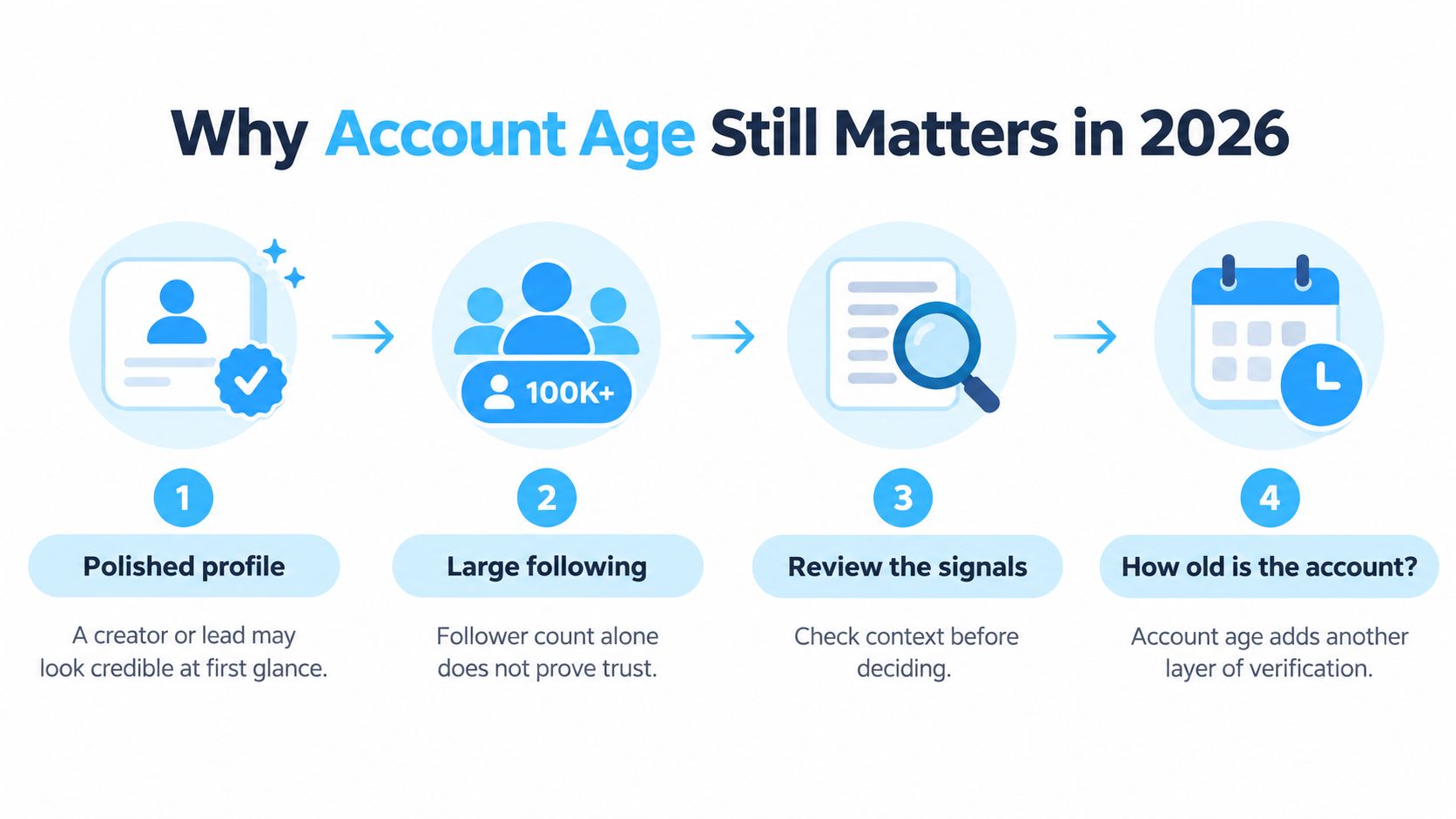
Age describes the account, not its current operator
A username can change while the underlying account stays active. That means a profile with a new handle may have a long history, while the account's current identity may be recent. A creation date is a time reference, not proof that the person or organization using the account today has always controlled it.
Read the date alongside other historical signals, such as previous usernames, verification status, registration country, and posting history. Each one needs its own interpretation. For instance, a long-established account that has recently adopted a creator's name deserves a closer look, but the age alone doesn't prove impersonation.
Practical rule: Use account age to ask better questions, not to make the decision by itself.
For influencer vetting, fraud screening, and lead qualification, the useful distinction is whether a profile is long-established, recently created, or old but suddenly rebranded. A large following can provide reach, but it doesn't establish longevity. Account age can help you put that reach in context.
Signals to Gather Before You Check
Before you check an account's age, make sure you know which account you're checking and what decision the result will inform. Start with a username, numeric identifier, or profile URL. If a brand or creator has changed handles, use the profile URL or identifier when available, then record the visible username separately. That makes it easier to match the result to the profile you reviewed.
Also write down the purpose of the check. You might be deciding whether to invite a creator to a campaign, flag a possible impersonation, or qualify a lead. The intended use determines how much corroboration you need. A quick review for context isn't the same as a fraud investigation.

Separate visible history from creation evidence
Note whether the profile is public or private, whether the handle seems recently changed, and whether transparency details are visible. A private profile may limit what you can inspect, but that doesn't tell you whether a platform transparency field is available. Record which fields appear rather than assuming that a missing field means the account is new.
Public history can help establish that an account existed by a certain point. Useful clues may include an old post, an early tagged appearance, an archived link from an official website, or a dated search result. None of these is a registration date. An old post proves activity by its posting date, and a historical link proves that the account was publicly referenced by then.
A changed handle doesn't establish the account's age, and a high post count doesn't establish it either. Accounts can be renamed, and content volume says little about when registration happened. If you're also reviewing visible activity and want a broader explanation of what such checks can and can't show, Instagram stalker checks explained offers related context.
Before calculating anything, assemble a short evidence packet:
- Account reference: Save the handle, profile URL, or numeric identifier you used.
- Reason for the check: Note the decision the result will support.
- Visible history: List which posts, tags, links, or transparency fields you could inspect.
- Access limits: Record whether the account is private, appears recently renamed, or shows incomplete information.
If you need structured post data to support later timeline review, consult the profile posts endpoint documentation. Collecting these details first helps prevent an estimate from being mistaken for a confirmed creation date.
Checking Age from Account History Data
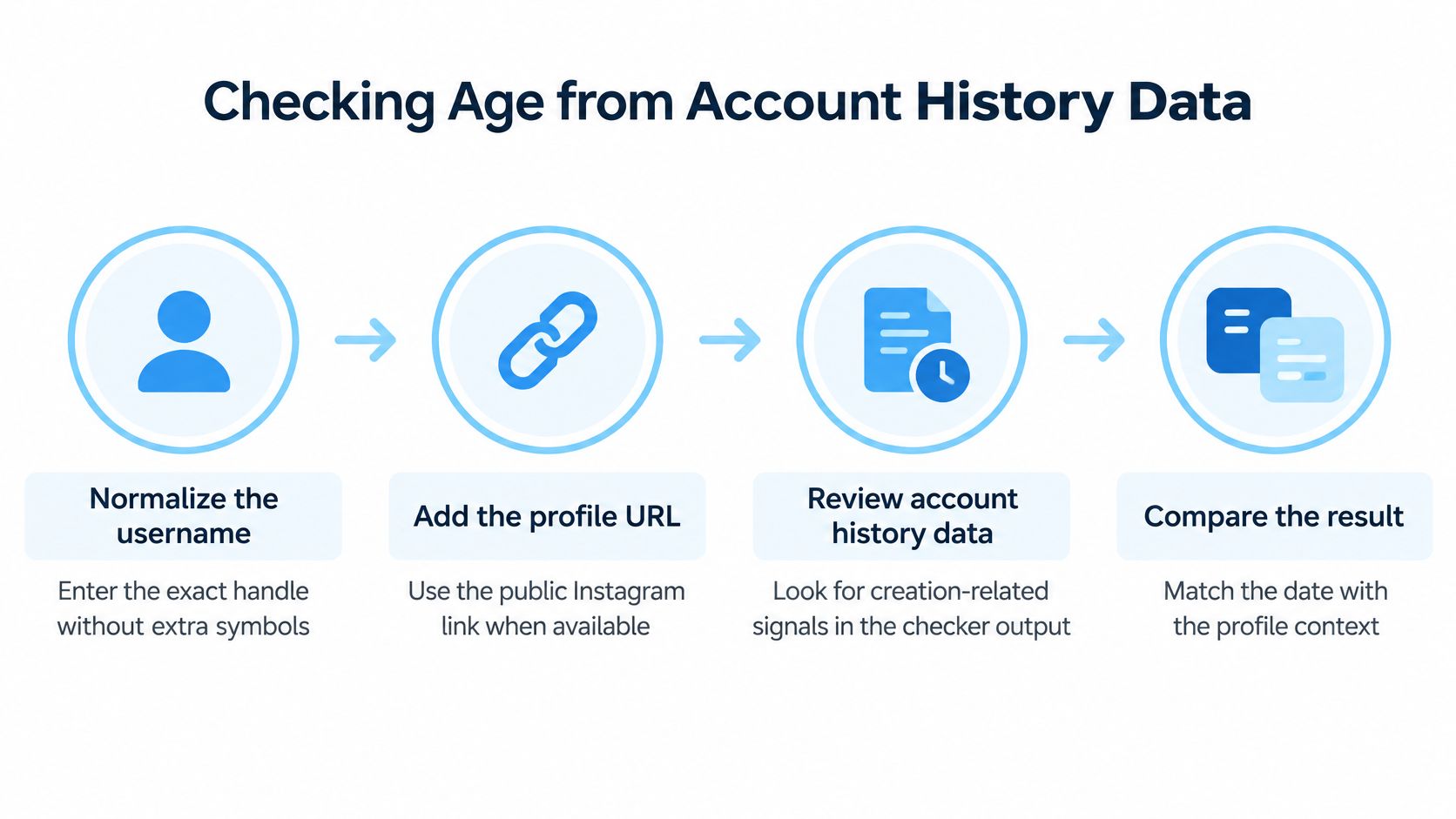
A reliable Instagram account age checker should make it clear where its date came from. Treat the check as a small evidence workflow: identify the profile consistently, look for a platform-provided creation value, calculate from a stated reference date, and keep the evidence with the result.
Keep the source value, not just the age
First, normalize the username or profile URL. Remove extra symbols or formatting that could lead your process to treat the same profile as separate inputs. When a numeric identifier is available, keep it alongside the handle, since a username may change.
Next, look for a platform-supplied creation field. Meta's research data-access documentation defines account_creation_date as the date an account was created, formatted as YYYY-MM-DD, and says the value is retrieved from Meta's production database. That makes a returned platform creation field stronger evidence than an estimate based on public posts. It doesn't mean every checker can access that field or that every profile will return it. See the Instagram data-access pilot user guide.pdf?hsCtaTracking=bd237895-5dd1-43d6-937c-3f76d2251eaf%7C04de5c77-319c-48b2-be31-6a697813531b&hsLang=en) for how the field is described in a research data-access context.
Calculate age using a fixed timezone and explicit reference date. Keep the original date returned and the time you retrieved it, even if your report also displays an age in years. If the creation value is missing, label it unknown rather than filling the gap with a guess.
When the primary creation field is missing
If you have to use public history instead, seek at least three independent historical signals. These might include the oldest visible post, an early tag, an archived official-site link, or a dated search result. Report the result as a lower-bound date: it shows that the account existed publicly by that point, not when it was registered.
A historical link proves public existence by that date, not account creation. Likewise, an old post demonstrates activity, not the registration date. Keep those distinctions visible in your notes.
A useful output should include:
- Creation date: The source value, or “unknown.”
- Age in years: A calculation tied to an explicit reference date.
- Confidence: Whether the result comes from a platform field or public-history clues.
- Evidence sources: The fields and historical items you reviewed.
- Limitations: Any missing data, access restriction, or reason the date is only a lower bound.
For background on evaluating older profiles on another social platform, Digital Footprint Check's Facebook account guide offers a separate example of account-history research. For Instagram profile transparency fields, refer to the profile about endpoint documentation.
Username history and post volume aren't account age.
Reading a Month and Year Result
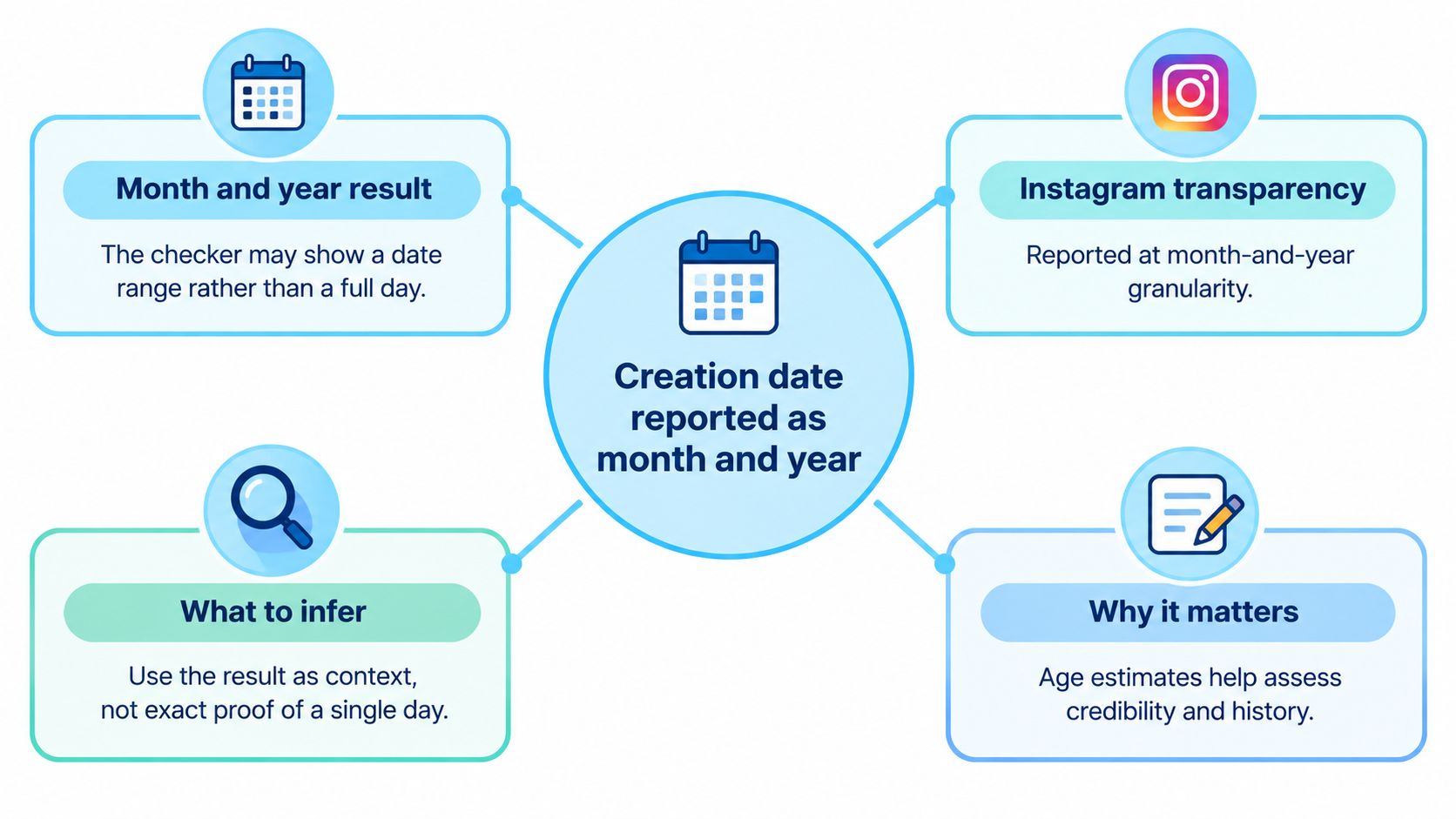
A result that says November 2010 doesn't identify a specific day. Instagram transparency can report creation at month-and-year granularity, so the result can't tell you whether the account was created on November 1 or November 30. That limitation matters when a team is applying an eligibility rule, comparing an account with a fraud timeline, or vetting a creator against a particular campaign cutoff.
Preserve the precision the source actually gives
Keep the original month and year in your notes. If a tool calculates an age from that result, label it an approximation and preserve the retrieval timestamp so another reviewer can see when the information was checked. If the response contains only a year, don't invent a month to make the display look complete.
Platform-wide growth can help place an account's creation period in context, but those user totals aren't counts of accounts. Instagram passed 1 billion monthly active users in June 2018, roughly eight years after launch, and exceeded 2 billion monthly active users in December 2021. Meta CEO Mark Zuckerberg announced 3 billion monthly active users in September 2025. These milestones describe monthly active users, not the number of profiles created. The report on Instagram's 2-billion monthly-user milestone provides context for that growth.
As a practical reference, accounts created around 2010–2011 belong to Instagram's earliest period. Accounts created before 2018 predate the 1-billion monthly-user milestone, while accounts created after 2021 emerged after Instagram had passed 2 billion monthly users. These are timeline comparisons, not shortcuts for calculating an individual account's exact age.
Account age is evidence of historical continuity, not proof of identity, legitimacy, or ownership.
Read identity signals separately
An old account can carry a recent identity. If the handle has changed, compare the available former usernames with the current profile and note what the history does and doesn't show. A partial list of former handles doesn't establish every previous identity or prove that one person controlled the account throughout its history.
Registration country also needs care. It may provide context about an account's registration, but it doesn't necessarily identify the operator's current residence. Keep it as a separate signal rather than treating it as a location confirmation.
The most useful report states what the month-and-year value supports and what it can't support. That keeps a helpful historical clue from becoming a false claim about a precise birthday or a person's identity.
Choosing the Right Checking Method
The right method depends on what evidence your decision requires. A manual review can work for a one-off profile. A public-history estimate can support a cautious lower bound. Structured transparency data is a better fit when you need consistent fields for repeated checks or integration into a workflow.
| Method | What you get | Honest limit | Best use |
|---|---|---|---|
| Manual public-history review | Visible posts, tags, links, and other dated clues | Shows public existence or activity by a date, not registration | One profile review where a lower bound is enough |
| Inferred lower bound | A timeline based on several independent historical signals | Must be labeled as a lower bound; clues may be incomplete | Due diligence when a creation field isn't available |
| Structured transparency data | Account creation information and related profile fields when returned | Availability and precision depend on the returned fields | Repeatable reviews, reporting, and data workflows |
Match evidence strength to the task
Manual review is straightforward for a single account, especially when the profile has visible historical material. It can become difficult to reproduce consistently when several people review the same profile or a team needs to check many accounts. Record the evidence, not just your conclusion, so another reviewer can understand how you reached it.
An inferred date is useful only when you describe it accurately. If the oldest visible post is from a certain month, you can say the account was active by then. You can't turn that post date into a registration date. More context from separate sources can strengthen the lower-bound estimate, but it doesn't change what those clues prove.
For structured checks, Instagram API on profilequery.com offers an account transparency endpoint that can return creation month and year, account age, registration country, previous usernames, and verification status. The service returns JSON for applications, analytics workflows, and AI agents. It uses an API key without Instagram OAuth, app review, or business verification, and access is based on prepaid credits rather than a subscription. New accounts receive 50 credits without a payment card; published packages are 2,500 credits for $20, 10,000 for $70, and 50,000 for $300. Most requests cost one credit, while some deeper requests cost two.
Choose by the claim you need to support
If the decision only requires “this profile existed by this date,” manual review may be enough. If you need a creation month and year alongside other transparency fields, structured data is a more suitable input, provided the response returns those values. In either case, don't claim that a method identifies a private operator. Account history supports a timeline, not a person's identity.
Registration country should also stay distinct from current residence. A field can describe an account signal without establishing where its operator lives now. Keep each result tied to its source and intended use so teams don't treat a convenient data format as stronger evidence than it is.
Tips for Trustworthy Age Checks
Private and changed accounts can leave gaps in the evidence. Coverage is inconsistent: someone who doesn't follow a private account may have difficulty viewing username history, while product pages may claim that transparency fields are available for private profiles. The useful response isn't to assume either outcome. Record which fields the checker returned, and leave unavailable values unknown.
A visible list of former usernames also isn't a complete rename ledger. It can provide context about a profile's previous names, but it can't prove every identity the account has used or establish that the same person operated it throughout. Treat each returned field as a separate clue.
Keep the conclusion narrower than the evidence
Account creation age doesn't verify the holder's age. A 2025 field study reported that age-assurance checks using birth dates, IDs, or video selfies were weak or inconsistently implemented. For that reason, an old account's creation date can't show that its current holder meets a minimum-age requirement. It also isn't a substitute for identity verification, consent checks, or a review of platform policies.
A result you keep should record:
- Month and year: Preserve the reported value, or mark it unknown.
- Approximate age: State that it's an estimate when the source doesn't provide a precise date.
- Confidence: Identify whether the result came from a creation field or public-history clues.
- Retrieval timestamp: Note when you accessed the result.
- Decision limits: State what the date doesn't establish, including identity or minimum age.
For a broader structured view of profile signals, see the profile audit insights documentation. Use that information as context, not as a substitute for the specific evidence your decision requires.
A practical next check is to review one known public account through the Instagram API transparency endpoint on profilequery.com. Compare the returned month and year with the oldest public post, then write down what the two signals agree on and what remains unknown.
Instagram API offers structured account transparency data, including creation month and year when available, alongside related profile fields. If you're checking account history for creator vetting or due diligence, visit Instagram API to review the endpoint and decide whether it fits your workflow.
Pull Instagram data with one API call
Profiles, posts, reels, followers and more. 50 free credits, no credit card.
Get your free key