
Social Media Screening: Signals, Steps and Fair Practice
Learn what social media screening checks, where it is used, its validity limits and how to apply it fairly with documented, job-relevant criteria.
The most repeated hiring advice is simple: look them up before you offer the job. Scroll the public posts, glance at the follower count, and trust your gut about "fit." That advice treats a profile as a character reference. It isn't one.
Social media screening is the review of publicly visible profiles and posts to inform a decision about a person or account, most often in hiring, admissions, partnerships, or fraud checks. Done well, it's an evidence problem. Each signal has to predict something you can name, and a missing profile has to stay missing data, not a mark against the person. Done casually, the same review rewards people who look familiar and punishes people who post less, stay private, or never opened an account.
A public profile can show continuity, tone, and conduct the person chose to display. It can't prove how someone will perform, and it often reveals protected facts you have no business using.
Table of Contents
- What Screeners Look For and Why
- Who Screens, Where Policy Lags and Why
- How to Run a Screening Check Step by Step
- Where Screening Predicts Little About Performance
- Fairness Problems With Private, Inactive and Missing Profiles
- Decide Before You Collect Any Data
What Screeners Look For and Why
Screeners usually want three things from a public profile. Credibility asks whether the account looks real and continuous. Risk asks whether any observable conduct is relevant to the role or relationship. Reputation asks how the person presents in public. Those are different questions, and a single screenshot answers none of them.
A profile is a shop window. It shows what the owner chooses to display, not the stockroom behind it. Account age, a verification badge, old usernames, registration country, follower quality, and the trail of posts and comments are window dressing until you tie each one to a stated purpose.
Why one signal is weak
Read each row as a hypothesis, not a finding. Older isn't the same as honest. A missing badge isn't proof of a fake. A rename is ordinary. Registration country isn't current residence. A follower sample isn't a census. A sharp comment, stripped of the thread around it, isn't a work record.
| Signal | What it can show | Common misreading | How to verify |
|---|---|---|---|
| Account age and creation date | How long a profile has existed | Older accounts are not automatically trustworthy | Compare with other dated evidence |
| Verification badge | Platform-level identity check | Missing badge does not mean fake | Check status at the time of review |
| Previous usernames | Identity continuity across renames | Renames are common and often harmless | Match against stable details such as name and photo |
| Registration country vs current residence | Where the account was set up | Not the same as where the person lives | Treat as context, never as proof |
| Follower quality | Share of suspicious or inactive followers | Sample-based estimate, not a certainty | Compare with engagement and content |
| Posting and comment history | Public conduct and recurring topics | Context-poor posts mislead | Read in full context against job-relevant criteria |
Before anyone opens a profile, write the decision the signal is allowed to inform. If you can't name that decision, you don't have a screening criterion. You have curiosity. Public posts are the right place to start that test, because a posts endpoint returns the thread, not a cropped screenshot, and the full thread is what stops a joke, a quote, or a reply from being scored as the person's own claim.
Practical rule: No signal gets collected until its purpose is written down. If the purpose is "see what they're like," stop. That isn't a criterion.
Who Screens, Where Policy Lags and Why
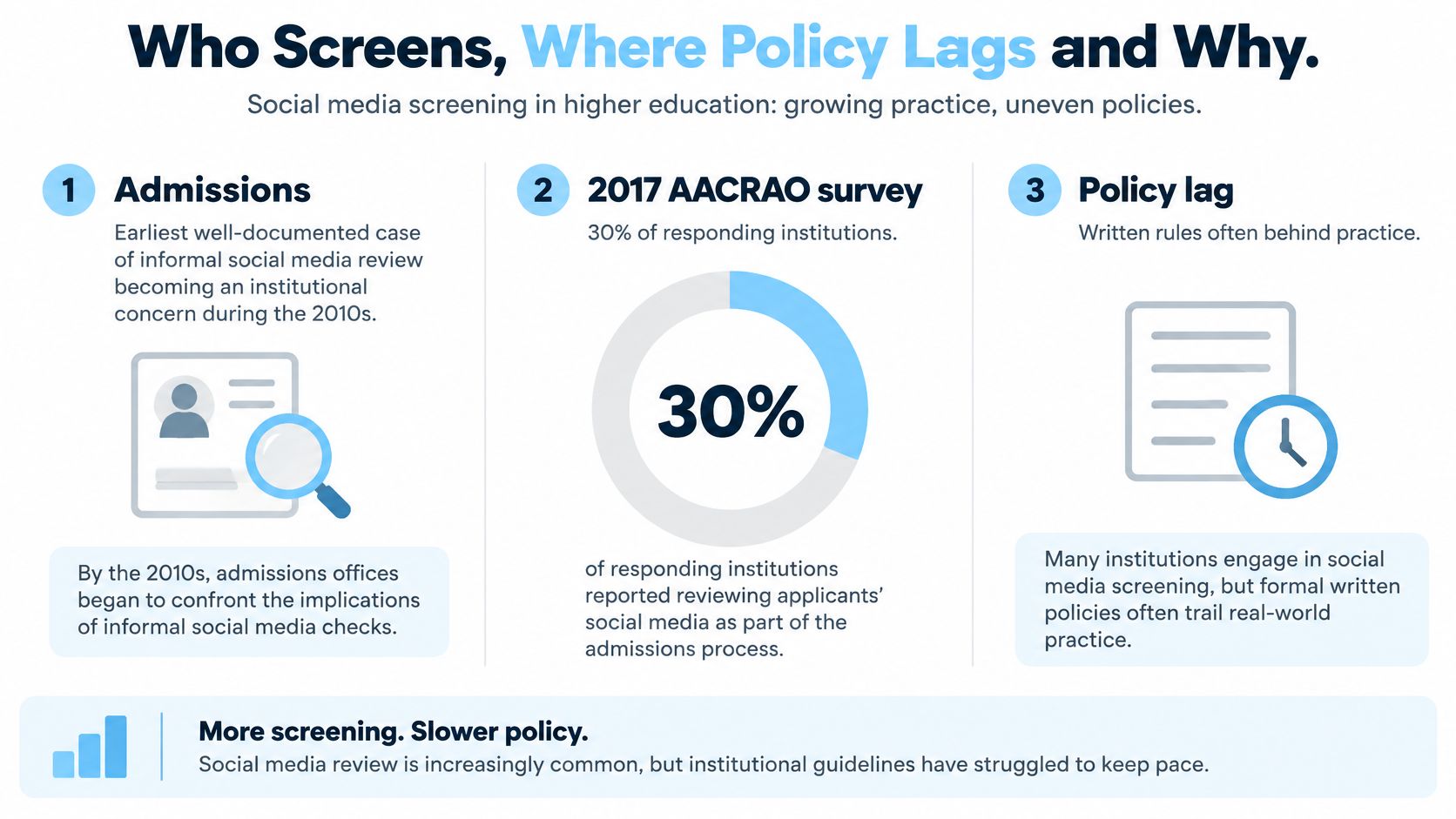
Admissions offices wrote the early chapter of this practice, and they wrote it without a rulebook. Informal review of applicants' personal accounts became an institutional concern during the 2010s, long before most employers had a named process. The pattern that followed is the one hiring teams still repeat: use first, policy later, if at all.
Review spread faster than the rules
A 2017 survey by the American Association of Collegiate Registrars and Admissions Officers found that 30% of responding institutions reviewed applicants' personal social media accounts at least occasionally, and 11% said they had refused admission based on social media content, including 8% of public institutions. Only 12% of institutions that acknowledged the review had a formal policy governing how that information should affect admissions decisions, leaving 88% without one. In Kaplan's 2023 survey of admissions officers at 205 U.S. colleges and universities, 28% said they had checked applicants' social media, while 67% considered doing so "fair game."
Normalization, not a sudden spike in risk, is the story. Officers kept looking. Written limits on purpose, consistency, and bias did not keep up. A refusal grounded in a context-poor post, with no shared standard and no record, is an arbitrary judgment wearing an institutional letterhead.
The same gap shows up in hiring
Employers did not close that gap. They inherited it. A 2023 survey covered by HR Daily Advisor found that 10% of North American companies included social media checks in pre-employment screening, up from 6% the previous year. Adoption was higher in the Asia-Pacific region, at 17%, and in Europe, the Middle East, and Africa, at 20%. Screening is not confined to one labor market. It is still a minority practice, not a hiring standard.
Among North American companies that did not screen, the brakes were knowledge and law, not indifference. 31% said they lacked sufficient knowledge about how to use it, another 31% cited the absence of regulations requiring it, and 26% reported legal concerns. Lawful use will not look the same in every jurisdiction, so a global program needs a local purpose, not a single scrape-and-score habit.
| Measure | Value | Note |
|---|---|---|
| North American companies with social media checks, 2022 | 6% | Prior-year baseline |
| North American companies with social media checks, 2023 | 10% | Up from 6% |
| Asia-Pacific companies with social media checks, 2023 | 17% | Regional figure |
| Europe, Middle East and Africa companies with social media checks, 2023 | 20% | Regional figure |
| Non-screening North American firms citing lack of knowledge | 31% | Method barrier |
| Non-screening North American firms citing no regulation requiring it | 31% | Governance barrier |
| Non-screening North American firms citing legal concerns | 26% | Legal barrier |
| Institutions reviewing applicants' social media, 2017 | 30% | AACRAO survey |
| Institutions with a formal policy on such review, 2017 | 12% | 88% had none |
Teams comparing tools should compare candidate screening software on whether a product forces a written purpose and an audit trail, not on how much public content it can pull.
Every program needs four controls before the first profile is opened. State the purpose. Apply the same review standard to every person in the pool. Keep a written record of what was used and why. Separate observable account facts from sensitive or legally protected inferences.
How to Run a Screening Check Step by Step
A fair check is a short file, not a long scroll. The order matters because criteria written after you've seen the posts will bend toward whatever you happened to notice.
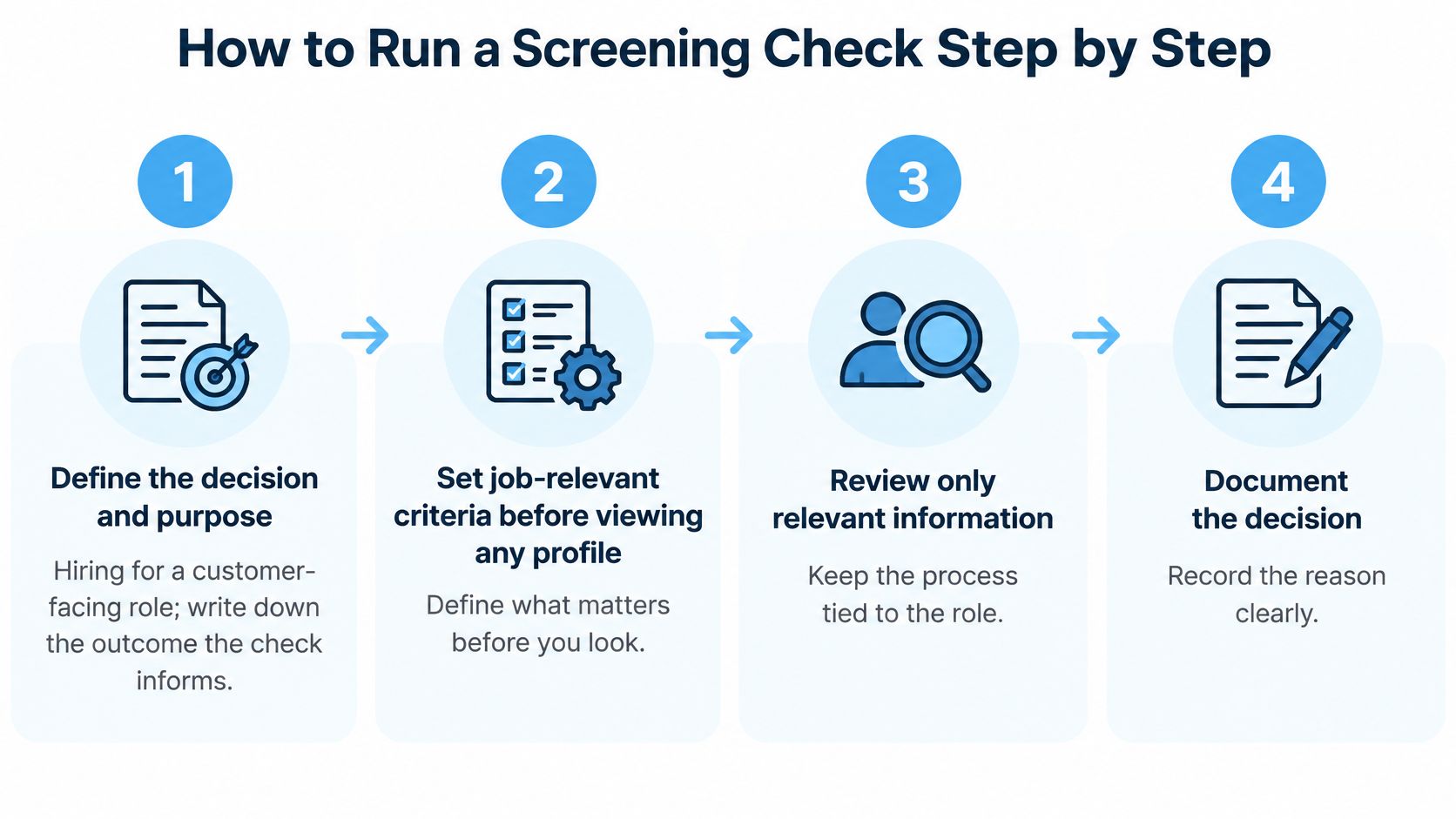
- Name the decision. Write the outcome this check informs, such as whether a finalist for a customer-facing role stays on the shortlist, so later findings have somewhere specific to land.
- Write job-relevant criteria first. Define them before any profile is opened, for example professional conduct with clients or public statements that conflict with a stated policy, because criteria drafted after the scroll chase the post instead of the role.
- Give notice, and keep another route open. Tell the person you're reviewing public accounts where the process allows it, and offer an equivalent evaluation that doesn't depend on social media, so privacy choices don't become a penalty.
- Collect only what is public, and log it. Record the handle, the URL, and the date of review. A user search should confirm you're on the right public account before any post is read, because the wrong handle makes every later note worthless.
- Verify identity before you use a finding. Compare usernames, photos, and stated details with independent evidence. A similar name and a similar city are not a match.
- Score each finding against the criteria. Mark it job-relevant, unclear, or irrelevant. Unclear stays unclear until someone reads the full thread. It doesn't get rounded up to a concern.
- Exclude protected and proxy attributes. Religion, health, family status, and age don't belong in the score, even when a bio or a photo makes them obvious.
- Record the decision and open a correction route. Write the reasons in plain language, and give the person a way to fix a bad match or a misread post before you act. The candidate background verification steps used for employment history are a useful model: identity first, evidence second, a written reason before any adverse step.
What the finished record looks like
One page per check is enough. It holds the criteria, the evidence (handle, URL, date, and the exact post or fact relied on), how identity was confirmed, what was excluded, and the outcome. If a second reviewer can't reconstruct the decision from that page, the check isn't finished.
If you can't point to the criterion a post was scored against, the post doesn't belong in the file.
Where Screening Predicts Little About Performance
Finding a post is not the same as predicting a job. Assessments based on social-media screening can be inconsistent with information the applicant supplied, and newer scholarship notes that the relationship between social-media information and important hiring outcomes such as job performance remains empirically unsubstantiated, as set out in research indexed on PMC. Professionalism, cultural fit, and hiring risk are impressions until someone shows they forecast a defined result.
Three questions before a criterion is allowed
Each question kills a different bad habit.
- Which observable signal predicts a defined job outcome? "Seems unprofessional" fails this test. "Repeated public insults toward named customers, scored against a client-conduct rule" might pass it, and only for roles where that conduct is part of the job.
- How much does it add beyond structured interviews and work samples? If a work sample already measures the skill, a profile adds noise and legal exposure, not information.
- Do results hold across countries, languages, occupations, and posting habits? A signal that only "works" for heavy posters in one language is a bias, not a predictor.
More data can make the decision worse. A profile can reveal lifestyle, political views, age, race, disability, religion, or family information without demonstrating work capability. Similarity between evaluator and applicant can raise ratings, so a warm feeling of fit may be measuring shared identity rather than performance.
What validation actually requires
Name the business outcome you're predicting. Test false positives, the people flagged who would have performed fine. Check whether error rates differ by subgroup. Keep job-relevant evidence in a separate column from protected or proxy attributes, and keep an auditable reason for every decision. Automated profile summaries and lead-fit scores don't escape that test. Without it, they convert ambiguous public behavior into an employment judgment nobody can defend.
Fairness Problems With Private, Inactive and Missing Profiles
Most screening talk starts with what can be found. The harder question is the person who can't be found, or who chose not to publish. Is no discoverable profile neutral evidence, negative evidence, or just missing data? Only the third answer is fair. Absence is an empty cell, not a low score.
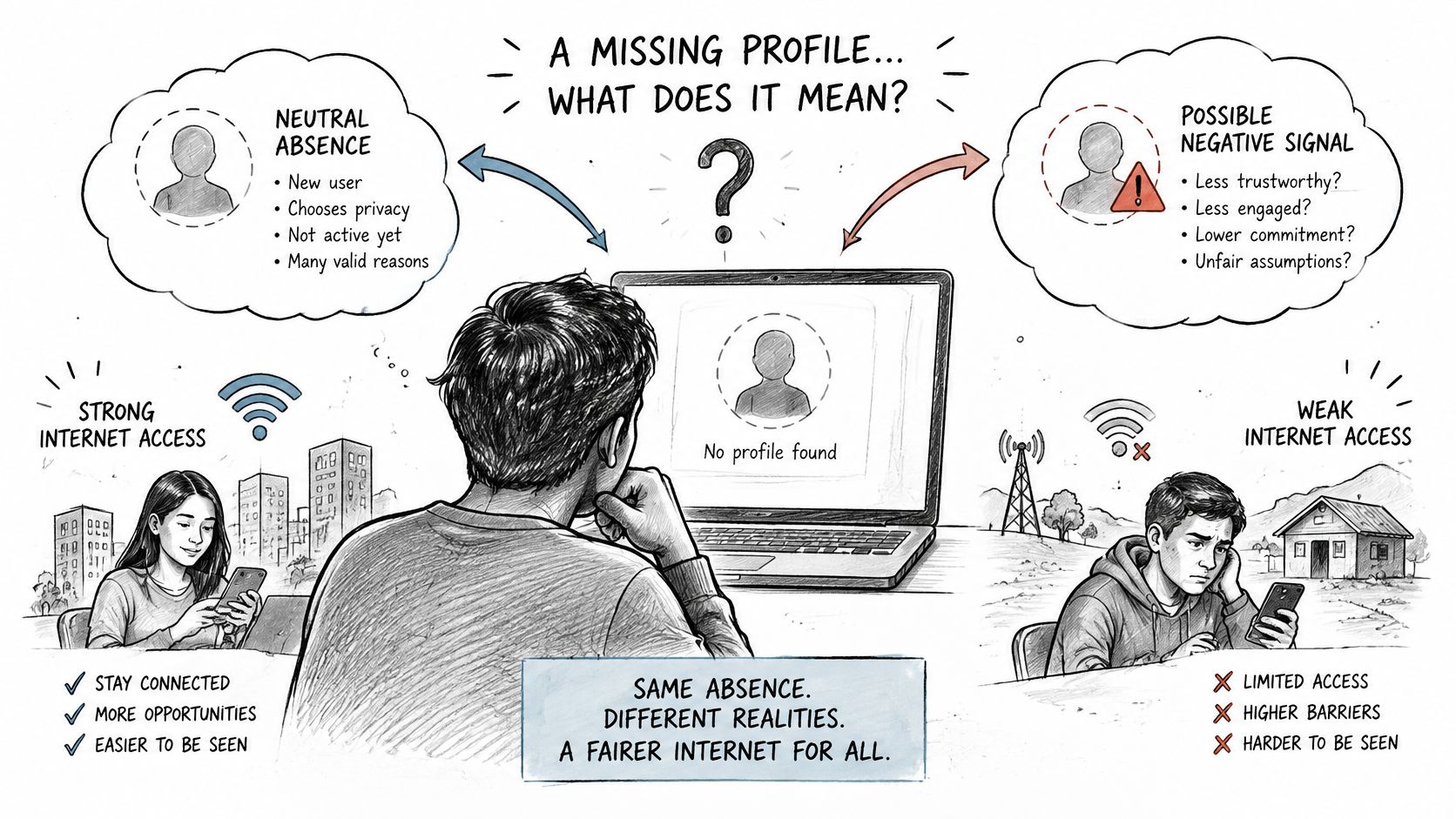
The digital divide, differences in internet access and use across demographic groups, can perpetuate hiring discrimination. Work in Industrial and Organizational Psychology finds that social-media assessments produce greater perceived privacy invasion among minority applicants. Those stronger privacy concerns were associated with greater litigation intentions, and lower social-media self-efficacy was linked to more negative reactions. Public availability is not informed consent, and it is not equal comparability. Two candidates with the same skills can have wildly different profiles because of access, confidence, culture, or a deliberate choice to stay off the platform.
Six situations that punish the wrong person
| Situation | Risk of unfair penalty | Fair handling |
|---|---|---|
| No discoverable profile | Missing data read as a negative | Offer an equivalent non-social route and record no inference |
| Private account | Privacy invasion felt as hostile | Use a consent-based review or drop the signal |
| Changed or previous usernames | Mistaken identity match | Confirm identity with independent evidence before use |
| Low or inactive posting | Read as disinterest or weak skill | Exclude unless tied to a documented job criterion |
| Different cultural posting norms | Lifestyle misread as risk | Review against role criteria with a second reviewer |
| Uncertain identity match | Another person's content attributed to the subject | Provide a correction and appeal route before any decision |
Account age, earlier usernames, registration country, and profile matching can tighten due diligence. They can also expose sensitive history or glue the wrong person's posts to your candidate. Proportion matters. If the match is uncertain, you don't have evidence yet.
No result is never a negative inference. A correction route has to exist before any decision that could cost someone a job, a place, or a contract.
Non-users, private accounts, multiple identities, and culturally different posting norms all need the same rule: an equivalent route that doesn't use social media, a written reason when a public signal is job-relevant, and an appeal when identity is in doubt.
Decide Before You Collect Any Data
Answer these five questions before anyone opens a profile. If any answer is no, pause.
- Is there a named owner accountable for the decision and its record?
- Does the decision have a stated consequence, such as shortlisting or declining, so the purpose can be tested?
- Can the outcome be reversed or appealed if an identity match turns out to be wrong?
- Is a review date set, so criteria and validation results get revisited as roles and evidence change?
- Is an equivalent non-social route ready for people with no discoverable profile?
Public Instagram data, and any vendor-supplied summary such as an engagement figure or a follower-quality estimate, is an input to human review. It is not the decision. Our fake-follower audit estimates real versus suspicious followers from a sample, and that estimate still needs the same criteria, the same validation, and the same appeal path as any other evidence. A practical way to keep collection inside those limits is to read how a social data API should be scoped before you wire it into a hiring workflow.
This week, write the purpose and the criteria for one screening decision. Don't collect a single post until that page exists.
If you're building a review workflow around public Instagram accounts, Instagram API returns structured profile, post, and account-history data you can log against written criteria instead of screenshots. Use it to separate what a public account shows from the judgment a person still has to make. Visit Instagram API to see the endpoints and start with the free credit allowance.
Pull Instagram data with one API call
Profiles, posts, reels, followers and more. 50 free credits, no credit card.
Get your free key