
10 User Generated Content Tools Compared for 2026
The best user generated content tools compared: collect, manage, and measure UGC from social platforms with the right tool for your team and budget.
The most popular advice about user generated content tools is also the least useful: buy a platform that helps you find and repurpose authentic content. That recommendation skips the question that determines whether the purchase will work: which job do you need the software to do?
UGC software covers five distinct stages: discovering public content, collecting it programmatically, managing rights and moderation, displaying approved content, and commissioning new creator assets. Review collection is a specialized collection workflow, while shoppable galleries sit at the display end. A creator marketplace won't fix unreliable Instagram data ingestion, and a social wall won't establish permission to run a customer's video in an advertisement.
The tools below serve different parts of that workflow:
- Discovery and programmatic collection: Profile Query's public-data API.
- Review collection and distribution: Bazaarvoice and Yotpo.
- Rights-managed curation and commerce: Emplifi UGC and Nosto Visual UGC.
- Social display and shoppable galleries: Taggbox, Walls.io, and Foursixty.
- Commissioned creator production: Billo and Insense.
Choose around the broken handoff, not the longest feature list. Before purchasing, confirm current pricing, Instagram source coverage, permissions requirements, and plan-level access. A supported platform name doesn't necessarily mean the vendor supports the particular posts, account types, refresh frequency, or publishing destinations your team needs.
Table of Contents
- 1. Instagram API
- 2. Bazaarvoice
- 3. Yotpo
- 4. Emplifi UGC
- 5. Nosto Visual UGC
- 6. Taggbox
- 7. Walls.io
- 8. Billo
- 9. Insense
- 10. Foursixty
- UGC tools compared
- Matching the Tool to Your UGC Workflow Stage
1. Instagram API
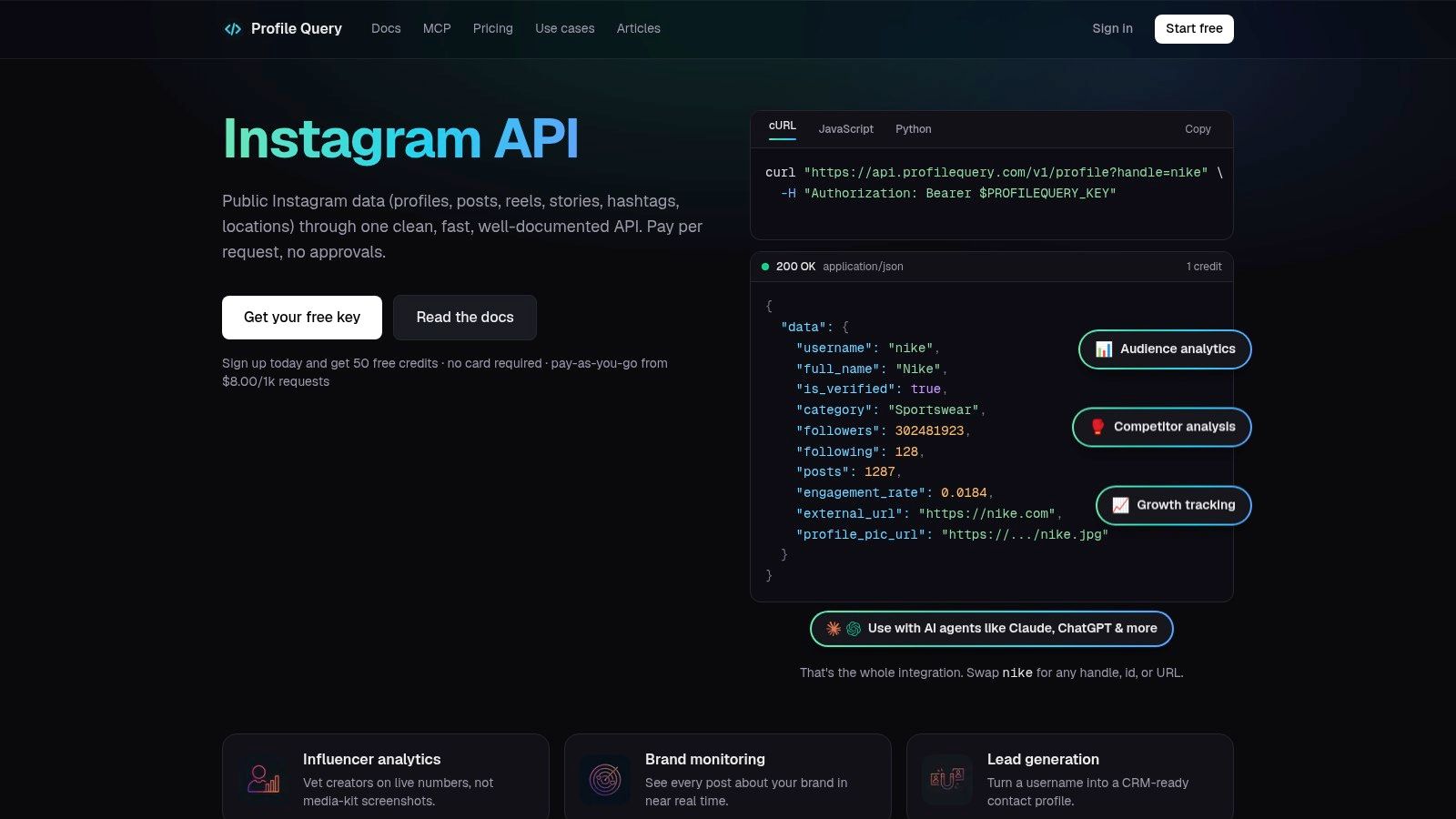
Best for developers who need public Instagram content as structured data rather than a finished gallery. Our service provides a REST API with predictable JSON, using an API key without Instagram OAuth, app review, or business verification.
Coverage includes profiles, posts, Reels, active Stories, highlights, comments, likers, hashtags, locations, and search. Analytics endpoints add engagement rates, posting-time analysis, follower-quality audits, account summaries, and comment sentiment, making the service useful for both UGC collection and creator assessment.
Where it fits in a production workflow
For store or venue monitoring, poll the location-posts endpoint, save identifiers you've already processed, and stop paging when you encounter a known post. Keep source URLs, retrieval timestamps, and request metadata alongside each record so your moderation team can trace an asset back to its origin.
- Integration resources: OpenAPI documentation, cURL, JavaScript, and Python examples, plus an MCP server for agent-based workflows.
- Usage controls: Responses include typed errors and metadata covering request identifiers, credit charges, remaining balance, and processing time.
- Billing: New accounts receive 50 free credits without a payment card. Prepaid packages include 2,500 credits for $20, 10,000 for $70, and 50,000 for $300, without a recurring subscription.
Most requests cost a credit, while deeper endpoints can cost more. Invalid inputs and upstream failures aren't charged, but a not-found result can consume credits when a query was performed.
The trade-off: public-data retrieval isn't rights clearance, and upstream availability remains a dependency. Private content and information requiring user login aren't available.
Use our comparison of Instagram API options to evaluate integration approaches. Pair the technical implementation with practical social advice from Creators Toolbox, especially when deciding how collected content will support an actual campaign.
2. Bazaarvoice
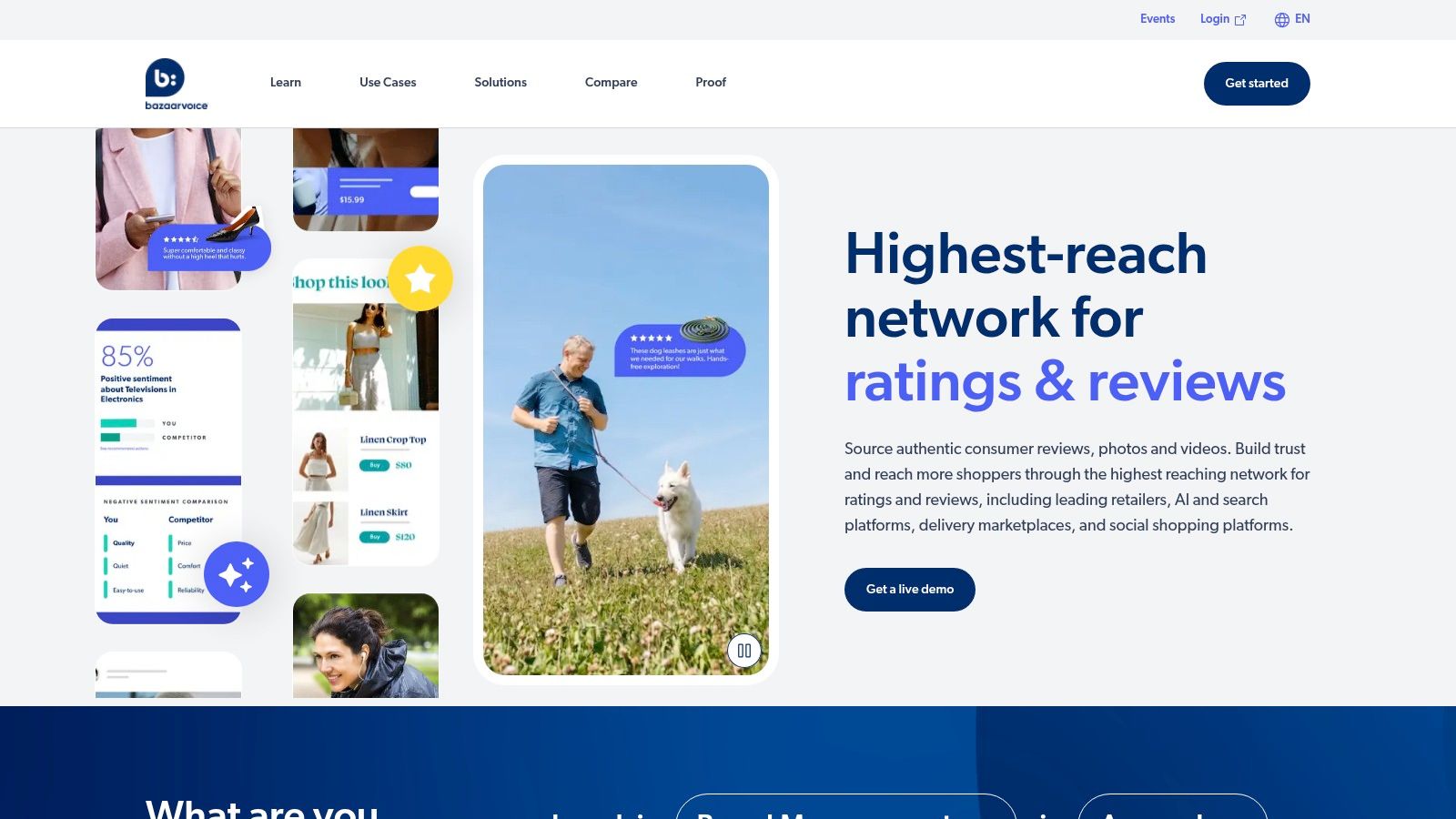
A brand selling through retailers has a different problem from a brand building an Instagram gallery: customer evidence needs to appear wherever shoppers evaluate the product. Bazaarvoice is built around review collection, moderation, display, and distribution, including syndication to participating retailers.
Its collection workflows cover ratings, reviews, questions, photos, and videos. Automated email and text requests help make customer contributions part of the post-purchase process rather than an occasional marketing campaign.
Visual reviews deserve attention during evaluation. According to Bazaarvoice's UGC statistics, 60% of shoppers in 2023 said they'd rather buy a product with 10 reviews containing user images than one with 200 reviews without images.
Evaluate the retail workflow, not just the widget
Ask the sales team to demonstrate how reviews map to your catalog and reach the retailers that matter to your business. Test product variants, identifier mismatches, moderation exceptions, and reporting ownership before committing.
- Strong fit: Brands that need collection, product-page display, and retail distribution in the same operation.
- Main limitation: Custom pricing and implementation scope can make it excessive for a simple social feed.
- Access consideration: API access is associated with the Enterprise package, so don't assume it's included in every proposal.
Bazaarvoice makes the most sense when distribution is part of the requirement, not merely when you need attractive customer photos on your own website.
3. Yotpo
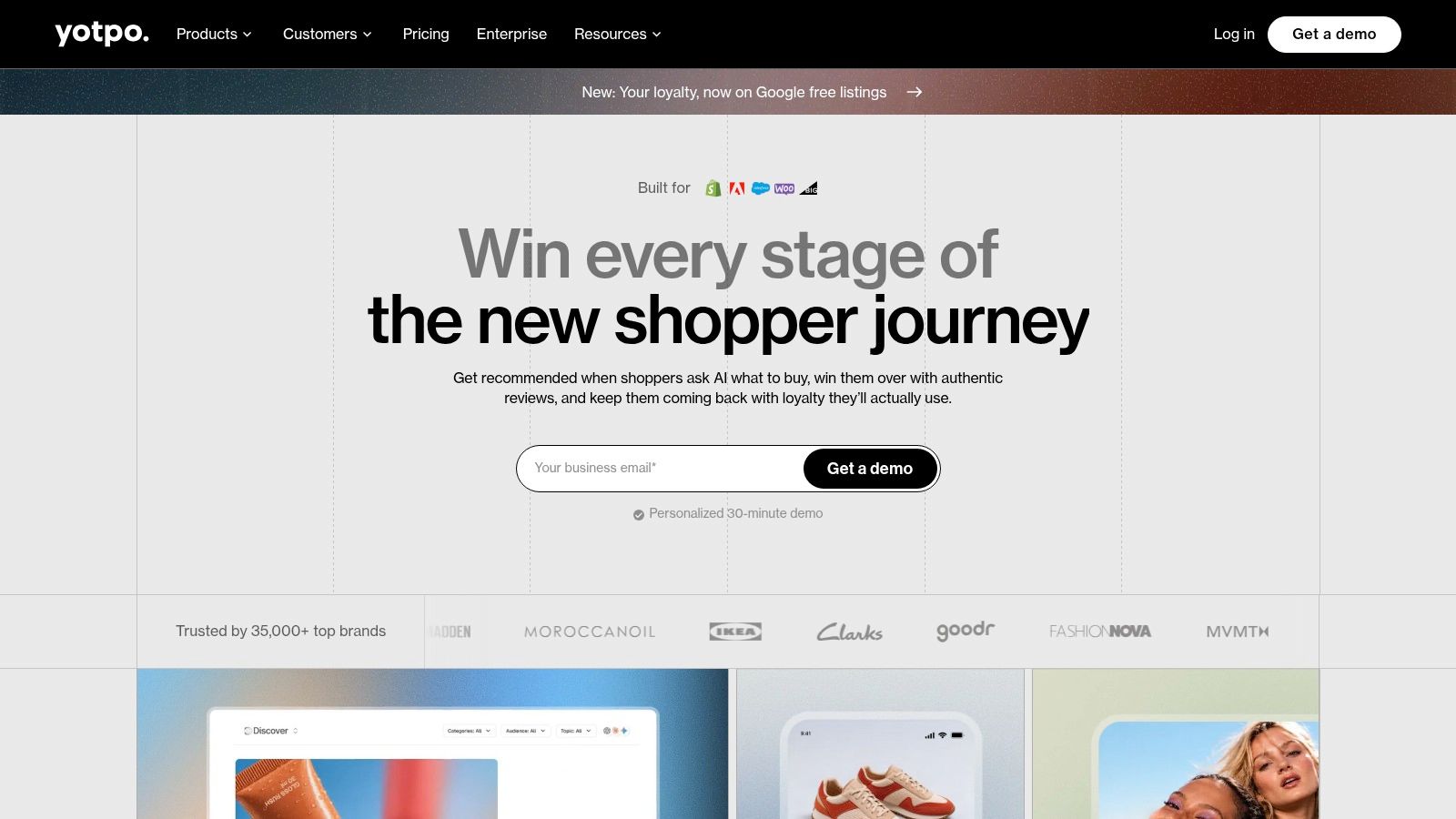
Start with the review request, not the homepage carousel. Yotpo suits ecommerce teams that want to collect product and site reviews, gather customer visuals, and display that evidence close to purchase decisions.
Its Reviews & UGC product can be purchased without adopting the full suite. Website widgets, carousels, and review-focused pages handle presentation, while eligible plans support photo and video reviews; higher tiers add capabilities such as Q&A, AI summaries, and syndication.
The practical advantage is a more focused starting point for a store whose immediate gap is customer feedback. You don't need to make creator sourcing or broad social listening part of the same buying decision.
A polished review widget won't compensate for poorly timed requests, confusing product matching, or a submission form customers abandon.
Test the economics against your order volume
Yotpo offers a limited free option, but order-based pricing means the entry offer may not represent your eventual operating cost. Model your normal order volume and promotional peaks, then check which review formats and integrations remain available at the proposed tier.
During a trial, complete the customer journey yourself: receive the request, submit a visual review, moderate it, and verify where it appears. Check the mobile experience and how reviews attach to product variants.
Choose Yotpo for commerce review operations. Don't treat it as a replacement for retrieving arbitrary public Instagram posts or assessing creator account credibility.
4. Emplifi UGC
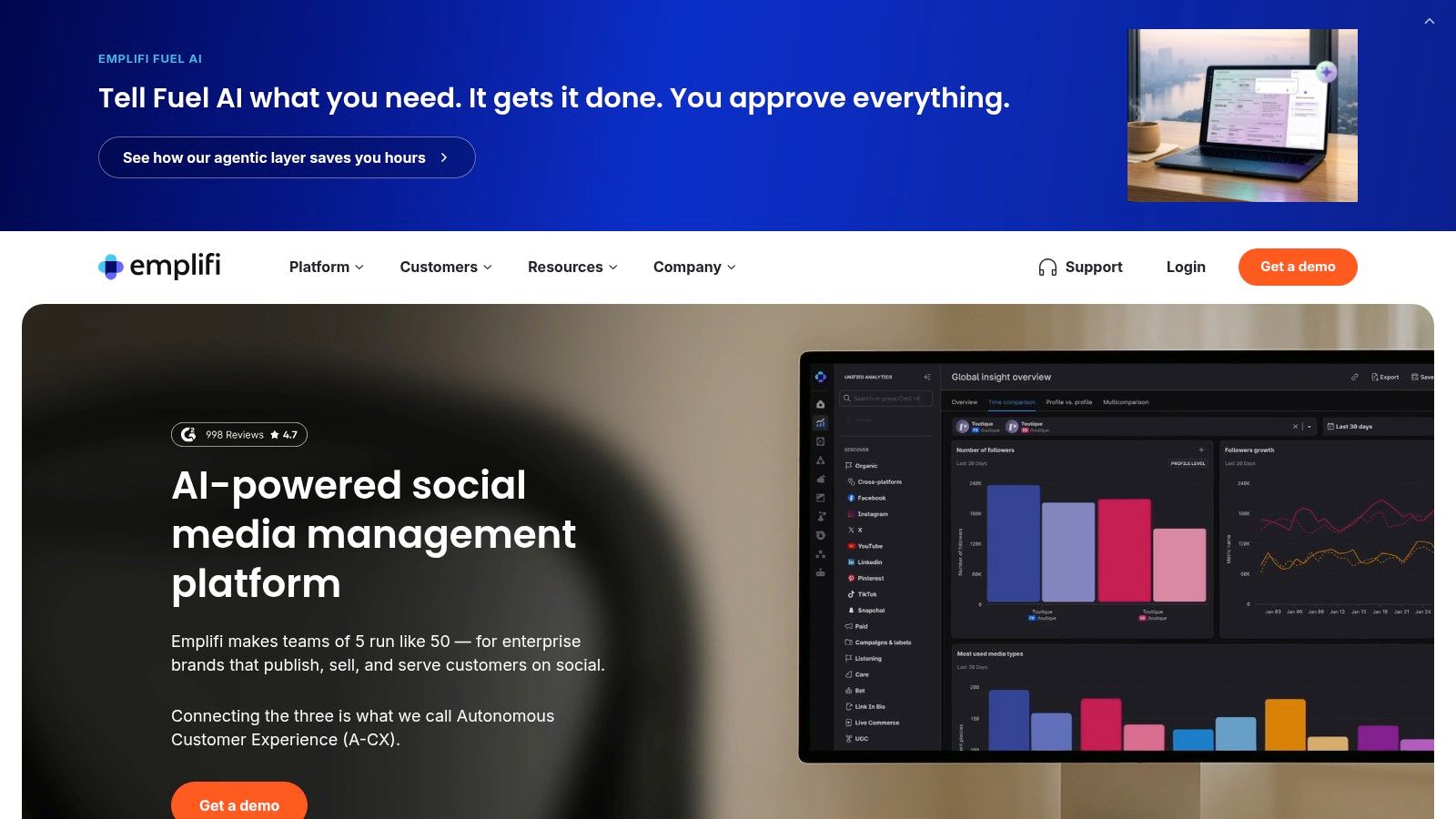
Emplifi UGC is a stronger candidate when the difficult step lies between finding content and approving it for publication. It combines social-content curation, permission workflows, albums, publishing, and analytics within a broader customer-experience and social-commerce platform.
That positioning matters for teams where community managers find assets, legal reviewers approve usage, and ecommerce managers publish them. The handoff needs statuses and ownership, not another shared folder.
Rights deserve explicit evaluation. A creator survey summarized by Emergen Research found that 47% of creators whose content brands used said it was used without permission.
Make the permission workflow prove itself
Ask for a demonstration that starts with an unapproved post and ends with a published asset. Then ask what happens when permission expires or the creator requests removal.
- Collection: Social curation and filtering sit alongside direct-upload options.
- Activation: Albums and publishing tools connect selected content to customer-facing experiences.
- Integration: Documented API-based integrations and connections with ratings and reviews can support a broader implementation.
The trade-off is suite scope. Quote-based pricing and a wider product ecosystem may be justified for coordinated social-commerce operations, but not for a basic embed.
Confirm what the permission record stores, whether approvals can be exported, and how downstream placements are tracked. A permission-request button alone doesn't establish a complete rights-management process.
5. Nosto Visual UGC
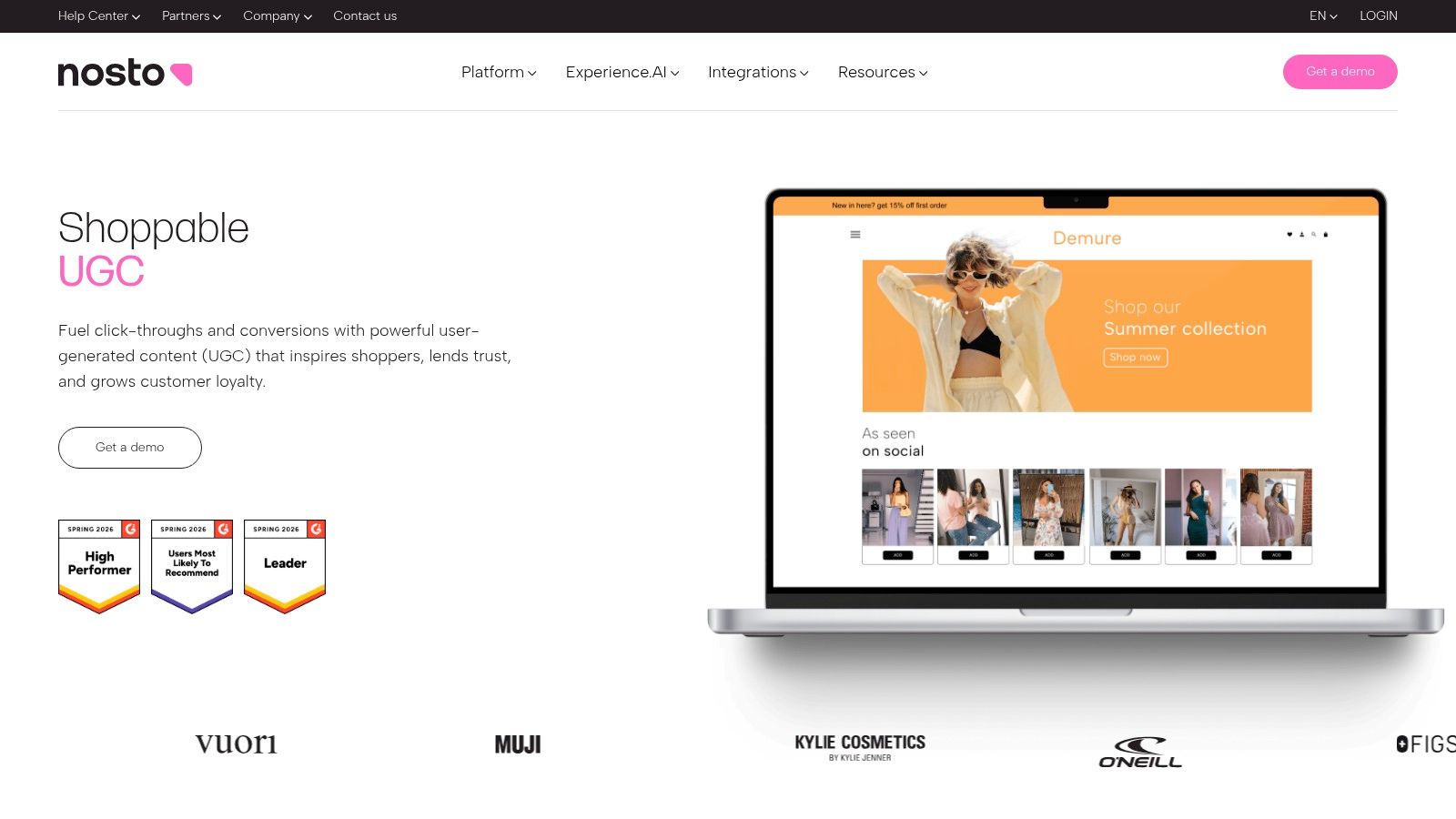
A retailer already evaluating personalization and merchandising should assess Nosto Visual UGC in that context. Its value proposition is customer imagery connected to commerce experiences, rather than an isolated social wall.
The offering, associated with the former Stackla product, supports discovering and curating social content, permission workflows, and using approved visuals in shopping experiences. That makes it relevant when merchandisers need to select content by product, campaign, or customer context.
Don't buy it solely because an older Stackla comparison lists an appealing feature. Product packaging changes, and legacy descriptions aren't a substitute for a current proposal.
Follow an asset through merchandising
Use a realistic scenario during the demo: a customer posts a jacket photo, the team obtains permission, and a merchandiser connects it to the correct product. Then change the scenario by making that product unavailable.
- Check product mapping: How does the team correct an incorrect association or handle a discontinued item?
- Check approval boundaries: Can unapproved assets accidentally enter a published collection?
- Check operating scope: Which capabilities require other Nosto products, integrations, or onboarding work?
Pricing isn't publicly listed for the UGC offering, so compare the complete implementation rather than an assumed standalone widget cost. Nosto is most compelling when visual UGC belongs inside a broader merchandising strategy; a lightweight feed buyer should verify that the scope isn't larger than the problem.
6. Taggbox
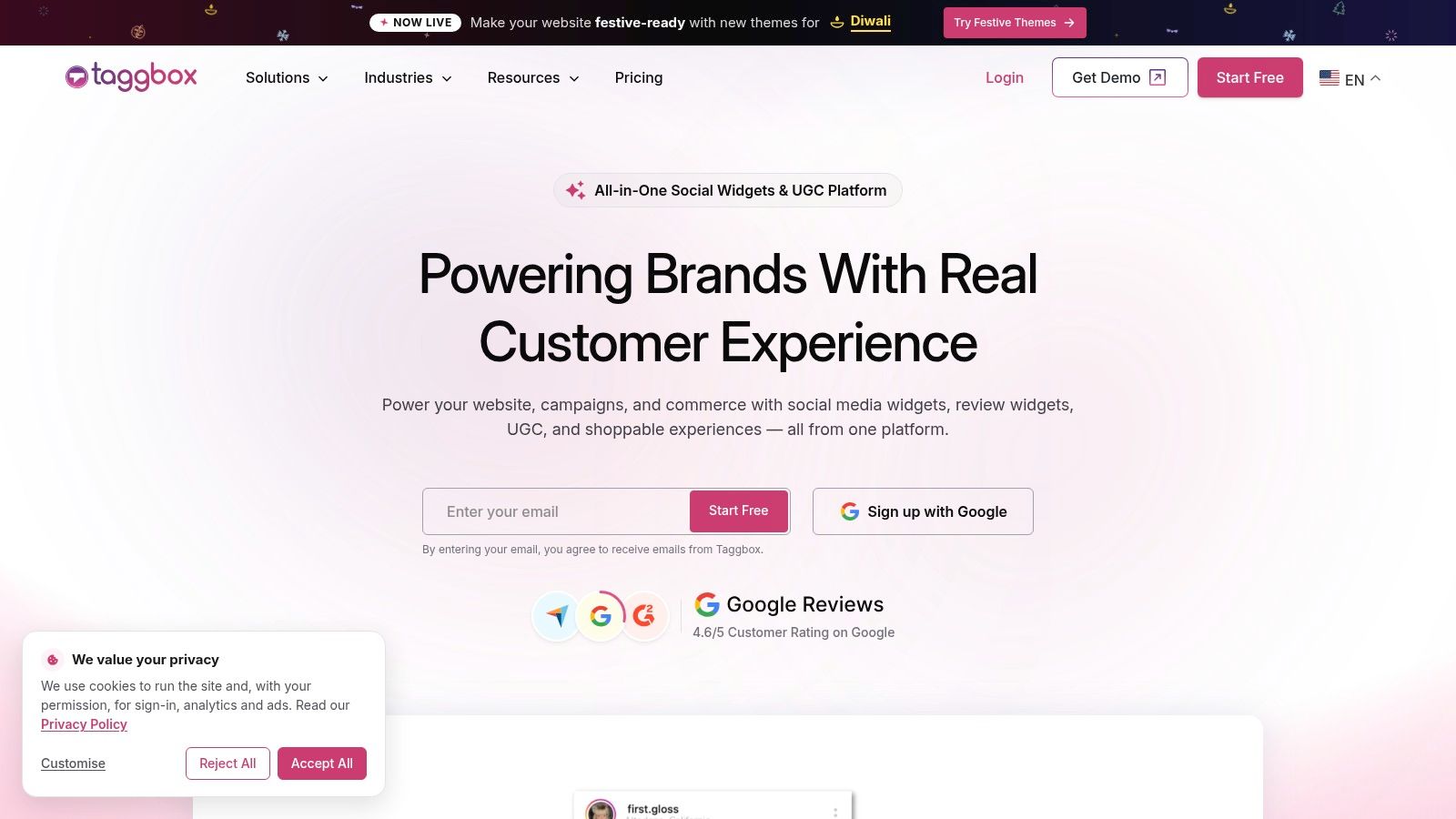
If the immediate requirement is a branded feed on a campaign page, Taggbox is closer to the job than an enterprise review-distribution platform. It aggregates social content and reviews into embeddable feeds, widgets, and social walls, with styling and moderation controls.
Shoppable UGC and product feeds are available on applicable plans. API access and rights-management features are associated with enterprise plans, which is an important distinction for teams expecting a low-cost display subscription to cover backend automation.
Published limits are useful, but read the right limits. Feed volume, sources, update cadence, and available moderation controls can matter more than the number of visual templates.
Practical rule: Specify the oldest acceptable post-fetch delay before comparing display plans. A campaign feed and a live event screen don't have the same freshness requirement.
For hashtag-led campaigns, separate discovery coverage from presentation. This guide to hashtag tracking tools helps frame what you need to collect before deciding how to display it.
During a trial, test your actual Instagram source rather than relying on a generic platform logo. Confirm whether the desired content requires account authorization, which formats appear, and how deletions are handled.
Taggbox offers a lower-complexity route to visible social proof, but it isn't automatically a complete rights, analytics, or data-export system. Verify those requirements against the specific plan.
7. Walls.io

An event organizer needs a screen that stays useful even when attendees don't post publicly. Walls.io addresses that problem with social aggregation and direct audience submissions, alongside moderation and display options for websites, intranets, and digital signage.
Direct uploads are an important distinction. They give attendees a contribution route that doesn't depend entirely on public accounts, campaign hashtags, or social-platform retrieval.
Walls.io also offers interactive options such as polls and photo booths, plus a social-wall API for custom implementations. Its core role remains collection and display, not creator contracting or retail review syndication.
Rehearse the moderation operation
For a live event, evaluate the person operating the queue as carefully as the screen layout. An attractive wall isn't useful if the moderator can't quickly identify submissions that shouldn't appear.
- Submission path: Test uploading from an attendee's phone and make contribution instructions easy to find.
- Review path: Assign a moderator and decide whether content must be approved before display.
- Display path: Test the actual screen dimensions, browser setup, and venue connectivity.
Plans vary by source limits and refresh frequency, while additional sources or custom requirements can change the cost. Confirm what happens when a source stops updating and whether the display can continue using approved content.
Choose Walls.io when participation and public presentation are the primary jobs. Keep creator agreements, long-term asset licensing, and review distribution in separate workflows unless the proposed implementation explicitly covers them.
8. Billo
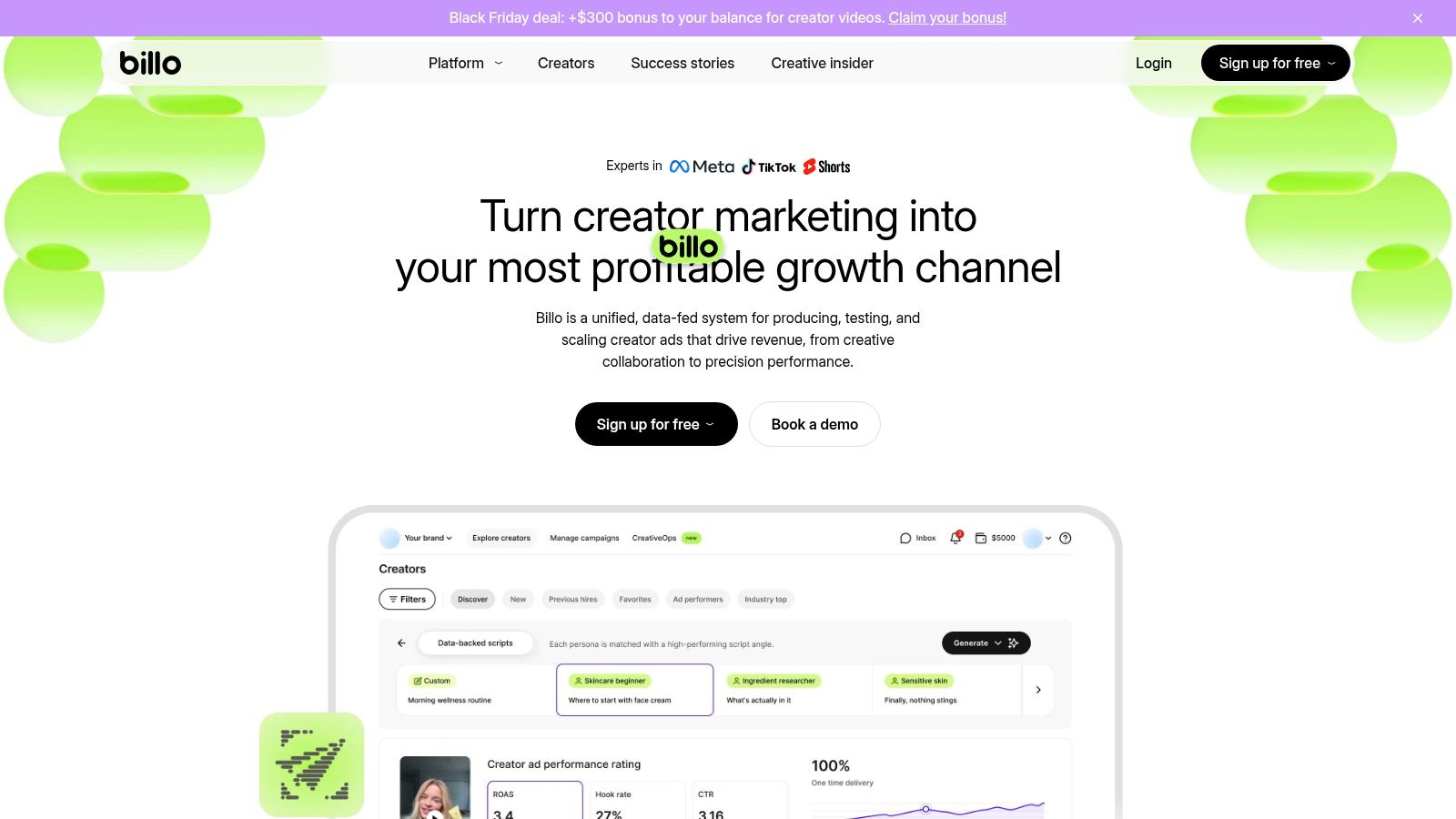
Billo produces new assets; it doesn't discover existing customer advocacy. Billo is a creator marketplace for commissioning UGC-style videos, especially short-form content intended for advertising and social channels.
Brands provide a brief and arrange product access, then commission creators to produce the requested material. Video formats and creative add-ons shape the order, with the total shown before purchase and an optional CreativeOps subscription available.
This distinction matters when interpreting trust claims. According to the MASV and Dynata UGC report, 81% of consumers in 2024 said they trusted user-generated video more than professionally created brand content or influencer marketing; that finding shouldn't be treated as proof that any commissioned advertisement will receive the same response.
Write a brief that permits a credible demonstration
Specify the customer problem, product action, required shots, claim boundaries, and delivery format. Leave room for the creator's natural phrasing rather than scripting every expression.
- Best use: Filling a creative-production gap when you need fresh demonstrations or ad concepts.
- Cost consideration: Platform access is free, while brands pay for ordered videos; confirm add-ons and the final order total.
- Operational requirement: Product shipping, revisions, usage permissions, and deadlines need clear ownership.
A weak brief produces usable footage less reliably than a clear brief with a concrete demonstration. Don't commission generic enthusiasm when the buyer needs to see how the product works.
9. Insense
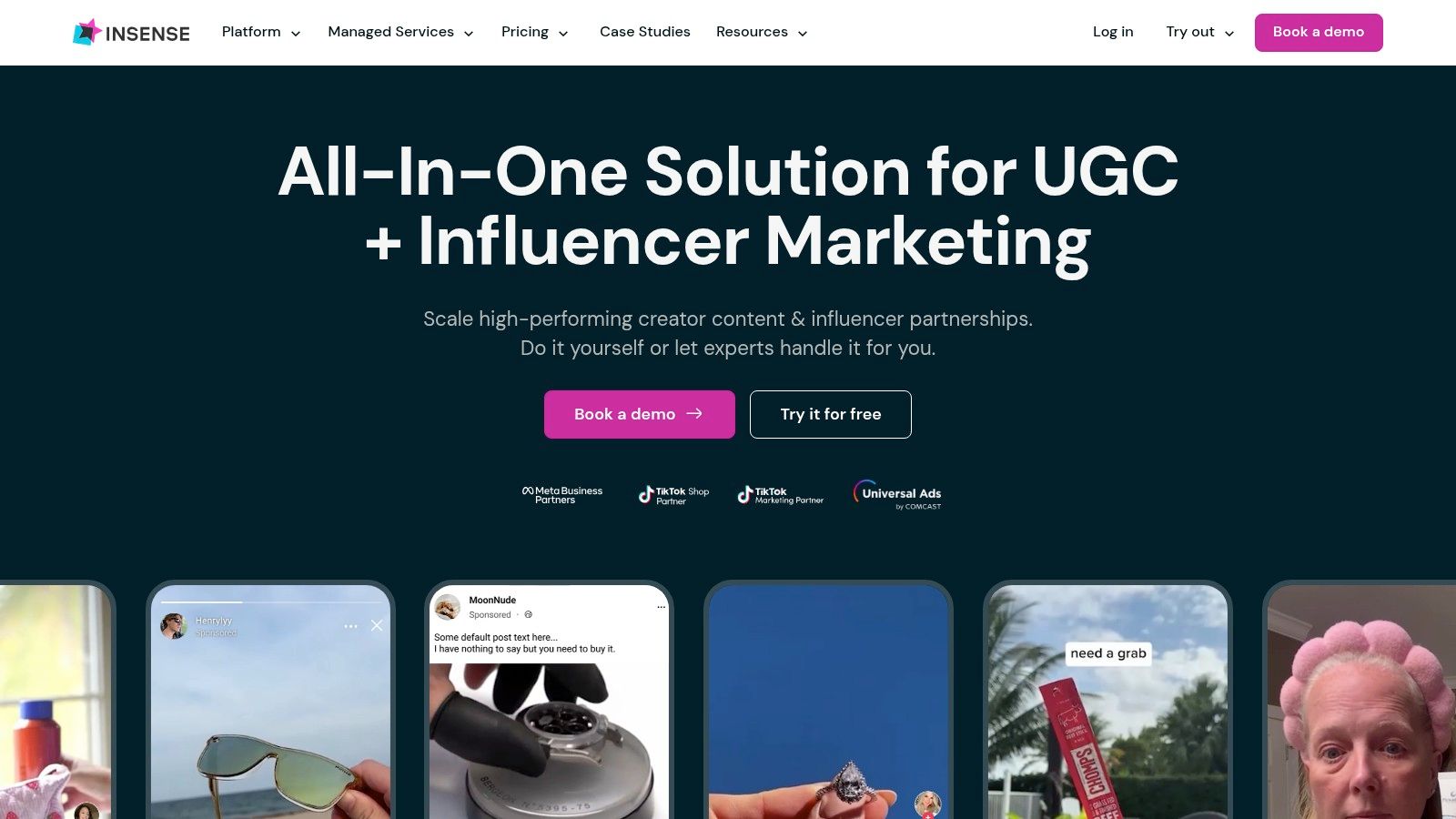
Recurring creator campaigns create coordination work beyond ordering a video. Insense combines creator discovery, campaign management, UGC production, and influencer workflows, making it relevant to brands and agencies managing ongoing relationships.
Campaigns can involve paid-ad usage or amplification through creator handles. Those arrangements require more precise approvals than receiving a downloadable file.
A creator's suitability also extends beyond their visual style. Use this guide to influencer social media evaluation to frame audience fit, content relevance, and account-quality checks before sending a brief.
Separate production fees from media permissions
The Influencer Marketing Report 2025 found that 48% of creators negotiate usage rights and licensing fees. Treat those negotiations as a campaign input, not an administrative detail after delivery.
- Define usage: Record channels, duration, territories, editing permissions, and whether paid amplification is included.
- Model total cost: Include subscription charges, marketplace fees, creator payments, shipping, and any additional usage rights.
- Assign ownership: Identify who approves creators, checks deliverables, and tracks license expiration.
Insense suits teams that need repeatable creator operations, rather than a review widget or passive social feed. Its broader campaign capabilities can justify more coordination and cost, but a team buying an occasional video should compare that overhead against a simpler per-order workflow.
10. Foursixty
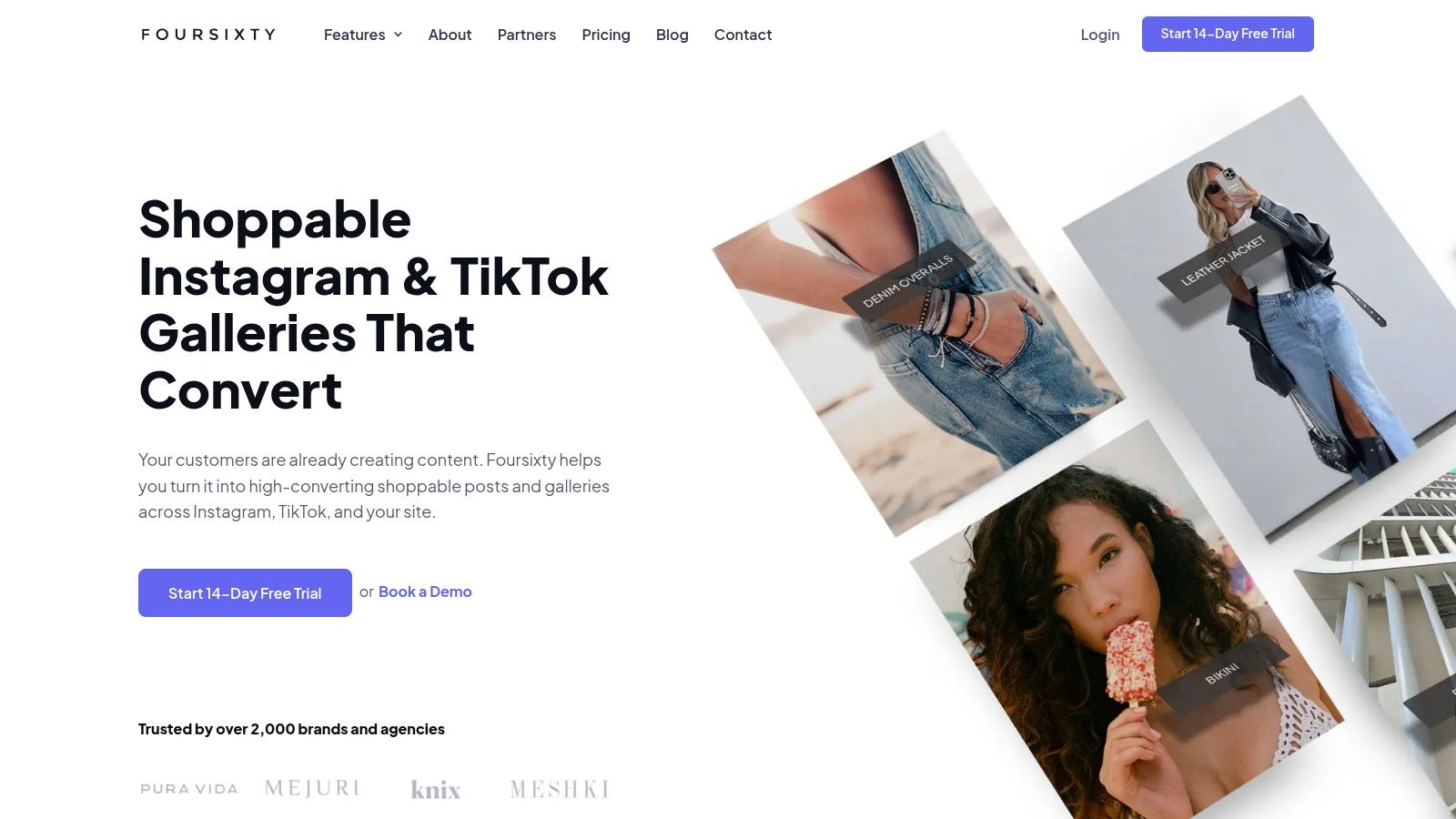
Foursixty belongs near the end of the UGC workflow: turning curated social imagery into product-linked shopping experiences. Its focus is shoppable galleries, product tagging, and connecting visual content to product discovery.
That's a narrower job than broad social listening, and the specialization can be useful. A commerce team may already have approved assets but lack a practical way to connect an outfit photo, room image, or product demonstration to purchasable items.
The evaluation should therefore begin on a product page, not inside the content library. Test whether a shopper can understand the featured product and reach the correct destination without unnecessary steps.
Inspect the shopping handoff
An appealing gallery can still create friction if tags are ambiguous or mobile interactions are awkward. Use your own catalog and representative images during the demonstration.
- Product accuracy: Verify that tags lead to the correct products and that merchandising staff can correct mistakes.
- Placement flexibility: Check the intended product-page, landing-page, and other retail touchpoints.
- Integration scope: Confirm ecommerce compatibility, supported social sources, permissions workflows, and current pricing.
Foursixty can complement a separate collection API or customer-review platform. It isn't a general-purpose Instagram data backend, and it shouldn't be evaluated as one.
Choose it when your bottleneck is activating approved imagery in a shopping journey. If the problem is finding content or obtaining permission, resolve that upstream before investing in the gallery.
UGC tools compared
UGC tools handle different jobs, from finding public posts to commissioning new creative. Comparing them by workflow stage makes the trade-offs clearer: a data API does not replace rights management, and a social wall does not collect product reviews.
| Tool | Primary UGC stage | Pricing model | Best for |
|---|---|---|---|
| Instagram API | Discover and collect public Instagram content | Prepaid credits; 50 free credits, then packages from $20 | Developers and teams collecting public Instagram data and analytics |
| Bazaarvoice | Collect, moderate, display, and syndicate reviews and visual content | Custom enterprise pricing | Brands distributing customer reviews across retail partners |
| Yotpo | Collect and display product reviews and visual content | Limited free option; paid pricing scales with order volume | Ecommerce stores building product reviews and shopper-content features |
| Emplifi UGC | Curate content, manage permissions, and publish | Quote-based | Brands connecting UGC rights management with social commerce |
| Nosto Visual UGC | Discover, curate, and use social content in commerce | Pricing not publicly listed | Retailers adding visual UGC to ecommerce experiences |
| Taggbox | Aggregate and display social content | Tiered plans based on features and usage | Marketers creating branded website feeds and social walls |
| Walls.io | Collect, moderate, and display social content | Tiered plans based on sources and refresh frequency | Events and organizations displaying audience content |
| Billo | Commission new creator-made videos | Per-video orders; total shown before purchase | Brands producing short-form UGC-style advertising videos |
| Insense | Source creators and manage UGC campaigns | Subscription and marketplace fees | Brands and agencies coordinating creator campaigns |
| Foursixty | Turn social visuals into shoppable galleries | Plans vary by product and requirements | Ecommerce teams linking curated visuals to product discovery |
Matching the Tool to Your UGC Workflow Stage
The best user generated content tools solve a specific operational failure. Start by naming the handoff your team can't complete reliably: finding relevant posts, retrieving structured data, approving reuse, collecting customer reviews, publishing shoppable content, or commissioning fresh creative.
For discovery and data collection, prioritize source coverage, stable records, useful metadata, failure handling, and exportability. For rights-managed curation, prioritize permission evidence, approval states, license scope, expiration, and removal workflows. For display, prioritize moderation, mobile usability, product mapping, and the experience after someone clicks.
- Choose review infrastructure when the missing evidence is product-specific customer feedback. Bazaarvoice and Yotpo address that problem more directly than a social wall.
- Choose curation and commerce tooling when approved customer imagery needs to move between teams. Emplifi UGC and Nosto deserve evaluation around that handoff.
- Choose display specialists when the assets exist but aren't reaching visitors effectively. Compare Taggbox, Walls.io, and Foursixty against the intended destination.
- Choose creator production when you don't have the assets you need. Billo and Insense commission content rather than uncovering spontaneous customer endorsement.
Trial a pair of tools at adjacent stages, not just competing products with similar feature lists. For example, test a collection backend alongside a gallery, then follow the same asset from retrieval through approval to publication. This exposes missing exports, duplicate records, manual re-entry, and unclear ownership.
Public visibility establishes discoverability, not permission to republish. Keep the discovery record and the reuse authorization separate.
Verify Instagram coverage using your actual accounts, hashtags, locations, and content formats. Confirm the total cost of the proposed workflow, including API access, rights management, refresh requirements, creator licensing, and implementation work.
Finally, judge outcomes beyond likes. The EMARKETER Creator Impact Report reports that 27.3% of respondents in a 2025 survey of 139 US marketers and agencies used conversions or sales to assess creator-partnership value.
Use metrics for measuring repurposed content to define downstream reporting, but don't confuse attributed results with incremental impact. Where feasible, compare comparable audiences or use a holdout, and record paid amplification separately.
Pick the smallest workable combination that carries an asset through the required stages with clear ownership. A broad suite is valuable only when your team needs, funds, and operates its connected capabilities.
Our public-data API returns Instagram posts, Reels, comments, hashtags, and account insights as structured JSON for UGC collection and creator-evaluation workflows. Visit Instagram API to try the documented endpoints with free credits and test how the results fit your collection pipeline before connecting rights review or display tools.
Pull Instagram data with one API call
Profiles, posts, reels, followers and more. 50 free credits, no credit card.
Get your free key