
10 Best Instagram Competitor Analysis Tools for 2026
Compare 10 Instagram competitor analysis tools for 2026, from benchmarking platforms to API data sources, with pricing, limits, and best-fit use cases.
You've got a competitor's profile open in one browser tab and a spreadsheet in the other. Follower count copied. Last twenty posts skimmed. A vague feeling that their Reels outperform yours, but nothing you'd defend in a planning meeting.
That gap between what a profile shows and what a decision needs is where Instagram competitor analysis tools earn their price. The platform makes the reading harder than it looks. Meta announced in 2025 that Instagram had reached 3 billion monthly active users, according to Statistics Global's Instagram statistics compilation, a figure the company reports as a milestone rather than an independently audited count. A comparison universe that size means plenty of profiles to study and very few that are comparable to yours.
Three things get in the way. Public engagement numbers have no fixed denominator, so two dashboards can disagree. Private Insights, the ones showing reach and audience demographics, stay locked to the account owner. And every tool starts its history on the day you added a profile, so a chart that looks like a trend is sometimes just a record of your own start date.
This guide sorts ten tools by the question you're trying to answer: benchmarking against peers, researching content, or pulling raw data into your own systems. Each entry covers what the tool measures, what it can't see, and what it costs in practice.
Table of Contents
- 1. Instagram API
- 2. Socialinsider
- 3. Metricool
- 4. Rival IQ
- 5. Iconosquare
- 6. Social Status
- 7. Sociality.io
- 8. Sprout Social
- 9. Hootsuite
- 10. Dash Social
- Instagram competitor analysis tools compared by best use, starting price, free options, and competitor limits
- Matching the Tool to the Question You Are Asking
1. Instagram API
If your deliverable is a dashboard someone else designed, this entry is not for you. If your deliverable is your own product, the Instagram API is the closest thing to a neutral data layer for public Instagram content.
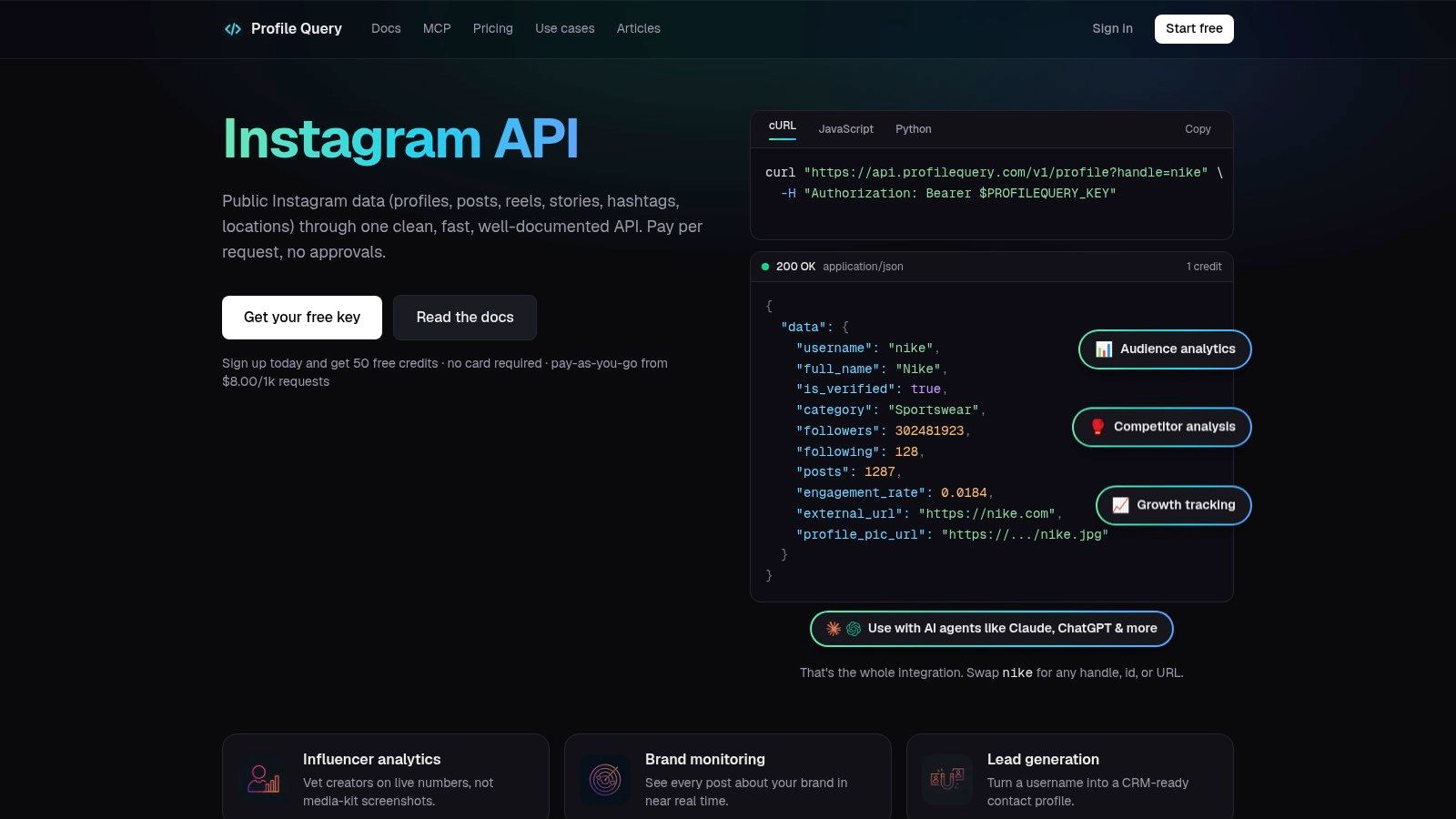
One REST API key returns public profiles, posts, reels, stories, highlights, comments, followers, following, hashtags, locations, and search results. On top of the raw retrieval endpoints sit computed ones: engagement rate, best time to post, account statistics, fake-follower audits, lead-fit scoring, profile summaries, niche classification, similar accounts, and an account transparency endpoint that returns creation date, account age, registration country, previous usernames, and verification status.
What the access model changes
Access runs on an API key. No Instagram OAuth, no app review, no business verification. You create an account, take the key, and send requests. Responses are predictable JSON with typed errors, and every response carries metadata for request ID, credits charged, remaining balance, and processing time, which is what makes repeated competitive scans auditable rather than anecdotal.
- Free start: 50 credits on a new account, no payment card required.
- Prepaid tiers: $20 for 2,500 credits, $70 for 10,000, $300 for 50,000, which works out at $8, $7, and $6 per 1,000 requests.
- Charge behaviour: most requests cost one credit, deeper endpoints cost two. Invalid input and upstream provider failures aren't charged.
Documentation includes an OpenAPI specification, examples in cURL, JavaScript, and Python, and an MCP server for AI tool workflows. The service is listed as featured on EarlyHunt.
What it cannot see
Public data only. Private profiles and anything behind an account holder's login stay out of reach. The service also wraps an upstream data provider, so a scan of a username that returns nothing may still consume a credit. Budget for that when you sweep long lists of handles.
Missing fields deserve their own caution. Meta's Graph API version history records releases back to version 2.4 in July 2015, and in December 2019 the company restricted Instagram insights to users with at least 100 followers. Neither rule makes a competitor's performance zero. A gap in your data usually marks a permission or eligibility boundary, so store request status, coverage, and timestamp beside every value.
Practical rule: treat an empty field as unknown, never as zero. Six months from now you won't remember which it was.
2. Socialinsider
Every benchmarking platform picks a denominator. Socialinsider publishes its choice openly, which is rarer than it should be, and that transparency is the main reason to shortlist it.
Its Instagram benchmark dataset reports a 0.48% average engagement rate by followers for 2025, drawn from 67.5 million posts across 579,000 brand accounts, and records Emplifi's 0.91% engagement by impressions in Q3 2025 on the same page. Those two figures aren't rival estimates of one truth. Follower-based rates divide interaction by audience size; impression-based rates divide it by exposure. Rank a large account and a small one on one leaderboard without labelling the formula and you've produced a conclusion nobody can reproduce.
Format mix moves the number again. The same dataset puts carousels ahead of other Instagram formats at 0.55% in 2025, so a competitor whose feed is carousel-heavy will beat a Reels-first account on follower-based engagement without necessarily having the better content strategy.
Cost and coverage in practice
Published plans start at $82/month, with API access listed as a further $100/month. A 14-day trial runs without a credit card, which is enough time to test a real competitor set.
- Best for: agencies and in-house teams producing recurring benchmark reports across Instagram and other networks.
- Watch the ceilings: entry plans cap profile counts, history depth, seats, and profile replacements.
- History starts late: follower history accrues only after a profile is added, and it's subject to platform data limits on top of that.
Run your own numbers through an Instagram engagement rate calculator before you trust any published average, including this one.
3. Metricool
Metricool's free tier is the cheapest way to find out whether competitor tracking changes how you post. That makes it a sensible first purchase for a creator or a small team already scheduling content.
The company's own benchmark research goes deeper than most vendor blogs. A 2024 study across 391,490 professional Instagram accounts, covering January to June 2024, put carousel engagement at 10.15% against 6.27% for Reels in Metricool's 2024 Instagram benchmark report. Read it as evidence about relative format performance inside your niche. As an absolute target for your own account, any single dataset will mislead you.
The setup friction nobody mentions
Your own Instagram account has to be linked through Facebook, and competitor profiles must be professional accounts. Some handles won't appear in search, so check your actual competitor set before you commit. The free plan tracks five accounts per network, and paid plans raise that cap considerably.
- What it shows for competitors: follower counts, posts, likes, comments, and engagement on public accounts.
- What it cannot show: reach, impressions, saves, or story performance for anyone else's account. Those metrics sit inside private Instagram Insights, and no public-data tool sees them.
- What else you get: scheduling, analytics, and reporting in the same workspace, so the competitor view sits next to your own publishing calendar.
If you want one tool covering publishing plus light competitive research, Metricool is the pragmatic choice at metricool.com.
4. Rival IQ
Rival IQ is priced like a research tool rather than a scheduler, and it behaves like one. Entry plans sit well above the lightweight options in this list, so it fits an agency or in-house team budget more easily than a solo one. A free trial lets you check the fit before committing.
The organising idea is the saved group of competitors that maps to a client, a market, or a business line. That structure matters once you're past three or four accounts. You define the set once, and alerts and scheduled reports fire against it instead of you re-adding the same handles every week.
Where the estimates come from
The platform benchmarks public metrics, analyses competitor posts and hashtags, and sends email alerts on notable movement. Higher tiers add social listening and estimated impressions, and API access comes as a paid add-on.
That word "estimated" carries weight. Modeled impressions are not private Instagram Insights. Rival IQ infers reach from public signals, which works for direction and misleads on precision. If a report says a competitor reached hundreds of thousands of people, label the figure as an estimate before it goes into a client deck.
- Strength: real benchmarking and reporting rather than manual comparison in a spreadsheet.
- Constraint: each plan tier caps tracked companies, history depth, and user seats, so a setup sized for a small portfolio won't stretch to a large agency roster.
- Reality check: the entry price is steep for a small business watching three accounts.
For hashtag-level research alongside account tracking, a dedicated hashtag tracking tool often covers ground Rival IQ leaves to its upper tiers. Details at rivaliq.com.
5. Iconosquare
Two gates decide whether Iconosquare's competitor module does anything for you. Your own account and the competitor's account both need to be Instagram Business profiles. Clear that, and you get benchmarking, custom monitoring feeds, hashtag analytics, industry benchmarks, publishing, and a social inbox in one place.
Pricing runs from a free plan and a 14-day trial of paid features, with competitor monitoring appearing on the Scale plan, listed from €69/month when billed yearly. Competitor tools aren't in the lowest paid tier, so the free plan won't tell you much about this particular capability.
The history problem
Native Instagram analytics are shallow by design. One recent industry review notes that account data generally covers a rolling 90-day window, and follower-growth graphs extend only about 30 days, which makes year-over-year competitor comparisons impossible unless you archive continuously, as Postplanify's comparison of Instagram analytics tools explains. No third-party tool can recover what nobody recorded.
Start archiving before you need the history. Every month you wait is a month you can never compare.
- Available: public engagement, follower trends from your tracking start date, hashtag performance, industry benchmarks.
- Not available: competitors' private Insights, including reach and audience demographics.
- Fit: teams that want analytics and publishing together and accept the Business-profile requirement.
More at iconosquare.com.
6. Social Status
Creator vetting is where Social Status earns its place on this list, and the demand side explains why. Influencer-marketing research covering more than 100,000 influencer profiles found 87% of respondents considered Instagram important for influencer campaigns, while 79% planned to allocate budget to influencer marketing in the measured period, per the Influencer Marketing Benchmark Report.
High channel importance plus continuing budget is exactly the combination that makes comparative screening worthwhile, and Social Status is built as an analytics product rather than an all-purpose scheduler.
What the plans actually cover
Professional plans start at $99/month for 100 plan-quota items and one year of history, with annual billing discounted. Quota items are the unit to read carefully: profiles, competitors, and other tracked objects all draw from the same pool, so a hundred sounds generous until you split it between your own accounts and a client roster.
- Benchmarks: public Instagram Business and Creator profiles, with posts sortable by engagement and other metrics.
- Content research: posting strategy, post frequency, content types, and per-format performance.
- Upper tiers: white-label reports, longer history, API access, and data warehouse features.
Personal Instagram profiles aren't supported for competitor analysis, and no-contract monthly billing is advertised. See socialstatus.io.
7. Sociality.io
Sociality.io treats competitor work as a report you build and schedule, not a dashboard you visit. That distinction matters for anyone producing the same deck every month.
The Instagram competitor module compares followers, posting volume, engagement, likes, and comments, then gives you a sortable posts table so you can surface a competitor's strongest content without scrolling their grid. Reports consolidate account metrics with content research and export to CSV, Excel, PowerPoint, or PDF. A single report can include up to 15 Instagram Business accounts, and a 14-day trial runs without a credit card.
The trade-off
Only public Instagram Business profiles are supported, and private account insights are never exposed. The wider platform, listed from $99/month, bundles publishing, engagement, and listening alongside the competitor module.
- Good fit: an agency that already produces scheduled client reports and wants exports in formats clients open.
- Poor fit: someone who wants competitor tracking only and nothing else. You'd be paying for a management suite to use one module.
- Worth testing in the trial: whether your full competitor list is recognised as Business profiles. Personal creator accounts will drop out.
More at sociality.io.
8. Sprout Social
Sprout Social's competitor reports sit inside a platform bought for other reasons. If you already need a shared inbox, publishing approvals, and stakeholder-ready reporting, the competitive benchmarking comes along at no extra tool cost.
Competitor reports are included in Professional and Advanced plans. Professional is listed at $299 per seat/month billed annually, or $399 monthly. That per-seat structure is the number that decides the purchase, because competitor analysis doesn't get cheaper when you add a fourth person who needs to view it.
What the reports show
Account growth, engagement, publishing behaviour, and top posts, with customizable competitor lists and date ranges. Reports export or share directly with stakeholders. Social listening adds context on topics and brand conversations, which is useful when a competitor's engagement spike lines up with a campaign you hadn't noticed.
Buying signal: if competitor analysis is the only requirement, per-seat pricing is the wrong shape. If three people already need publishing and reporting, it's close to free.
- Strength: competitor data sits beside the workflows your team uses daily.
- Constraint: reporting is gated to the upper tiers.
- Overkill risk: high for solo analysts and small brands.
Details at sproutsocial.com.
9. Hootsuite
Hootsuite bundles competitive benchmarking into an analytics suite widely known for scheduling. It compares posting frequency, post types, hashtags, and post performance for Instagram Business accounts, which covers the core benchmarking questions around cadence and engagement.
Watchlist size varies by plan, so confirm which tier you're on before you build a list. A narrow cap is plenty for a niche creator tracking two rivals and nowhere near enough for a multi-brand agency mapping a category.
The history limit is the real constraint
Historical data depth also varies by plan, and tracking generally begins when a profile is added rather than reaching back to older posts. That one rule reshapes how you should use the tool. Add your competitor list on day one, even before you have a question to ask, because the clock starts when the profile is added, not when the report is due.
- Add early, ask later: create the watchlist now and let the data accumulate.
- Plan around the gap: anything older than your tracking window has to come from another source or your own archive.
- Fit: teams already running publishing, monitoring, and listening in one place.
The wider suite is more than an analytics-only user needs, so the purchase only makes sense when scheduling and monitoring justify the seat. Check current competitor and history limits on the pricing page at hootsuite.com.
10. Dash Social
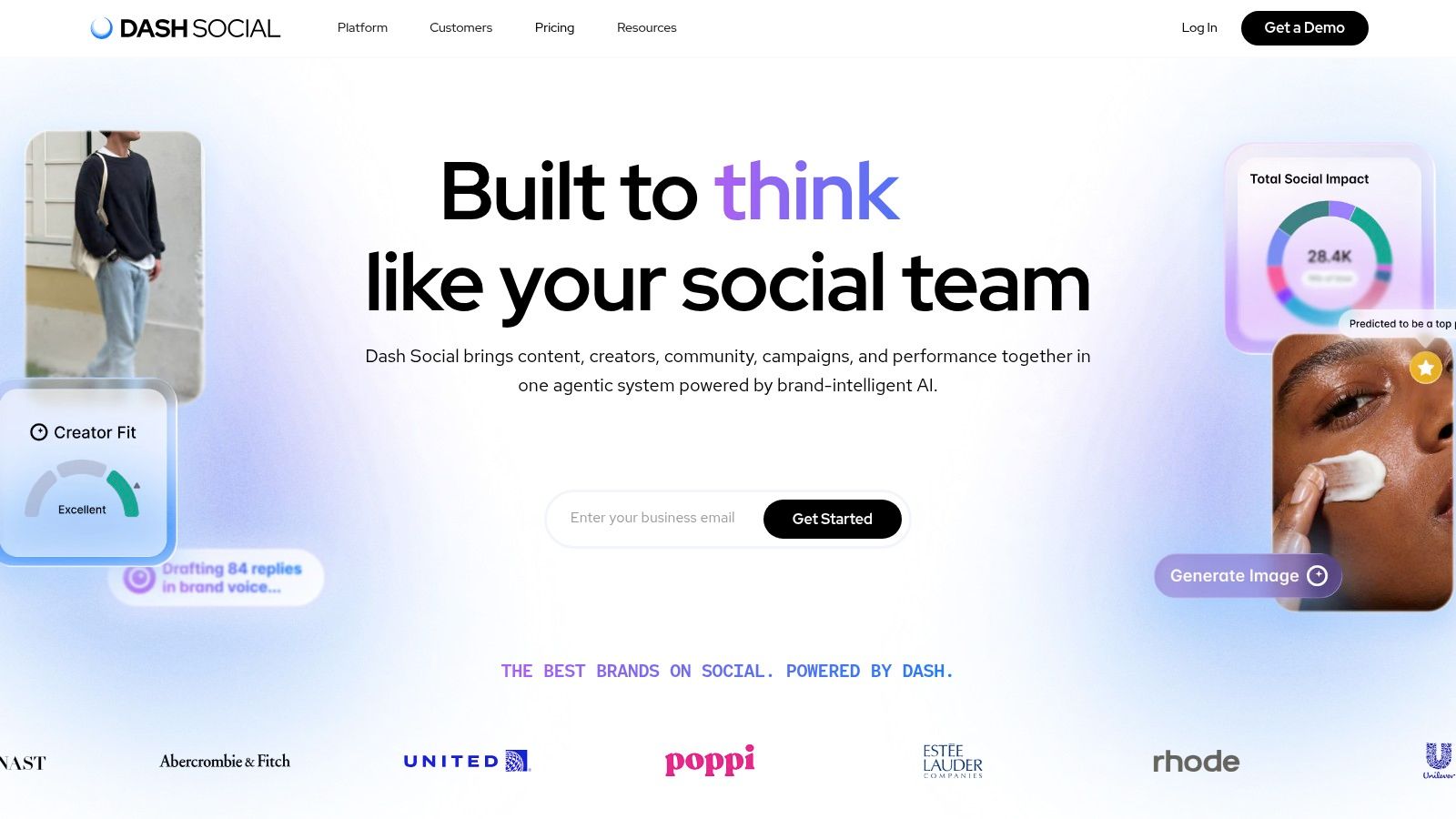
Ask Dash Social a creative question rather than a volume question. It suits teams trying to understand why certain visuals, hooks, and formats pull ahead, not analysts who only need another engagement-rate table.
Why the AI framing matters
AI-assisted interpretation is now standard. In HubSpot's Instagram marketing report, a 2026 survey of more than 600 global B2B and B2C Instagram marketers found that 51% use artificial intelligence to analyze performance, audience data, and competitive intelligence. The useful dividing line is the structured data underneath: clean post, caption, hashtag, and timing inputs make recommendations specific, while thin inputs produce generic advice.
Dash Social does not publish a clear starting price on its public pages, so request a quote before budgeting and confirm which tier includes competitor tracking and how many rival profiles it allows. It also cannot open a competitor's private Insights, so true reach, saves detail, audience demographics, and history from before tracking remain outside view.
- Strength: visual trend analysis and creative guidance beside industry benchmarks.
- Constraint: competitor features are plan-dependent, so verify the cap before committing.
- Budget note: pricing is quote-led rather than clearly posted.
More at dashsocial.com.
Instagram competitor analysis tools compared by best use, starting price, free options, and competitor limits
Entry price below means the lowest paid tier each vendor publishes, and the tracking column shows how many rival accounts each tool watches and in what form. Read the two together: a cheap plan tracking two competitors answers a narrower question than a pricier plan benchmarking twenty.
| Item | Best for | Starting price | Free option or trial | Competitor tracking |
|---|---|---|---|---|
| Instagram API | Developers retrieving public Instagram data | $20 prepaid for 2,500 credits | 50 free credits; no card required | Public profiles, posts, and analytics; no dedicated benchmarking |
| Socialinsider | Cross-channel competitor benchmarking | $82/month; API access costs extra | 14-day trial; no card required | Side-by-side account and industry comparisons |
| Metricool | Small teams combining analytics and scheduling | $0 on the free plan | Free plan | Up to 5 competitors per network on the free plan |
| Rival IQ | Agencies and brands monitoring competitor groups | $239/month | Free trial | Benchmarks competitors' content and performance |
| Iconosquare | Teams combining Instagram reporting and publishing | €69/month, billed yearly | Free plan and 14-day paid-feature trial | Competitor monitoring on the Scale plan |
| Social Status | Agencies creating client-ready analytics reports | $99/month | No free plan or trial published | Benchmarks public Instagram Business and Creator profiles |
| Sociality.io | Teams combining competitor research with social management | $99/month | 14-day trial | Compares up to 15 Instagram Business accounts per report |
| Sprout Social | Larger teams needing competitor reports and publishing workflows | $299/seat/month, billed annually | No free plan or trial published | Competitor reports on Professional and Advanced plans |
| Hootsuite | Teams combining competitor research with social management | No single published starting price; tiers priced by plan | No free plan or trial published | Tracks 2–20 competitors depending on plan |
| Dash Social | Teams analyzing visual content and creative trends | No public starting price; request a quote | 14-day trial | Competitive insights on Advance, with up to 3 competitors |
One limit applies to every row. Competitor tools read public Instagram data only, so a rival's reach, saves, and profile visits inside their private Insights stay invisible on any plan. The Instagram API row sits apart because it returns raw JSON fields rather than side-by-side charts; it suits teams building their own comparisons, with pay-as-you-go at $8.00 per 1,000 requests once free credits are used and prepaid packages up to 50,000 credits for $300.
Matching the Tool to the Question You Are Asking
Start with the decision the data has to support, then pick the tool. That order saves money and keeps you from paying for a dashboard that answers a question nobody asked.
If the question is "how do we compare to peers," you want a benchmarking platform. Socialinsider, Rival IQ, Social Status, and Sprout Social all produce recurring comparative reports, and the differences between them come down to price shape and how far back the data goes. Check tracked-account limits and history length first. Those two numbers decide how useful the tool is in month twelve rather than month one.
If the question is "what content is working and why," content-focused suites fit better. Metricool, Iconosquare, Sociality.io, and Dash Social all let you sort and compare competitor posts by performance. Iconosquare, Sociality.io, Sprout Social, and Dash Social gate competitor features to specific tiers, so confirm the tier before you trial, not after.
If the question is "get this data into our own systems," API access is the only answer. Socialinsider prices API access separately from its plans, Rival IQ reserves it for higher tiers, and Social Status puts it on upper plans. A metered API built for the job usually costs less than a suite subscription with an API bolt-on, and it returns the raw fields your models need rather than chart-ready aggregates.
Three checks before you commit
- Run the trial against real competitors. Use two or three accounts from your actual market rather than demo profiles the vendor chose. If half your list doesn't resolve, that is your answer.
- Test the oldest question you have. Ask the tool what a competitor looked like six months ago. If it can't answer, every future analysis depends on archiving you start today.
- Separate measured from modeled. Reach, impressions, and audience demographics for a competitor are estimates or unavailable. A vendor that presents them as exact figures is selling confidence.
The limitation is the same across all ten tools. Instagram's private Insights, the numbers that would make competitor comparison exact, belong to the account owner. Third-party tools work from what is public, and the better ones label which figures are measured, which are modeled, and which are missing outright. For a structured approach to the wider discipline, Silver Spoon Agency's competitor research covers how to turn these comparisons into a strategy rather than a report.
Run the trial. Add the competitors. Then read what the tool can't tell you, because that is where your real analytical work starts.
If your competitor analysis has outgrown screenshots and someone else's dashboard, the Instagram API returns public profiles, posts, reels, hashtags, and engagement metrics as structured JSON you can query on your own schedule. One API key covers the data types that separate tool subscriptions charge for individually, and prepaid credits mean you pay for the requests you run. Start with 50 free credits at Instagram API and point your first competitor list at it.
Pull Instagram data with one API call
Profiles, posts, reels, followers and more. 50 free credits, no credit card.
Get your free key