
Data as a Service Providers: 10 Options Compared for 2026
Compare 10 data as a service providers by coverage, access methods, pricing, and fit—plus a practical evaluation framework to pick the right one.
Your team needs public Instagram data for creator vetting. You've found a dozen providers, opened their documentation, and discovered that almost everyone promises profiles, posts, and engagement metrics. The differences that determine whether you can ship, including incomplete follower lists, cached results, billed errors, and separate analytics charges, are buried in FAQs.
Choosing data as a service providers isn't just a coverage exercise. You're deciding which collection and normalization work to delegate, which failure modes your application must handle, and how much you'll pay when an account disappears or a collection job returns partial records. A working profile request doesn't answer those questions.
Use a compact evaluation framework:
- Coverage: Can you retrieve the fields and account types your workflow needs?
- Access: Is this public-data retrieval, creator-authorized access, or general website extraction?
- Reliability: Can you distinguish stale data, missing records, and upstream failures?
- Pricing: Are you paying for requests, returned records, processing, or a combination?
- Fit: Does the delivery model match an application, monitoring pipeline, or warehouse workload?
The options below fall into purpose-built social APIs, multi-platform social APIs, and general web-scraping platforms. That grouping matters more than a universal ranking: an influencer-discovery product and a browser-extraction service can both return Instagram information, but they leave very different amounts of engineering work with your team.
Table of Contents
- 1. Instagram API
- 2. Phyllo
- 3. Modash API
- 4. Bright Data
- 5. Apify
- 6. HikerAPI
- 7. Scrape Creators
- 8. Data365
- 9. Zyte
- 10. Oxylabs
- How the 10 providers compare at a glance
- How to Pick Your Provider and Ship the First Integration
1. Instagram API
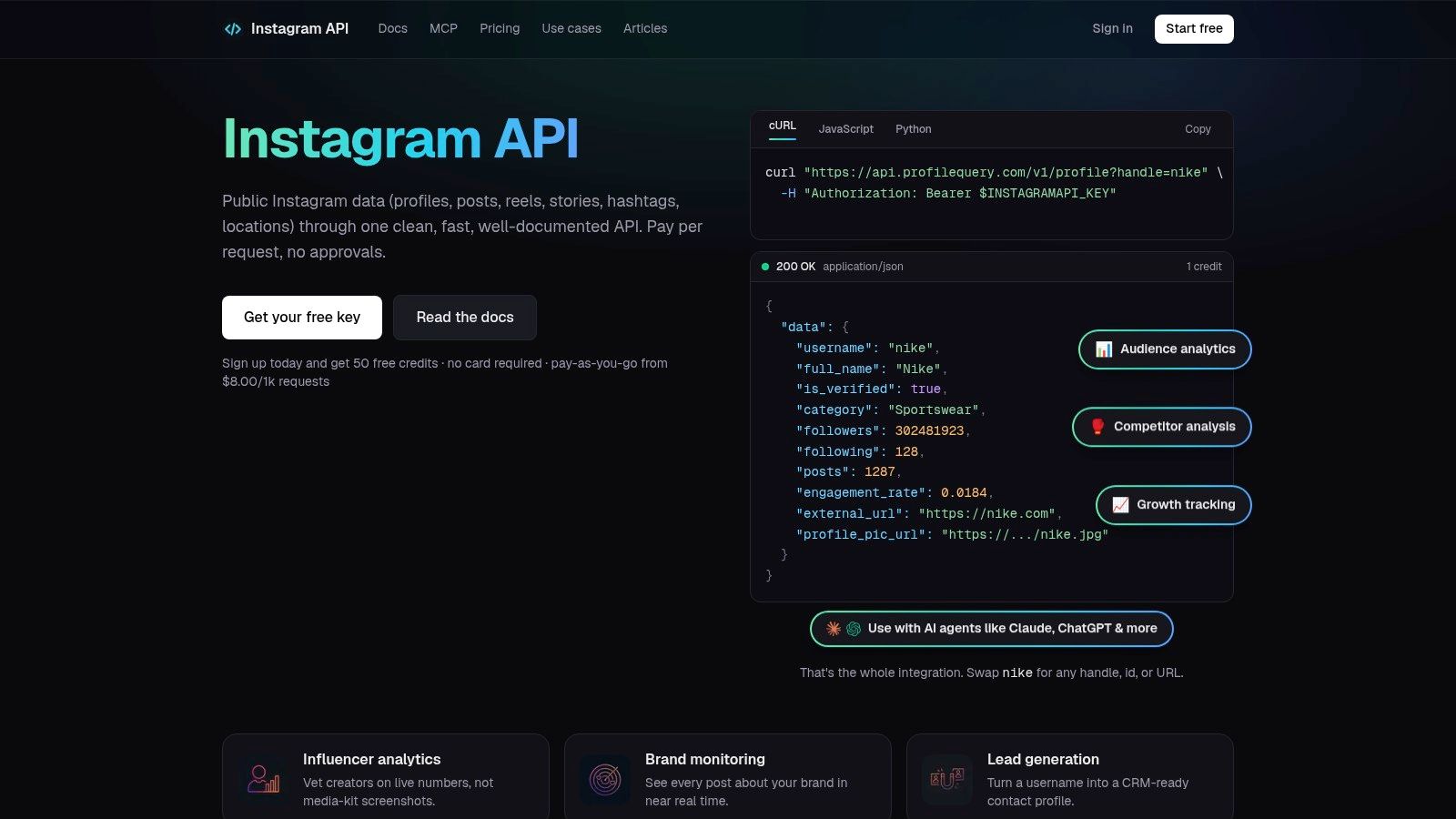
Model: Purpose-built public Instagram API. Our REST service provides structured JSON for profiles, posts, Reels, Stories, comments, followers, hashtags, locations, and search. Access uses an API key without Instagram OAuth, app review, or business verification.
The practical advantage is a consistent interface across retrieval and enrichment. Engagement analysis, follower-quality audits, niche classification, lead-fit scoring, and account-history information support creator assessment beyond basic follower counts. Our guide to APIs for social media provides context for choosing this access model.
Integration and billing trade-offs
We provide an OpenAPI specification, cURL, JavaScript, and Python examples, plus an MCP server. The service wraps an upstream provider, so a stable response contract doesn't remove dependence on upstream availability or public-data coverage.
Billing is prepaid, without a recurring subscription. New accounts receive 50 free credits without a card. Packages start at $20 for 2,500 credits; most requests consume a credit, while deeper endpoints can consume more.
- Invalid input: We don't charge for malformed requests.
- Provider failures: An
upstream_errorisn't charged. - Missing public data: A
not_foundresponse can be billed when Instagram was queried, including private, deleted, or nonexistent accounts. - Access boundary: We never retrieve private or protected account data.
For evaluation, compare a straightforward profile lookup with a follower audit and an unavailable account. Inspect both the returned fields and the balance changes before scheduling larger jobs.
For teams combining creator intelligence with advertising research, the separate workflow to find competitor ads with the API addresses a different dataset. Don't assume public Instagram retrieval includes advertising-library coverage.
2. Phyllo
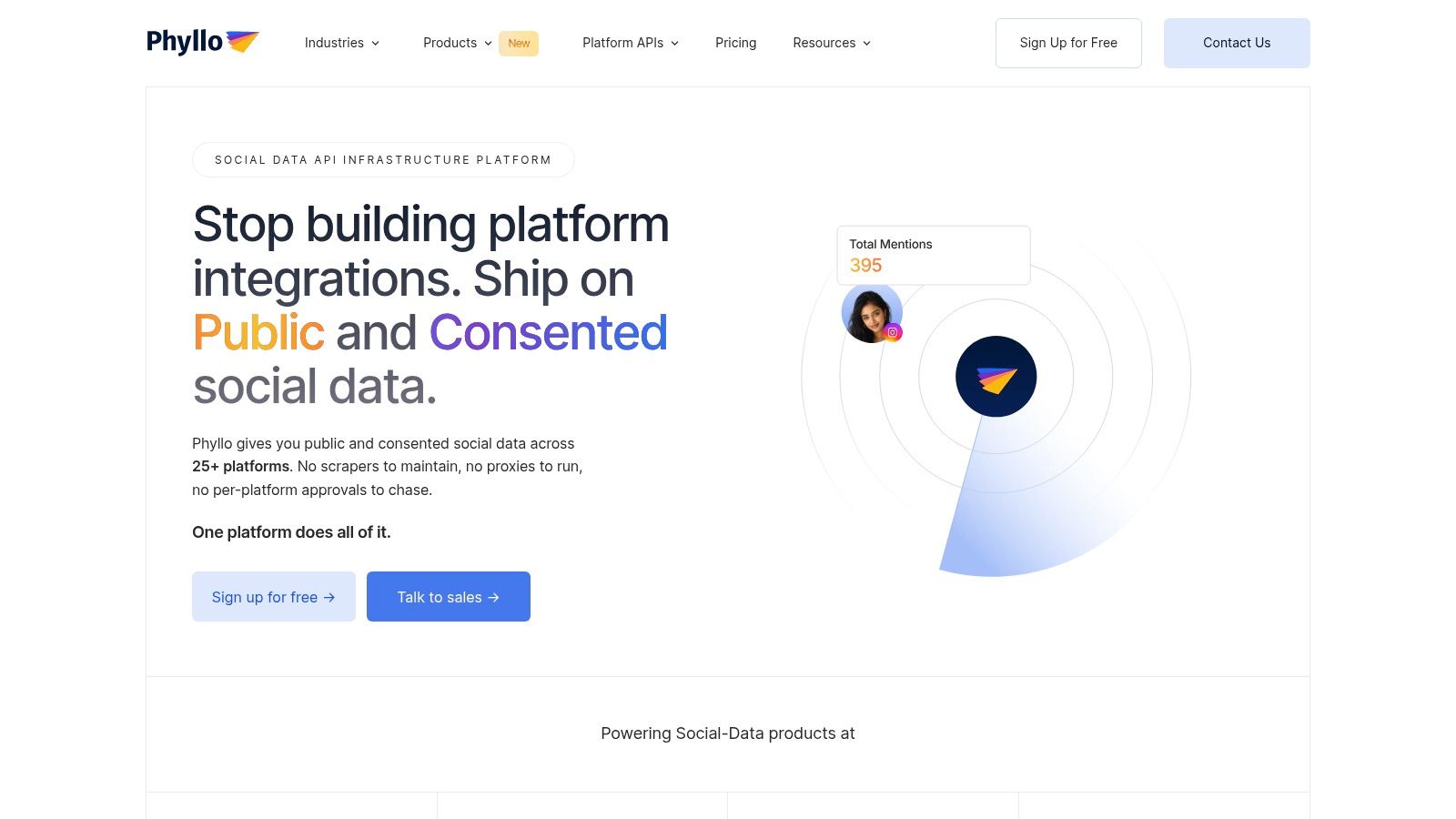
A creator marketplace may need public discovery before a creator joins, then authorized account information after onboarding. Phyllo is worth evaluating for that distinction: it offers public creator-data access alongside a separate creator-connected authorization path across social platforms.
Model: Multi-platform social-data infrastructure. Its profile, content, search, and analytics capabilities suit products that need more than an Instagram lookup. MCP support also provides an integration route for compatible AI tools.
Keep public and authorized data separate
Don't design a shared internal schema that treats public observations and creator-authorized metrics as equivalent without distinction. Preserve the access method, collection timestamp, and account identifier so downstream users understand what each field represents.
Two access methods also mean two failure modes. A public lookup degrades when coverage thins out; a connected-creator metric disappears entirely when the creator revokes authorization. Build retry and fallback logic for each path separately, and flag in your data model which fields can gradually go stale after a disconnect.
The trade-off is commercial and implementation complexity. Phyllo may be more infrastructure than a narrow public-profile enrichment job needs, and Phyllo does not publish a simple public rate card, so pricing requires a direct conversation with the vendor.
Ask these questions before committing:
- Coverage: Which required metrics are public, and which require a connected creator?
- Freshness: Do connected and public-data endpoints refresh differently?
- Billing: Are empty results, expired authorizations, and upstream failures chargeable?
- Lifecycle: What happens to stored records when a creator disconnects?
Test the transition from public discovery to authorized access, not just each endpoint independently. A marketplace needs account identity to remain consistent through that transition, including when a creator changes their username.
3. Modash API
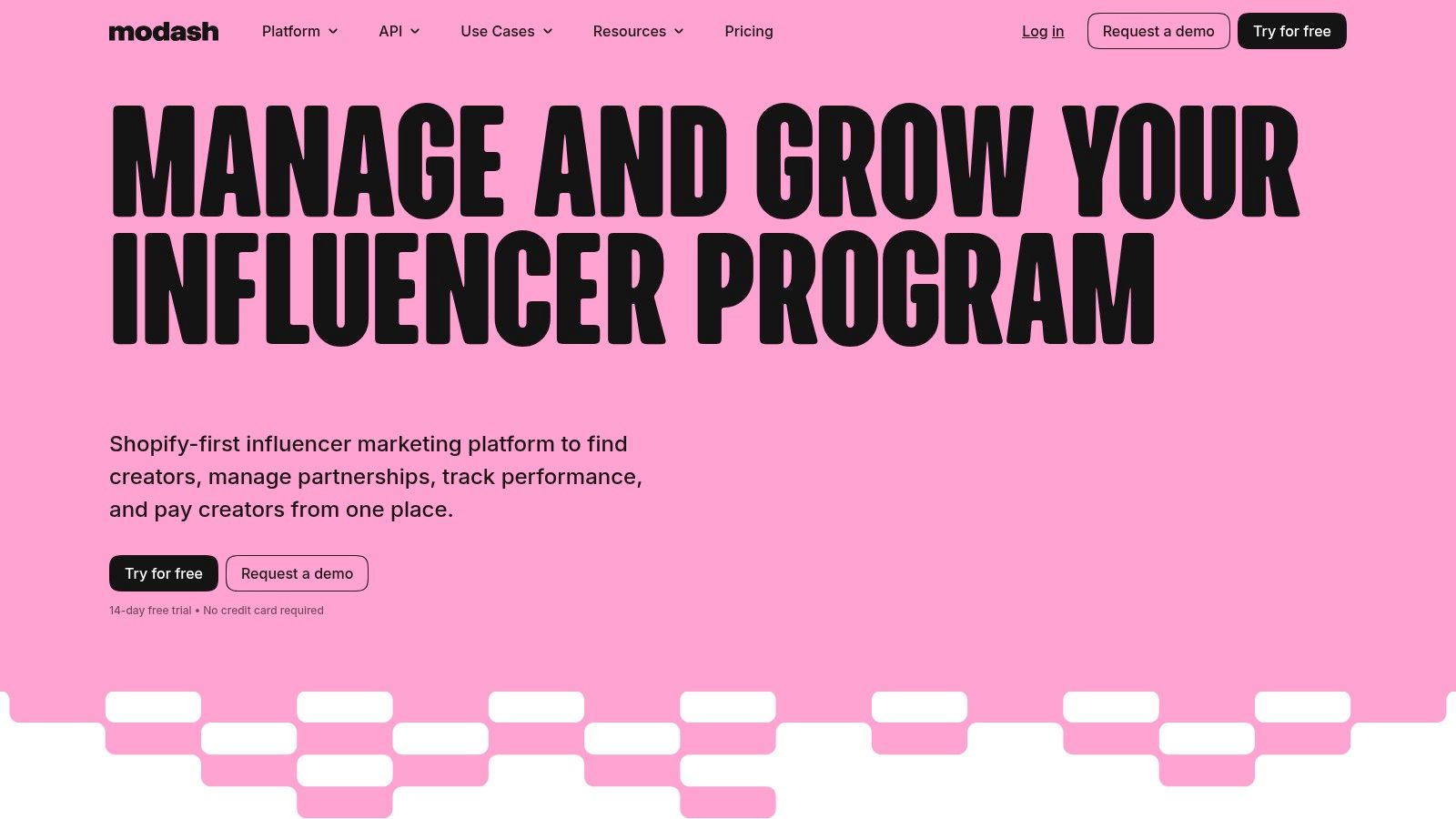
Modash is an influencer-focused choice rather than a general extraction platform. Its Discovery API supports creator search, filtering, and audience-analysis workflows, while its RAW API retrieves public profile and content data.
Model: Multi-platform creator discovery and raw social data. That separation is useful when campaign teams need both a shortlist of suitable creators and current information about selected accounts.
The main purchasing trap is assuming that standard platform access includes the API. API access is separate, and commercial terms and trial availability require a discussion with Modash.
Treat discovery results as candidates for validation, not as a guarantee that every field reflects the account's current state.
Test discovery against retrieval
Run your actual creator-selection criteria through Discovery, then retrieve the selected profiles through RAW. Compare identifiers, engagement fields, content availability, and timestamps before storing the results in a shared analytics model.
- Eligibility: Which discovery inclusion thresholds could exclude smaller creators?
- Freshness: Which fields are indexed, calculated, or collected live?
- Charges: How are discovery searches, raw lookups, empty matches, and failed requests billed?
- Completeness: Can Stories, comments, and audience fields be absent without a request-level error?
An Instagram analytics API evaluation should also separate observed metrics from derived scores. An engagement rate is only useful when you understand its content sample and calculation method.
Modash fits creator marketing well. It's less compelling if your application only needs lightweight account enrichment without discovery or audience analysis.
4. Bright Data
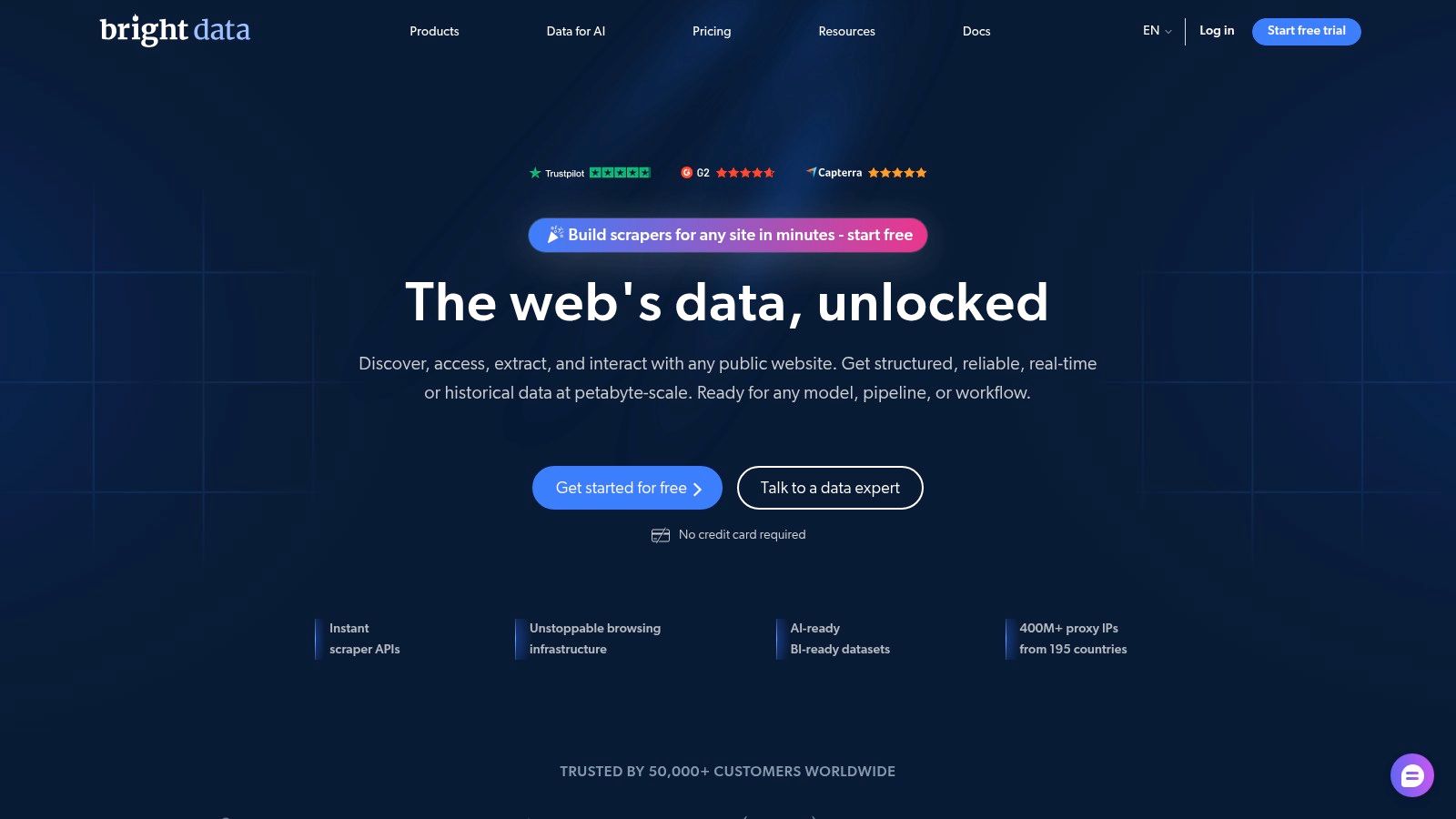
Model: General web-data platform with dedicated social scrapers and datasets. Bright Data deserves consideration when Instagram is part of a broader pipeline that also collects company websites, product pages, or other public sources.
Its important distinction is live collection versus pre-collected datasets. A scraper request and a dataset purchase aren't interchangeable products, even if both return profile records.
For a creator-vetting application, live retrieval may be the better fit for checking a selected account. For exploratory analysis across a larger population, a dataset may avoid building a request scheduler. Neither choice removes the need to inspect collection dates and missing fields.
Evaluate the product, not the platform umbrella
Ask Bright Data to scope the exact scraper or dataset you intend to buy. General platform capabilities don't establish that a particular Instagram endpoint returns the follower, comment, or historical fields you need.
- Freshness: Does the timestamp describe collection, dataset refresh, or delivery?
- Billing: What counts as a billable result, and how are partial records handled?
- Delivery: Does your integration receive immediate results, a job identifier, or a downloadable dataset?
- Duplicates: Are repeated records and repeated collection attempts charged separately?
The trade-off is breadth versus simplicity. Bright Data can serve a multi-source data operation, but a small application may inherit unnecessary product-selection and orchestration work.
Start with a representative sample export and a live collection test. Compare their schemas before assuming they can share an ingestion pipeline.
5. Apify
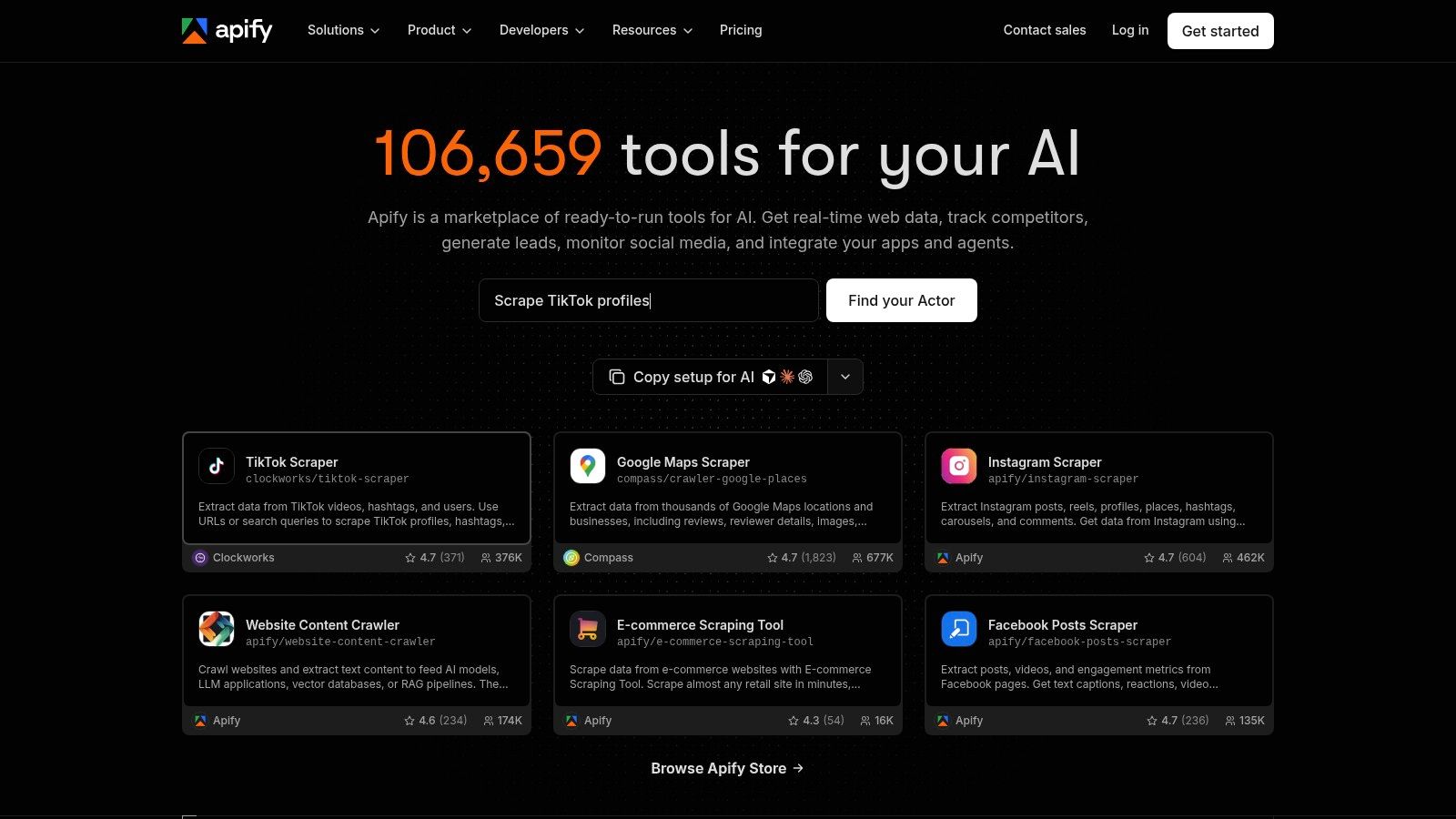
With Apify, the unit you're evaluating is usually an Actor, not the platform. Instagram Actors from Apify and third-party developers can collect profiles, posts, Reels, and comments, with API-triggered runs and structured dataset output.
Model: General extraction platform with packaged workflows. It's a useful option when you need scheduled collection, configurable inputs, and dataset-oriented processing rather than a synchronous lookup endpoint.
The flexibility introduces another dependency: the selected Actor's maintainer. Supported fields, maintenance practices, and billing differ between Actors, so a successful test of one doesn't validate another.
Inspect a complete run
Evaluate input validation, execution, dataset retrieval, and failure handling together. Your application needs to know whether a run finished successfully but returned incomplete data, or whether execution stopped before collection completed.
- Maintenance: Who maintains the Actor, and what does its update history show?
- Pricing: Are you billed for results, execution resources, an Actor fee, or combined charges?
- Retries: Can restarting a failed run duplicate previously collected records?
- Freshness: Does each record include collection context, or only the run itself?
A practical test is to interrupt a collection workflow and resume it. Inspect whether your pipeline can identify previously ingested records without treating the entire rerun as new data.
Apify is attractive when you want workflow control. It's less attractive when your team expects a uniform social-data contract without evaluating extraction components individually.
6. HikerAPI
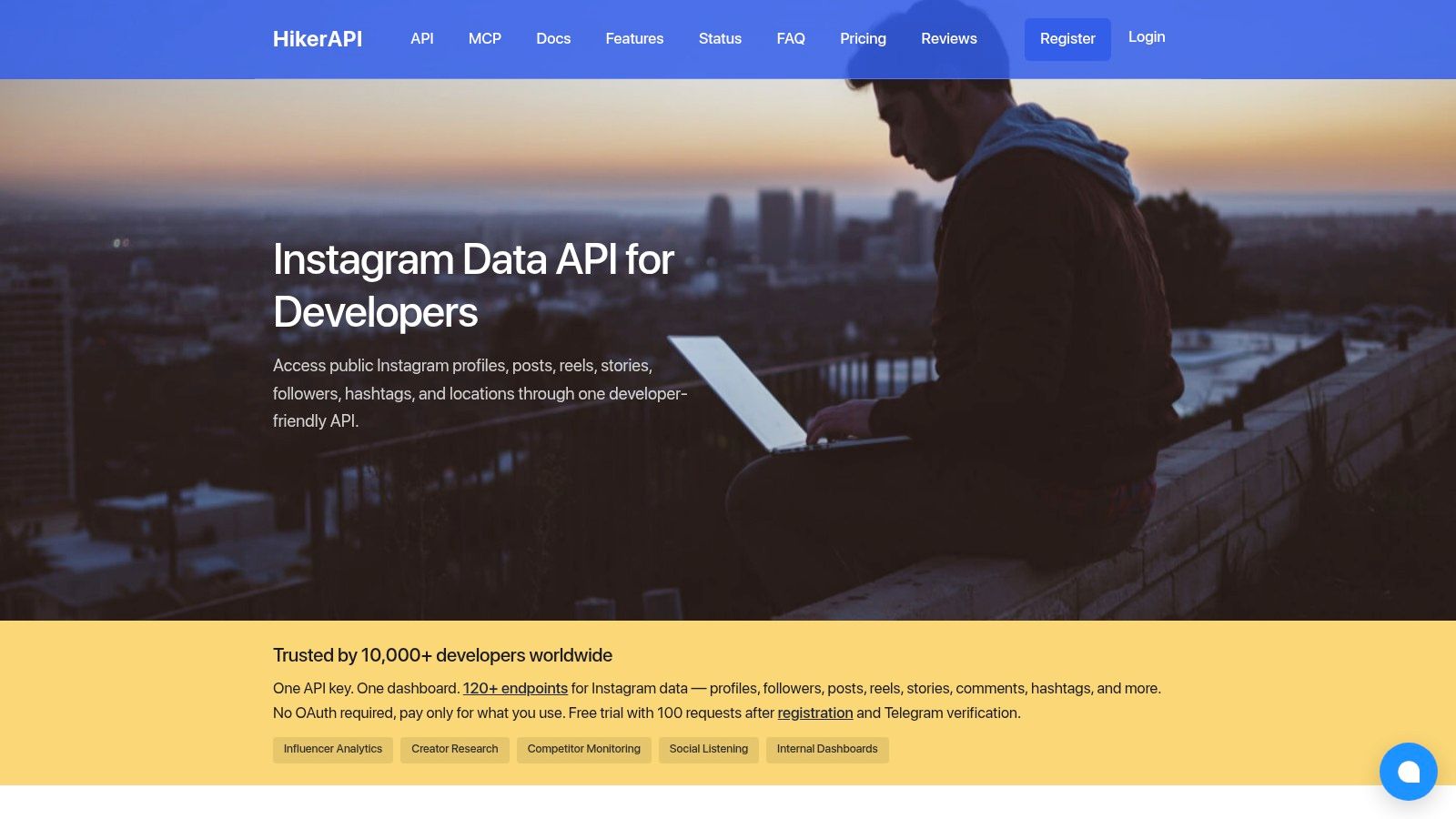
HikerAPI belongs on an Instagram-first shortlist when endpoint breadth matters. Its REST interface covers public profiles, content, Stories, highlights, comments, likers, followers, hashtags, locations, and search.
Model: Purpose-built Instagram API. API-key access, interactive documentation, prepaid usage, and MCP support make it a more direct integration candidate than a general browser-extraction platform.
The limitation to examine closely is endpoint-specific coverage. Follower retrieval, including restrictions involving verified accounts, needs testing against your actual creator population rather than a convenient demonstration account.
Read the billing rules alongside the errors
HikerAPI indicates that some forbidden or not-found outcomes may still be billed. Don't interpret every unsuccessful business outcome as a free request, and don't let your retry worker repeatedly query an unavailable account.
A request can succeed as a collection operation while failing to return the account information your application wanted.
Before funding production usage, establish:
- Billed outcomes: Which forbidden, missing, and partial-data responses consume balance?
- Coverage limits: Which account types or list endpoints have restrictions?
- Freshness: When can cached data be returned, and can you identify its age?
- Retry behavior: Which errors justify retrying, and which should stop the job?
Use the Instagram API options comparison to distinguish access models, then validate HikerAPI's specific contract directly. Its specialization is useful for Instagram applications, but it won't replace a broader provider when unrelated data sources become part of the same product.
7. Scrape Creators
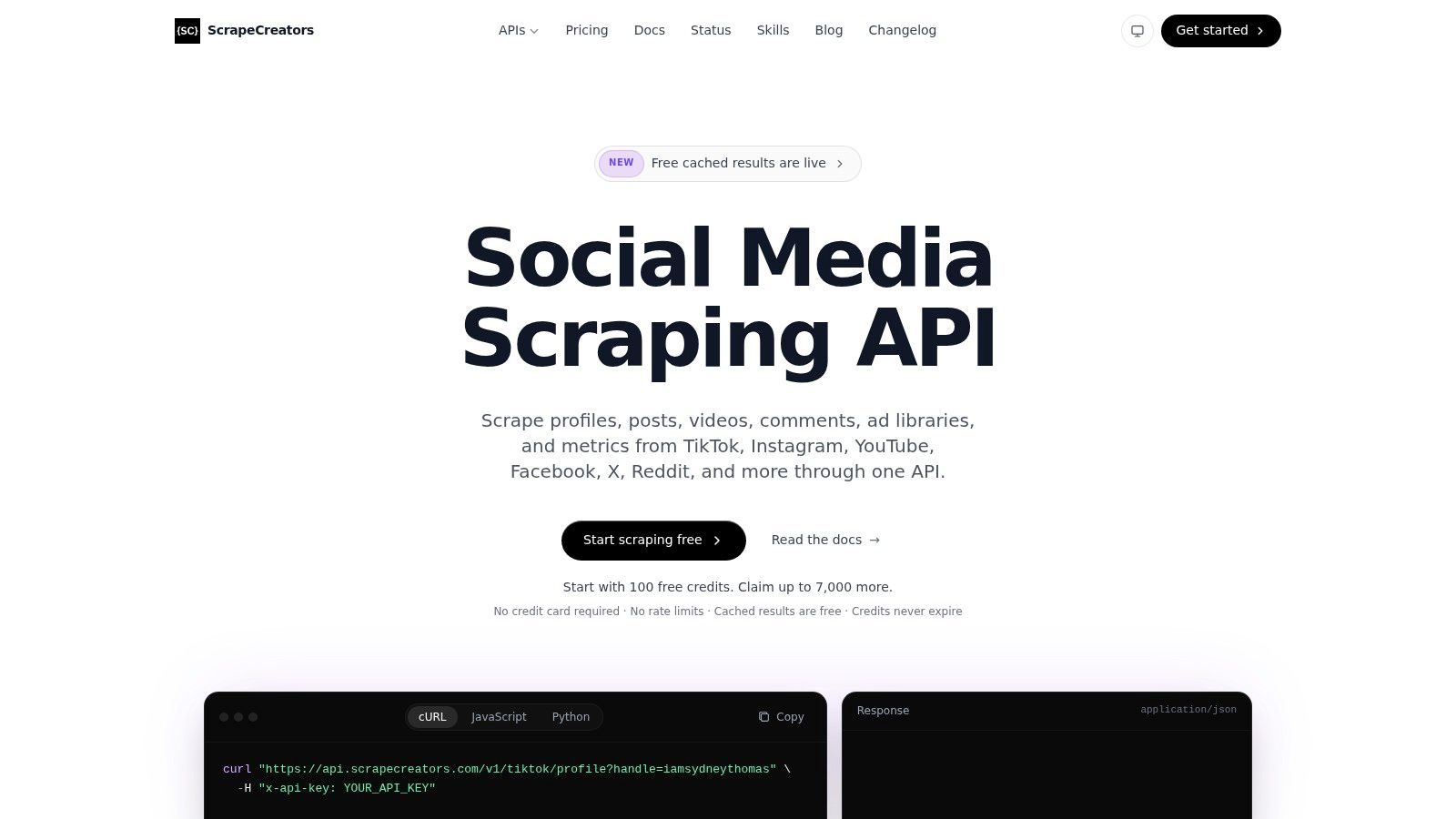
Maintaining separate clients for Instagram, video platforms, and other social networks creates repetitive authentication and error-handling work. Scrape Creators offers a multi-platform REST API, with an OpenAPI specification, MCP server, CLI, and workflow integrations.
Model: Multi-platform public social-data API. It's a sensible candidate when reducing integration count matters more than having the deepest possible Instagram-specific analytics.
A documented API contract is valuable, but it isn't enough by itself. Postman's State of the API survey identifies API-first development as a mainstream practice; for buyers, the practical test is whether documentation matches real responses, pagination, and errors.
Breadth doesn't imply uniform behavior
Build a small adapter for each platform rather than assuming every endpoint shares identical field meanings. Video views, post engagement, and account identifiers need explicit mappings.
Ask Scrape Creators about:
- Billing: Do credits vary by platform, endpoint, or depth of retrieval?
- Failures: Are upstream errors and empty content results charged differently?
- Freshness: Which endpoints collect on demand, and which can return cached records?
- Throughput: What concurrency should your workload use, and how are overload conditions reported?
Claims about absent API rate limits shouldn't become an unlimited-concurrency configuration. Use bounded workers, backoff, and a spending ceiling.
This provider fits cross-network collection. Confirm historical access and follower-list requirements separately, because broad platform coverage doesn't establish depth for every data type.
8. Data365
Model: Multi-platform social-data service. Data365 targets public social-data collection across networks including Instagram, Facebook, X, Reddit, Threads, and Pinterest. Its offering is relevant to recurring monitoring, analytics, and larger collection projects.
A sales-led setup can be inconvenient for a prototype, but it creates an opportunity to negotiate a workload-specific agreement. Use that conversation to define collection scope and failure treatment, not just monthly capacity.
For example, a brand-monitoring team may care more about retrieving recent comments consistently than collecting every available profile field. Specify that priority before discussing a general allowance.
Turn requirements into acceptance criteria
Ask for sample responses from the endpoints you'll use. Then make the contract distinguish service availability, record completeness, and source freshness.
- Freshness commitment: What does real-time access mean for each requested object?
- Billing treatment: Are failed collection attempts, missing accounts, and partial responses included in usage?
- Capacity: How are bursts, queued jobs, and sustained collection handled?
- Retention: Can your team retain records, and how should deletion requests propagate?
Don't accept a generic social-data demonstration as proof of Instagram coverage. Test the account types, languages, content formats, and comment patterns relevant to your monitoring project.
Data365 is worth considering when you need an ongoing supplier relationship with agreed capacity. It's less convenient when your priority is immediate self-service experimentation with a clearly published unit price.
9. Zyte
Zyte API is a general website-extraction service, not a uniform catalog of Instagram profile, follower, and hashtag endpoints. Browser rendering and structured extraction make it relevant to broader web-data pipelines.
Model: General web-scraping API. Choose it for a collection architecture spanning different kinds of websites, provided your tests establish that the required Instagram information is accessible and reliable.
The distinction matters because retrieving a page isn't the same as delivering a validated social record. Your team may still need extraction logic, schema validation, account-state detection, and checks for missing metrics.
Define success at the field level
Zyte's pricing documentation describes successful-response charging, but you should establish what success means for your target and configuration. A returned page may not contain the business fields your application expected.
- Charging: Which response outcomes are billable, including pages without usable target data?
- Configuration: How do rendering and extraction choices affect cost?
- Freshness: Are you receiving current page content or another retrieval mode?
- Maintenance: Who owns extraction changes when the target page changes?
Practical rule: Validate required fields before marking an extraction job successful. HTTP success alone isn't a data-quality test.
Zyte can fit a team already operating a general extraction stack. For an Instagram-only application, compare its implementation burden against a purpose-built API before choosing on request pricing alone.
10. Oxylabs
An organization collecting from search engines, retail sites, and social pages may prefer a broader infrastructure supplier. Oxylabs offers web-data collection products, including scraper APIs and a Web API combining search and page extraction.
Model: General web-data collection platform. Its developer resources and target-specific extraction options are relevant to multi-source pipelines, but they don't establish a dedicated Instagram social-data contract.
Start by naming the exact product you're buying. Web search, page extraction, and structured scraping solve different problems, even when a supplier offers them through related interfaces.
Require an Instagram-specific proof
Ask for responses covering the fields your application must retain. A profile page extraction isn't sufficient evidence for follower-list coverage, consistent engagement metrics, or account-history information.
- Product fit: Which product supports the required Instagram targets and fields?
- Billing: How do unsuccessful extraction, empty responses, retries, and rendering affect charges?
- Freshness: Can you identify when the source was collected?
- Operational ownership: Who diagnoses missing fields and maintains target-specific extraction?
Compare total implementation work, including normalization and validation, rather than treating every successful scrape as a ready-to-use record. Keep raw collection status separate from your application's acceptance status.
Oxylabs is a reasonable candidate for an enterprise evaluating broader collection infrastructure. A focused social API is usually the more direct starting point when Instagram records are the entire requirement and your team doesn't want to maintain extraction logic.
How the 10 providers compare at a glance
Read the table by data-access model first: purpose-built Instagram APIs, multi-platform social APIs, then general web-scraping platforms. That order predicts how much normalization, field validation, and billing clarification your team will need before production.
| Provider | Data coverage | Access model | Pricing transparency | Best for |
|---|---|---|---|---|
| Instagram API | Public Instagram data only: profiles, posts, Reels, Stories, comments, followers, hashtags, locations, search, and insights | Purpose-built Instagram REST API; API key with no login, OAuth, or app review | Prepaid rates published; free credits; bad input and provider outages are not charged | Instagram data and insights with quick API integration |
| Phyllo | Instagram plus other major social networks; public and creator-authorized data | Multi-platform social API with separate public and consent-based paths | Commercial pricing requires inquiry | Cross-platform creator data and connected accounts |
| Modash API | Instagram, TikTok, and YouTube; discovery and live profile data | Multi-platform social API with separate Discovery and RAW APIs | Pricing and trial details require contacting Modash | Influencer discovery, creator vetting, and campaign analysis |
| Bright Data | Instagram profiles and posts, plus broader web data and datasets | General web-data platform: scraper APIs and dataset products | Some pricing is published; costs differ by product | Bulk data or broader web-data pipelines |
| Apify | Instagram profiles, posts, Reels, details, and comments | General scraping platform: run Actors and retrieve datasets via API | Varies by Actor; some publish rates and free testing | Customizable or scheduled extraction workflows |
| HikerAPI | Public Instagram profiles, posts, Reels, Stories, comments, followers, search, and more | Purpose-built Instagram REST API with API key | Endpoint-level billing published; prepaid usage | Instagram-focused integrations with pay-as-you-go access |
| Scrape Creators | Instagram plus a broad set of other social platforms | Multi-platform social REST API, with OpenAPI, MCP, and integrations | Costs vary by platform and data type | Multi-platform social-data access |
| Data365 | Public social profiles, posts, comments, and other data across several networks | Multi-platform social API with custom capacity options | No simple public rate card | Recurring, multi-platform analytics projects |
| Zyte | General website extraction; Instagram-specific coverage needs validation | General web-scraping API with browser rendering and structured extraction | Usage-based pricing varies by target and request | Broader web-data pipelines |
| Oxylabs | General web data with target-specific scraper options | General web data platform: Web Scraper API and broader Web API | Depends on product, target, and request pattern | Enterprise-scale, multi-source collection |
Before signing up, ask each provider the same three questions: which failed requests are billed, how freshness is exposed for each field, and whether the exact Instagram fields you need come from the product tier you are buying.
How to Pick Your Provider and Ship the First Integration
Shortlist by delivery model first. Choose a purpose-built API for an Instagram application, a multi-platform social provider for cross-network workflows, or a general extraction platform when your team needs broader website coverage and accepts more normalization work.
Then test real accounts you care about. Include active creators, renamed accounts, unavailable profiles, and content with substantial comments or pagination. Define required fields before testing so attractive optional fields don't distract from missing essentials.
Evaluate the contract and the bill together
Inspect response envelopes, error codes, timestamps, pagination, and balance changes. The Data Sharing as a Service market report describes usage monitoring and policy-governed sharing as relevant DaaS capabilities; your acceptance test should turn those concepts into observable behavior.
Use our service as a worked example:
- Response structure: Successful responses put the payload under
dataand billing information inmeta. - Chargeable activity: We charge only when the API queries Instagram. Bad input and provider outages are free, while queried-but-missing public data can be billed.
- Delivery fit: We offer a BigQuery integration for teams that want Instagram data in their warehouse rather than only in application responses.
Model cost using your endpoint mix, pagination, unavailable accounts, and permitted retries. Calculate the cost of an accepted record, not just the advertised request unit. Put a ceiling on automatic retries so an application defect can't repeatedly consume balance.
Keep authorization and reuse in scope
Public visibility isn't blanket permission for automated collection. Instagram's Terms of Use restrict unauthorized automated access and collection, so API-key convenience shouldn't be mistaken for platform authorization.
Review your intended purpose, applicable privacy obligations, retention, and deletion procedures before launch. We provide a privacy policy and DPA, but your team still needs to assess its own processing and downstream uses, particularly lead generation, scoring, and AI workflows.
If you operate your own collection infrastructure, guidance to improve data collection with proxies concerns transport and operational design, not permission to bypass access controls.
Ship a bounded integration first: save request identifiers, validate required fields, log billing metadata, and stop retries for terminal account states. Pick the provider whose worst-case bill you understand before you write the first line of integration code.
Instagram API offers public Instagram profiles, content, discovery, and account insights through a REST interface with predictable JSON and prepaid credits. Visit Instagram API to test your target accounts, inspect response metadata, and compare chargeable outcomes before committing your production workload.
Pull Instagram data with one API call
Profiles, posts, reels, followers and more. 50 free credits, no credit card.
Get your free key