
Social Media Monitoring API Data and Workflows
See how a social media monitoring API structures posts, comments, and discovery, where coverage fails, and how to choose an Instagram data workflow.
In January 2024, DataReportal counted 5.04 billion active social media user identities, about 62.3% of the global population. That total rose by 266 million identities, or 5.6%, in the prior year. Those figures count identities, not verified unique people, so they aren't a headcount. They still show why a feed you scroll by hand can't be the system of record.
Instagram was the favorite platform among internet users aged 16–64, chosen by 16.5% of respondents in that same overview. By October 2024, DataReportal estimated about 2.00 billion monthly active Instagram users and advertising reach of about 1.69 billion, up 3.1% from 1.64 billion in October 2023. A social media monitoring API exists so that volume can become rows your code, dashboards, and models can query.
Table of Contents
- What a Social Media Monitoring API Returns
- Monitoring Data Categories at a Glance
- Post Comment and Profile Field Entries
- Discovery Workflows for Hashtags and Locations
- Coverage Gaps That Change What You Can Claim
- Choosing an Instagram-Focused Monitoring API
- Cross-References for Schema and Metric Meaning
- Quick Reference and the Next API Call
What a Social Media Monitoring API Returns
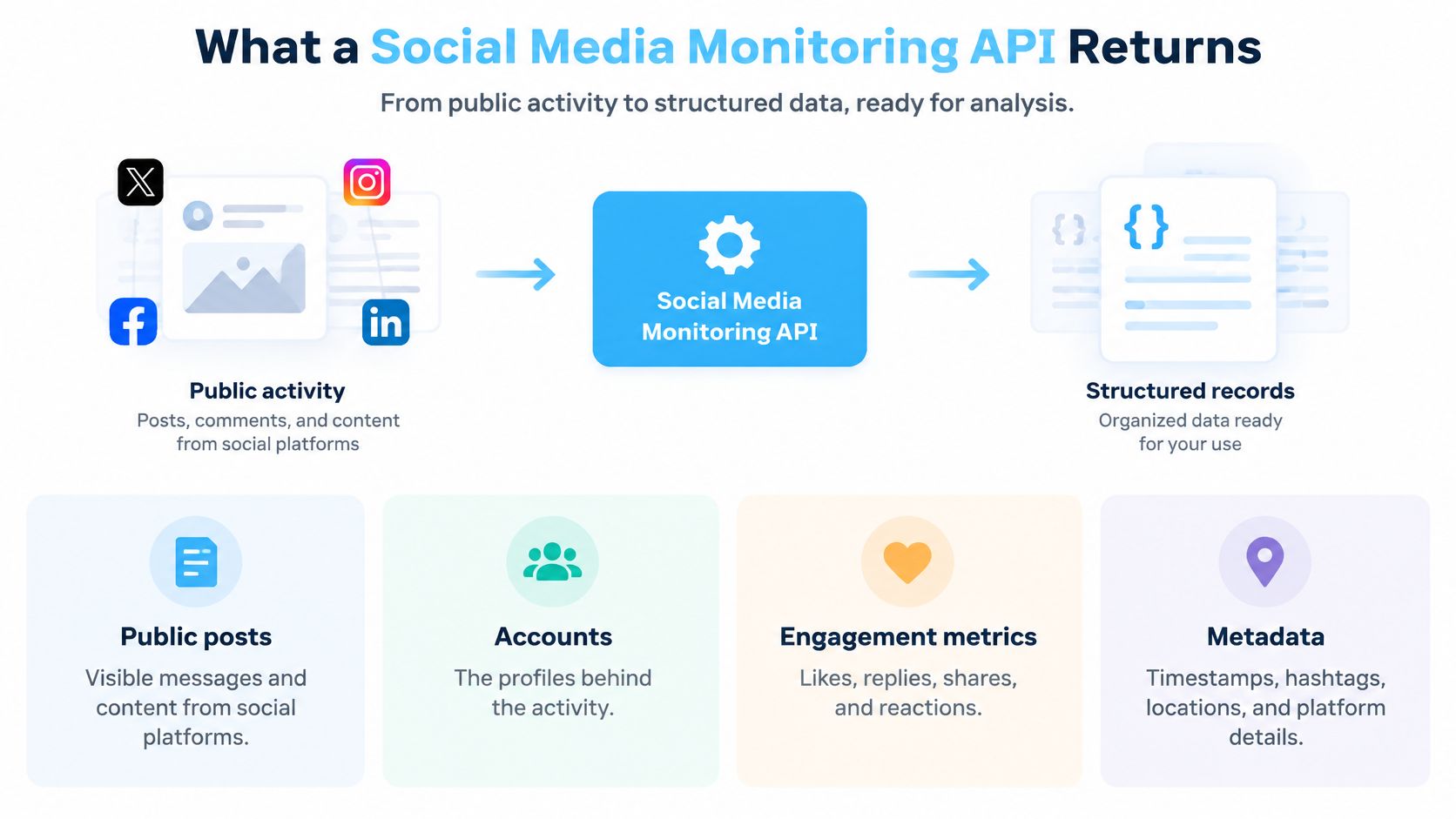
A social media monitoring API is a programmatic interface that turns publicly visible activity into structured records. You send an identifier or a search, and you get JSON your application can store, join, and re-check. You aren't logging into a native app and reading a timeline.
The jobs that belong in those records are concrete. Posts carry captions, media, and publish times. Comments carry thread text and authors. Hashtags and locations tell you how a mention was found. Engagement signals such as likes and counts tell you how far an object traveled. Analytics-style reads then help a team rank a smaller set of accounts, campaigns, or prospects instead of keeping every row equally loud.
A native login shows one person's view of a product. An API returns a record with a stable identity, a source, and a time you observed it. That split matters when an analyst later asks whether a number moved because the audience moved, or because the job ran late.
Treat the rest of this reference as a lookup system, not a setup tutorial. You'll find categories, field entries, discovery workflows, coverage limits, a choice comparison, cross-references, and a short card for the next call. If you're still deciding which free views are safe to trust before you wire storage, the Unfollowers Track guide to free analytics is a useful companion for reading Instagram numbers without treating a screenshot as a schema.
A monitoring record is evidence of what an authorized query returned at a retrieval time, not a claim that the public web was fully observed.
Monitoring Data Categories at a Glance
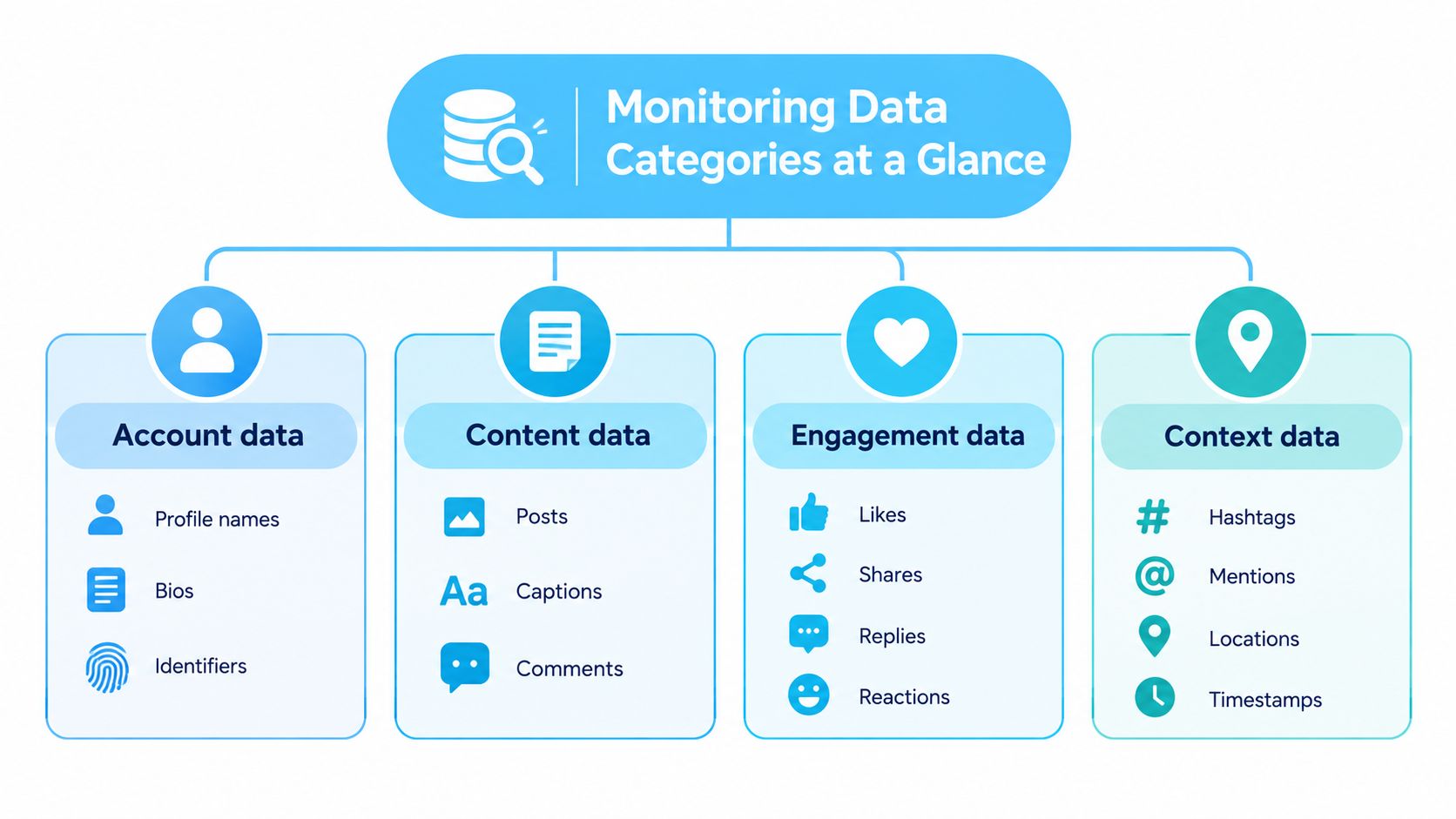
Categories here are shelves. Pick the shelf for the question, then open the field entry. They aren't steps you must run in order.
Account and profile records
These answer "who is this account, and what history can we see?" Fields include username, a numeric identifier, profile URL, creation month and year, account age, registration country as distinct from current residence, previous usernames, and verification status. A trust reviewer comparing a sudden handle change against an older username is on this shelf, not in the comment thread.
Published content
This shelf answers "what did the account publish?" It holds posts, reels, stories, and highlights. A brand team saving the caption and media of a mention starts here. Stories are especially time-bound. If you didn't retrieve one while it was live, later jobs can't invent it.
Interaction records
Comments, likers, and engagement counts answer "who responded, and how large was the response?" A comment is text. A liker is an account that reacted. A count is a summary. Mixing those three into one blob makes later audits impossible. When a creator's audience needs a credibility check, counts sit next to follower-quality reads, not in place of them.
Discovery and insight records
Search and measurement answer "where do we look, and what should we prioritize?" This shelf covers user, hashtag, and location search, posts at a place, engagement rate, posting-time patterns, follower-quality signals, and niche or lead-fit classification.
A local team matching a mention to a venue uses location posts. An influencer manager asking whether an audience looks credible uses follower-quality and engagement reads. Those aren't substitutes for the post that produced the numbers.
Don't walk the shelves in sequence on every job. Known handle? Account, then content. Unknown phrase? Discovery. Dispute about a trend? Insights, then the metric cross-reference later in this guide.
Post Comment and Profile Field Entries
Profile retrieval accepts a username, a numeric identifier, or a profile URL. One profile request can fan out to companion content when you need it: posts, reels, stories, highlights, followers, and following. The profile object and those lists aren't the same record. Store the account key once, then attach child objects with that key.
What a post or reel record can hold
For a single post or reel, keep full-detail fields when the provider returns them. That set includes caption, media URLs, engagement counts, author, a stable object identity, a canonical source URL when present, an account identifier kept separate from the username, content type, published time, and retrieval time.
Published time is when the platform says the object went live. Retrieval time is when your job observed it. An analyst who plots both can see a late backfill instead of a fake spike in publishing.
A brand team storing a mention should keep caption plus author, not caption alone. Usernames change. The account identifier is what joins tomorrow's profile pull to today's post.
Comments and likers are different objects
A comment entry is text, author, and its own identity, tied to a post or reel. A liker entry is an account that liked the post. Comment text isn't a hashtag search, and a like isn't a sentence. Threads, sentiment, and spam-style summaries belong on the comment object. For the comment payload shape, see the Instagram Comments API.
A trust team doesn't start in the liker list. They compare verification status and previous usernames on the account-history record, then decide whether the people liking the post are even relevant.
| Record group | Typical identifier | Primary use |
|---|---|---|
| Profile | Username, numeric ID, or profile URL | Identity, history, and fan-out to content lists |
| Post or reel | Provider-scoped object ID | Caption, media, counts, author, both timestamps |
| Comment | Comment ID on a post or reel | Thread text, separate from discovery search |
| Liker | Account ID on a post | Who reacted, without storing a comment body |
A stable JSON shape still needs a versioned dictionary. Field names can stay put while a count's meaning shifts. That dictionary is the cross-reference later, not an extra column you skip on day one.
Discovery Workflows for Hashtags and Locations
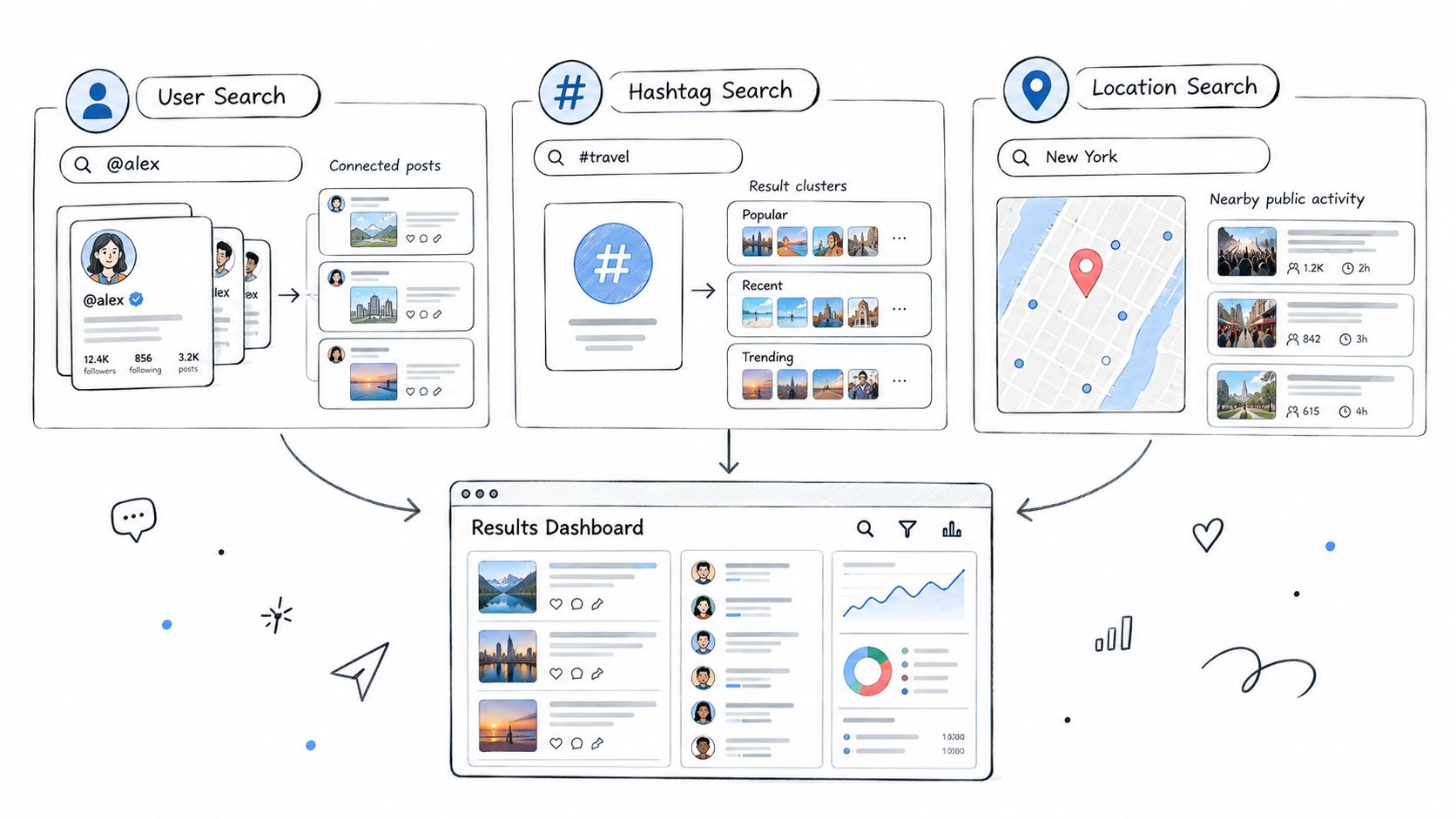
Discovery is how you find objects you don't already have an ID for. Three workflows stay separate: user, hashtag, and location search; hashtag result sets split into top-ranked posts and most recent posts; and location lookup followed by posts tagged at that place.
Hashtag path for a brand mention
Start with hashtag search, not a guessed username. Keep recent posts when you care about what just appeared. Keep top posts when you care about prominence. Open comments only for items that match the brand, product, or campaign language. Pulling every thread on a broad tag burns calls and mixes unrelated chatter into the mention table.
The Instagram Hashtag API is the shelf for that split between recent and top results. A hashtag sample isn't the full public conversation. Coverage limits, covered next, decide what you're allowed to claim from the sample.
Location path for a place or event
Store, venue, local marketing, event coverage, and customer-content collection start from a location, not a handle. Look up the place, then request posts tagged there. Location-post JSON is already specific: caption, media URLs, engagement counts, and author. Enrich the author from the profile shelf only when the post is in scope.
Pagination is part of the workflow
Persist the cursor with the business job ID. Resume from that cursor. Make retries idempotent so a timeout doesn't insert the same post twice. Bounded concurrency matters once followers, posts, comments, or discovery pages stack up.
A discovered author who needs history goes back to profile retrieval. A velocity number that suddenly jumps goes forward to metric meaning, not to another copy of the same search.
Coverage Gaps That Change What You Can Claim
Monitoring coverage isn't representative measurement. A dashboard can look complete while the access rules drop whole classes of accounts and content. Expanding endpoints can raise false confidence if missingness never shows up beside the count.
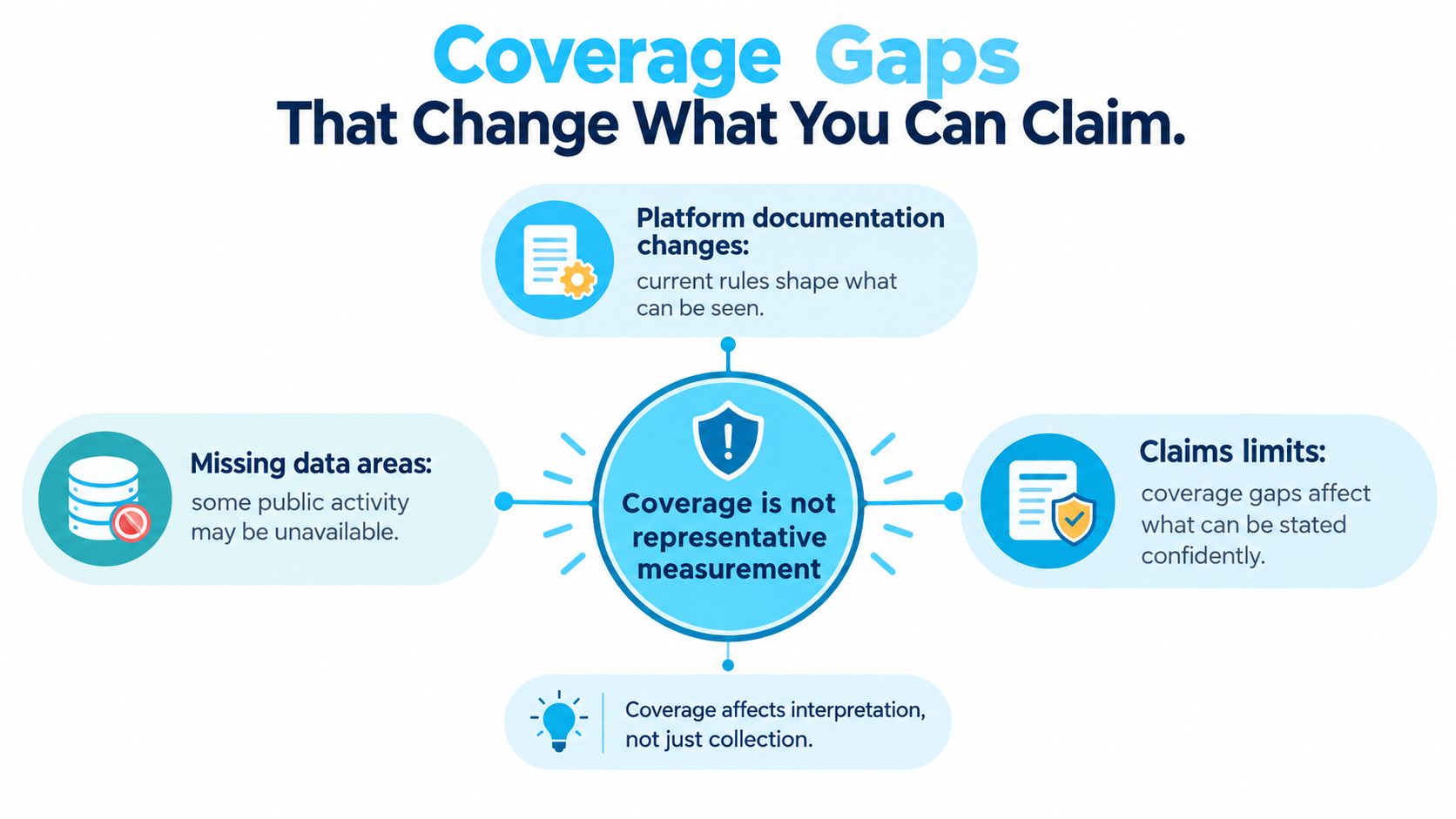
Meta's Instagram Platform overview centers API access on professional accounts, requires permissions for account data, and provides only limited access to some public data outside the authorizing user's content. Read every metric in this guide against that constraint.
Blind spots you should name in the record
- Personal accounts: A professional-account gate underrepresents people who never switched account type.
- Private activity: What a viewer can't see, your job can't backfill.
- Deleted content: Absence after the fact isn't the same as zero engagement at publish time.
- Stories not captured live: A highlight reel isn't proof you saw every frame while it was up.
- Thresholded audiences: People excluded by platform rules won't appear just because your query was broad.
Research on social-media data access finds that API restrictions increasingly impair large-scale, replicable studies. Privacy rules such as the GDPR constrain consent, collection, anonymization, and deletion. A scholarly review of platform access after Cambridge Analytica, cited in the choice section below, treats that regulation as the main legal frame for outside use of social data.
A global brand can watch "conversation" fall in one country after a permission, language, or endpoint change. The consumer didn't necessarily go quiet. The collection changed. Country, language, privacy, and platform-access differences can all imitate a demand shift.
Practical rule: Don't ship a sentiment score or a mention total without provenance, collection time, an unavailable-data reason, account-type mix, sampling limits, and a confidence note.
Coverage-aware monitoring means the API exposes those fields, not only counts. If a later chart can't say who was eligible to be counted, don't let anyone act on it.
Choosing an Instagram-Focused Monitoring API
Coverage sets the ceiling on what a dashboard may assert. The access model sets how public Instagram objects reach your pipeline. Evaluate them together: a broad endpoint list still fails if eligibility fields are missing, and a clean permission model still fails if it returns only owned-account data.
Official platform APIs
You implement the network's own API, its review process, and its deprecations. In one scholarly review, the timeline runs from Facebook's Graph API in April 2010 to the original Instagram API in April 2014, the Instagram Graph API announcement on January 30, 2018, and full legacy deprecation scheduled for early 2020; the same chapter reports that data from at least 50 million Facebook users reached a political consulting company in the Cambridge Analytica episode and identifies the GDPR as the most influential legal framework for outside access to social-media data.
That history matters because an integration can face a material migration inside a few years. Official access fits when you operate the professional account and accept that permission model. It should not be treated as a route to every public personal profile.
Scraping without a contract
Page scraping avoids OAuth, then inherits breakage, uneven JSON, and unclear lawful-use footing. There is no stable error body, no request ID, and no promise that an empty page means zero posts. For production monitoring, that is an incident waiting on a layout change.
A REST service that already returns JSON
Instagram API at profilequery.com is the concrete third option for public Instagram data. Its catalog spans profile, account age and country, posts, reels, stories, highlights, followers, following, single-post or reel detail, comments, likers, user search, hashtag search, location search, top hashtag posts, recent hashtag posts, locations, and location posts.
The insight layer covers engagement rate computed from recent posts, best hours and days to post based on recent engagement, account stats, a fake-follower audit that estimates real versus suspicious followers from a sample, lead fit scoring, profile summary, niche classifier, similar accounts, image analysis, comment sentiment, hashtag competitiveness and velocity, caption generation, and a DM opener. That range supports influencer analytics, brand monitoring, lead generation, and AI agents; the location and hashtag endpoints also fit store and venue monitoring, local marketing, event coverage, and UGC collection.
Decide on four tests: the public-data scope you need, the permission burden you can support, schema predictability, and whether cost terms match retries and misses. Official APIs win when you must act as the account owner. A JSON service wins when many public objects must land in one warehouse and the work centers on reading public data at catalog scale.
Cross-References for Schema and Metric Meaning
Records point at each other. A change in one shouldn't rewrite another.
Profile history feeds trust reviews. Comments and likers hang off the post or reel entry, not off search. Hashtag and location results hang off discovery, then enrich through profile retrieval when the author matters. Engagement rate and best posting time must point back to the recent posts they were computed from. If those posts were missing, delayed, or ineligible, the insight is not a property of the account in the abstract.
A stable shape can still change meaning
Metric continuity is an operational risk. Meta deprecated the Instagram Basic Display API and has retired or changed insight metrics. Version 22.0 changelog notes say requests for the impressions metric can error for newer media after April 21, 2025. Integration notes in that same documentation trail report that some insight data can be delayed by up to 48 hours, that unavailable values may appear as empty datasets rather than zero, and that demographic totals can be lower than follower counts because only users with demographic data are included.
Empty isn't zero. A lower demographic total isn't proof that followers vanished. A 48-hour delay isn't a performance decline.
The Instagram Analytics API is where those computed reads should stay attached to a metric dictionary, not pasted into a chart as bare numbers.
What to keep so a trend can be audited
- Versioned metric dictionary: Name, definition, eligible account types, and the API generation that produced it.
- Raw-response retention: Normalized fields plus the provider payload, so a remap doesn't destroy evidence.
- Null versus zero: Empty datasets stay null. Don't coerce them.
- Backfill and freshness: Show retrieval time and whether the window is still inside a known delay.
- Semantic alerts: Page someone when an impressions-style field starts erroring or disappearing.
W3C's ActivityPub recommendation isn't something an Instagram-only API must implement. It's a useful benchmark. ActivityStreams models social activity in JSON-LD, and ActivityPub separates client-to-server actions from server-to-server delivery. Borrow the idea: typed records, stable actor and object fields, creation time distinct from observation time, raw payload kept apart from normalized fields, unknown fields left forward-compatible.
Pagination and credits meet the same discipline on the client. RFC 9110 defines Retry-After as an HTTP date or a number of seconds. Treat HTTP 429 as throttling, honor that header, use exponential backoff with jitter, and don't retry validation errors. Distinguish auth failures, bad parameters, not-found, throttling, and upstream failures. Store the provider request ID next to the business job ID.
When a trend, a comment count, or hashtag velocity moves, re-check the source posts, the nulls, the delay window, and the metric version before you brief anyone.
Quick Reference and the Next API Call
Use this card to route a task. Don't reread the field essays first.
- Post: A published object with caption, media, author, and a publish time.
- Comment: Text on that post. Not a hashtag hit.
- Liker: An account that liked the post. Not a sentence.
- Hashtag result: A top or recent post found by tag, not proof of every use of the tag.
- Location post: A post tagged at a place, with caption, media URLs, counts, and author.
- Engagement rate: A computation from recent posts. Only as good as those posts.
- Coverage gap: An account or object the access rules never entitled you to see.
- Retrieval time versus publish time: When you observed the object, versus when it went live.
Route the job
- Known account. Profile and content fields, then followers or following only if the question needs the graph.
- Unknown mention. User search or the hashtag workflow. Comments only after a match.
- Venue or event. Location lookup, then location posts. That pattern fits store monitoring, local marketing, event coverage, and UGC collection.
- Creator credibility. Engagement rate, best time to post, account stats, fake-follower audit, lead-fit scoring, profile summary, and niche classification. The audit estimates real versus suspicious followers from a sample. It doesn't certify a person.
- Trend dispute. Metric dictionary, nulls, freshness, and the impressions-style change notes above.
Developers need typed JSON, cursors, and request IDs. Influencer teams need performance and follower-quality reads beyond screenshots. Brand and social commerce teams need posts, comments, hashtags, and places. Sales enrichment turns a username into a profile plus a lead-fit score for a CRM. Trust and safety uses account age, registration country, prior usernames, and verification when judging impersonation.
The same key supports influencer analytics, brand monitoring, lead generation, AI agents, social commerce, and trust and safety. Insight, content, and discovery endpoints are the shelves already defined here, including posts, comments, likers, top and recent hashtag posts, locations, location posts, and user, hashtag, and location search.
Before a large job, confirm the shape on one public profile and one post's comments. If you're connecting those records to an agent workflow, explore the API documentation for how tool calls expect structured inputs, then map fields rather than dumping raw JSON into a prompt.
Instagram API returns public Instagram profiles, posts, comments, hashtags, and locations as structured JSON so a social media monitoring API workflow can store what it observed and show what it couldn't see. Coverage notes, retrieval times, and versioned metrics belong in that same pipeline, or the charts will outrun the evidence. Start with one profile and one comment thread at Instagram API, then widen the job only after the identifiers and nulls look right.
Pull Instagram data with one API call
Profiles, posts, reels, followers and more. 50 free credits, no credit card.
Get your free key